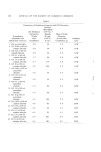
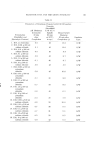
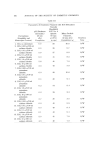
ELECTROLYTES AND EMULSION STABiLiTY 183 By applying Stokes' equation to the experimental formulations, those in a given series which exhibited a reduction in the mean particle diameter would be expected to have relatively reduced creaming or sedimentation rates, assuming all other variables remained constant (7). Further microscopic study of the emulsions revealed that all possessed a highly agglomerated internal phase. However, agglomera- tion at emulsifier concentrations in excess of the C.M.C. is not unusual (8). Agglomeration does not necessarily hasten coalescence, and Van der Waals' attractive forces (in the absence of marked electrostatic repulsion, a situation which exists in these experimental emulsions) cause rapid particle agglomeration. However, as the agglomerated emulsion particles coalesce, those emulsions which have a large initial particle size may exhibit rapid visual evidence of coalescence, observable as an increasing transparent surface layer. Calcium chloride produced somewhat different, although parallel, emulsion parameter variations from those observed with sodium or potassium chloride. In this case the particle size in the ES, El0, and El5 experimental formulations diminished with increasing concentra- tion, but the reduction was less pronounced than that induced by sodium or potassium chloride. Emulsion type, where sufficient stability permitted this determina- tion, was O/W in all cases. Measurements taken at the specified inter- val of 30 minutes by any of the methods were in complete agreement. The pH measurements conducted 24 hours after completion of the experimental formulations did not show any marked variations from those taken immediately after cooling. Surface tension data compiled with the aid of the DuNouy tensi- ometer in the absence of added electrolyte revealed that the E5 ethoxy- late produced a somewhat lower value (at the C.M.C.) than the El0 or El5 ethoxylates. It was further ascertained that emulsions with ]5 10 possessed a somewhat lower surface tension (at the C.M.C.) than those with the El5 ethoxylate. A decrease in the surface tension at the C.M.C. was evident in specific instances with increasing concentrations of electrolyte. The phenomenon was observed in the formulations con- taining the El5, El0, and E5 ethoxylates. The decrease continued until a limiting concentration was added. Further additions of electro- lytes (in excess of the optimal or limiting concentration) raised the sur- face tension. The experimental data obtained with the DuNouy tensiometer disclose a direct relationship between the ethoxylate series

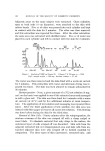
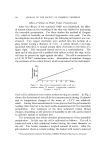
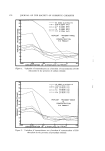
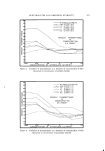
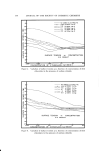
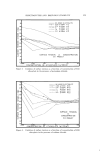
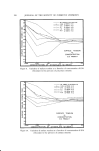
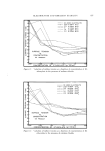
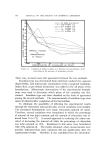
184 JOURNAL OF THE SOCIETY OF COSMETIC CHEMISTS number and the optimum quantity of added electrolyte which yields the lowest surface tension at the C.M.C. that is, the E5 product exhibits its lowest C.M.C. surface tension at 0.001 g/100 ml of electrolyte, the El0 at 0.1 g/100 ml, and the El5 formulation at 10.0 g/100 ml. Formulations containing sodium or potassium chloride in combination with the El0, El5, and E5 ethoxylates presented somewhat lower sur- face tensions at the C.M.C. at optimal (0.001 g/100 ml for the ES, 0.1 g/100 ml for the El0, and 10.0 g/100 ml for the El5) electrolyte concen- trations than those given by limiting quantities of calcium chloride. Relative to their C.M.C. surface tensions in the absence of included electrolyte, the El5 and El0 formulations exhibited greater reductions of surface tension than the E5 compositions after addition of optimum quantities of electrolyte (Figs. 5-13). In the absence of any electrolyte, C.M.C.s, determined by both dye and tensiometer methods, decrease with decreasing ethoxylate series number. In most cases, the inclusion of electrolyte was accompanied by decreases in the C.M.C. The decreases were directly related to the quantity of electrolyte. Exceptions were noted at 10% electrolyte when the dye method was used it is postulated that inclusion of 10% electrolyte may have interfered with the validity of the results obtained by this procedure (Figs. 1-4). It is also suggested, through correlation of decreases in C.M.C. sur- face tension, that specific quantities of electrolyte included in the presented experimental emulsions containing the ES, El5, and El0 ethoxylates cause increased interfacial coverage by the emulsifier through interactions favoring a decrease in the area occupied by the individual ethoxylate molecule. The ethoxylates used in the experimental formulations function by tightly binding water to the surface of the dispersed or oil phase (9). Coalescence of the dispersed oil droplets would occur if this water of hydration is displaced and if the emulsifier is desorbed into the internal phase. This mechanism is postulated on the premise that steric hindrance would prevent the desorption of emulsifier into the con- tinuous or water phase. Ethoxylate desorption and ultimate particle coalescence are retarded by the presence of an energy barrier which depends upon the number and type of hydrated groups on each molecule of the emulsifying agent and on the fraction of the interface covered (.•)). The greater the number of hydrated groups the greater is the energy barrier to displacement of water of hydration and ethoxylate desorption.
Purchased for the exclusive use of nofirst nolast (unknown)
From: SCC Media Library & Resource Center (library.scconline.org)