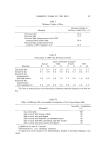
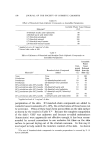
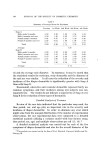
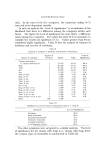
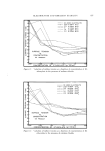
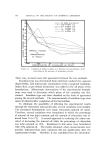
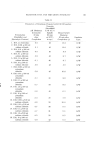
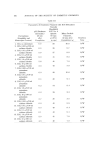
ELECTROLYTES AND EMULSION STABILITY 185 For optimum emulsion stability, it is essential that the ethylene oxide groups on the cetyl/stearyl alcohol not only hydrate with water mole- cules but occupy the greatest possible fraction of the emulsion inter- face. Therefore, the emulsifier should not only undergo maximum interfacial adsorption (thereby occupying the greatest fraction of the emulsion interface) but form a coherent desorption-resistant film. Since the ethoxylate will reduce surface tension, adsorption will occur, as postulated in Gibbs' adsorption equation (7). Adsorption does not in- crease infinitely in direct proportion to the quantity of ethylene oxide on the ethoxylate molecule. Adsorption and, consequently, interfacial coverage increase to a finite maximum with increasing ethylene oxide content. Increases beyond a limiting optimal quantity will, however, result in decreasing adsorption. A conflict arises between resistance to desorption, which depends only on number and type of hydrated groups, and interfacial adsorption, which depends on an optimal hydration energy. The addition of electrolyte to the experimental formulations will inhibit hydration of ethylene oxide groups. The presence of ions, released by the addition of electrolyte, will cause water molecules to be drawn toward themselves and prevent them from participating in hydro- gen bonding with other neighboring water molecules (10). Because of its interaction with the water molecules, the electrolyte reduces the energy of hydration and solubility of the ethoxylates. Even though hydration energy and solubility are decreased by added electrolyte, the experimental emulsions with the El5, El0, and E5 ethoxylates and with specific quantities of sodium, potassium, or calcium chlorides may show enhanced emulsion stability because of the nature of C.M.C. surface tension and particle size variations created by the included electrolyte. As mentioned earlier, surface tension data indicated reduced C.M.C.s and, consequently, increased ethoxylate adsorption in those formulations containing the El5, El0, and E5 ethoxylates in the presence of optimal quantities of electrolyte. Also, particle size variations (due to in- clusion of specific electrolyte concentrations) suggest decreased cream- ing velocities on the basis of Stokes' equation. Further clarification of the experimental results can be obtained by mathematical justification of the enhanced stability observed in experi- mental formulations containing electrolyte in conjunction with the El5, El0, and E5 ethoxylates (Tables I-III).

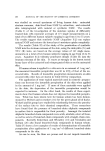
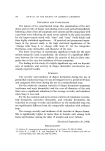
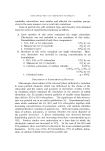
186 JOURNAL OF THE SOCIETY OF COSMETIC CHEMISTS Gibbs' adsorption isotherm can be expressed thusly' c dT I'- -- KT ' dc' where' c = concentration of the ethoxylates K = constant iF = absolute temperature • = surface tension r = surface concentration of the adsorbed monolayer. Stokes' law, relating creaming and sedimentation velocity to specific emulsion variables, may be expressed mathematically as follows' V = 4/3•'rag(d• -- d2), 6•-nr where' V = rate of creaming or sedimentation r = droplet radius g = acceleration of gravity d• = density of the droplet ds = density of the liquid n = viscosity of the dispersion medium. Application of Gibbs' adsorption isotherm to the experimental formulations shows that the adsorption becomes more positive as sur- face tension decreases. As adsorption increases, the fraction of the interface covered by the ethoxylate may increase. Theoretically, a reduced rate of coalescence and enhanced stability should result. Ac- cording to Stokes' equation, an inverse relationship exists between the particle radius and creaming velocity. Experimental emulsions in which the radii of the particles of the internal or dispersed phase are smaller than those of other members of the series should exhibit higher stability (assuming that other variables in the equation remain con- stant). In the specific instances cited above, the influence of added electrolyte on the C.M.C., surface tension, mean particle diameter of the dispersed phase, and to a minor extent (in the case of the experiments presented here) on emulsion viscosity is such as to cause possibly en- hanced emulsion stability. CONCLUSION The direction of parameter variation due to added electrolyte is influenced primarily by the ethylene oxide content of the fatty alcohol.
Purchased for the exclusive use of nofirst nolast (unknown)
From: SCC Media Library & Resource Center (library.scconline.org)