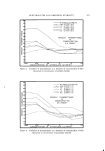
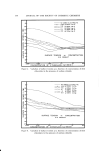
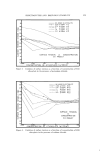
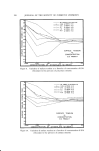
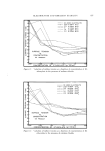
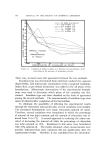
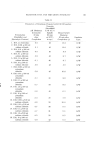
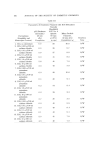
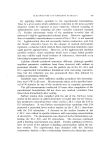
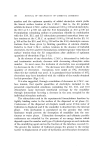
ELECTROLYTES AND EMULSION STABILITY 189 in some cases induced greater positive emulsion parameter variations (indicative of possible increased long range stability) than those observed upon addition of calcium chloride. The ions released by hydrolysis of calcium chloride give rise to excess protons. It is postulated that protons are not strongly adsorbed at the emulsion interface and do not compete with the ethoxylate for interfacial sites. However, in formula- tions containing the El5, El(), and E5 ethoxylates calcium chloride does not produce emulsion parameter variations which indicate a degree of adsorption as great as that induced by optimal quantities of sodium or potassium chloride. ACKNOWLEDGMENT The author of this paper wishes to express his gratitude to William Moll. Mr. Moll's illustrations have been invaluable in the preparation of portions of this paper. (Received September 12, 1966) (2) (a) (4) (6) (7) (8) (9) (lo) (•) (12) REFERENCES Harkins, W. D., The Physical Chemistry of Surface Films, Reinhold Publishing Corp., New York, 1952. Matijevic, E., and Pethica, B. A., The properties of ionized monolayers, Trans. Faraday Soc., 54, 1382 (1958). Van Voorst Vader, F., Adsorption of detergents at the liquid-liquid interface, Trans. Faraday Soc., 56, 1067 (1960). Becher, P. J., Non-ionic surface-active compounds determination of critical micelle concentration by a spectral dye method, J. Phys. Chem., 66, 374 (1962). Schmolka, I. R., and Raymond A. J., Micelle formation of polyoxyethylene poly- oxypropylene surfactants, unpublished, Wyandotte Chem. Corp., (1965). Miller, A., The effect of ethoxylated fatty alcohol combinations on emulsion stability, Proc. Sci. Sect., Toilet Goods Association, 43, 28 (1965). Martin, E. W., and Cook, E. F., Remington Practice of Pharmacy, Mack Prtg. Co., Easton, Pa., 1956, pp. 186-199. Riegelman, S., New data on determining emulsion stability, Am. Perf., 77, 59 (1962). Osipow, L. I., Surface Chemistry, Reinhold Publishing Corp., New York, 1962, pp. 295-341. Abu-Hamdiyya, M., The effect of urea on the structure of water and hydrophobic bonding, J. Phys. Chem., 69, 2720 (1965). Lorenz, J., Specific adsorption isotherms of thiocyanate and hydrogen ions at the free surface of aqueous solutions, J. Phys. Chem., 54, 685 (1950). Ariymna, A., Theory of surface tension of aqueous solutions of inorganic acids, Bull. Chem. Soc. Japan, 12,109 (1937). Anderson, C. A., and Truter, E. V., Hydrolysis of wax-esters in emulsions, J. Soc. Cosmetic Chem., 15,447 (1965).

J. Soc. Cosmetic Chemists, 18, 191-198 (Mar. 4, 1967) The Application of Microbiology to Cosmetic Testing STANLEY W. OLSON, M.S.,* Presented September •0-•1, 1•66, Seminar, New York City Synopsis Sanitation and preservation hold the key to the control of microbial contamination in cosmetic products. Ultraviolet radiation can be used industrially to control the build-up of micro flora in the stored deionized water that is utilized in the manufacture of cosmetics. A titration technique has been developed for measuring the relative antimicrobial activity of test preservative systems in products. The technique employs varying dosages of selected test microbes which are inoculated into the test systems. The method has been found pre- dictive in that preservative systems inactivating high dosages of test microorganisms are effective under practical conditions. INTRODUCTION Cosmetics need not be completely free from nonpathogenic bac- teria and fungi, but the residual organisms present in any product at the time produced must be prevented from multiplying during the product's shelf and use life by an effective preservative (1). While the desired objective of a microbiological program in the production of cosmetics is to develop "sterile" products, the desired ob- jective is not always readily attainable. "Sterile," as used in this con- text, means free from living microflora which can be detected by routine sterility tests. Ideally, cosmetics should be self-sterilizing against all microbes encountered during production, packaging, and usage: When complete sterility is not feasible, the cosmetics must be free of viable human pathogens and inhibitory against residual nonpathogens. Actively viable microorganisms can be deleterious to both the es- thetics and to the functional characteristics of cosmetic products. * Microbiology Section of The Toni Company, St. Paul, Minnesota. 191
Purchased for the exclusive use of nofirst nolast (unknown)
From: SCC Media Library & Resource Center (library.scconline.org)