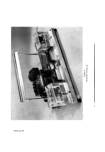
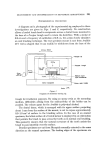
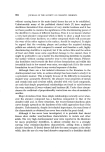
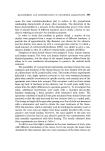
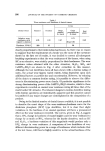
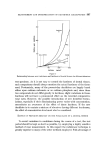
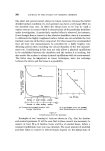
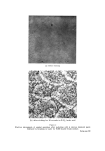
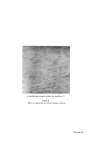
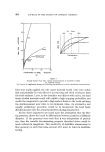
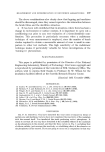
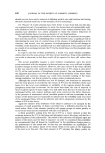
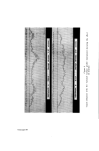
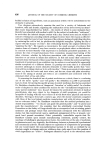
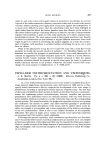
MEASUREMENT AND INTERPRETATION OF DENTIFRICE ABRASIVENESS 391 EXPERIMENTAL PROCEDURE A diagram and a photograph of the experimental rig employed in these investigations are given in Figs. I and 2, respectively. Its construction allows a loaded brush head to reciprocate across a dental tissue mounted in the base of a Perspex trough used to retain the dentifrice. With a stroke of 3.8 cm and a frequency of oscillation of 2.5 c/s, the action closely simulates an oral brushing technique. The test specimen mount is cast from Araldite MY 753 so shaped that it can readily be withdrawn from the base of the Stroke 58mm 2.5
Drive c...•_• ] cm Scale I • Figure 1 Diagram of dentifrice testing rig • Perspex lid Perspex trough Medium hard nylon toothbrush •Epoxy resin holder trough for irradiation purposes. By using an epoxy resin as the mounting medium, difficulties arising from the radioactivity of the holder can be avoided. The release agent for the A raldite is polyvinyl alcohol. The dental tissue, which is arranged with its upper surface projecting about 1 mm from the surface of the mount, is cut to expose approximately 0.5-1.0 cm2 of surface to the brushing action. In the case of an enamel specimen, the labial surface of a frontal incisor is employed in an orientation that permits the brush to pass across the tooth as in normal oral brushing. This geometry ensures that the natural curvature of the tooth assists the brush to pass smoothly over the surface. Dentine specimens are cut from Bicuspids normally oriented in the same direction as the enamel specimens. The leading edges of the specimens are

392 JOURNAL OF THE SOCIETY OF COSMETIC CHEMISTS slightly rounded to prevent the brush fibres encountering abrupt changes in height. The brush head of the machine is equipped with four perforated vanes conforming closely to the internal dimensions of the trough and so orien- tated as to force the slurry to pass through the brush fibres when the head is in motion. The presence of these vanes also assists in preventing sedi- mentation of the dentifrice abrasives. The specimens, after mounting, are thoroughly scrubbed with a dentifrice slurry and distilled water, and then placed in a polythene capsule which is filled with distilled water and a trace of bacterial antiseptic 1% Hibitane. The capsule and contents are irradiated for a period of five hours. After removal from the reactor, any Na 24 activity is allowed to decay before the specimens are inserted in the rig, but the level of this ¾ activity can be reduced by avoiding direct handling of the specimens whilst cleaning. To perform a typical brushing test, a known volume of dentifrice slurry is placed in the trough and at the end of the prescribed brushing period, 1 cm 3 samples are withdrawn with the aid of a pipette fitted with a micro- filler. The samples are transferred to 2.5 cm diameter aluminium planchets and dried beneath an ir lamp at a surface temperature of 105øC for one hour. In cases where excessive frothing of the slurry has occurred, it is preferable to pour the contents of the trough into a beaker and break the foam with a drop of ether. After careful restirring of the slurry a non-aerated sample may be withdrawn. The level of [i activity of the dried samples is measured with a 5 cm diameter mica end-window Geiger-Muller counter with the specimens placed within a millimetre or so of the window. With this geometry a high counting sensitivity can be obtained and errors arising from a non-uniform deposit eliminated. This arrangement also reduces the small back scattering errors which can occur if a comparison is made between dentifrices con- taining elements of widely different atomic number (6). The dentifrice samples are usually taken from slurties having a dentifrice concentration of 20% or less and thus containing only 100-200 mg of solid matter when dried. At such mass thicknesses (20-40 mg/cm 2), [• absorption errors can be neglected. In other tests where a high concentration of the dentifrice is employed the slurry must be diluted before taking a sample. The measured figures for the [i activity are corrected in the usual way for counter 'dead time' followed by background activity, and the final result multiplied by the volume of slurry originally added to the trough. The latter may vary slightly from one dentifrice to another if weight concentrations
Purchased for the exclusive use of nofirst nolast (unknown)
From: SCC Media Library & Resource Center (library.scconline.org)