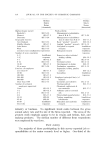
496 JOURNAL OF THE SOCIETY OF COSMETIC CHEMISTS bation of physically adsorbed molecules. Relatively little space is devoted to experi- mental techniques. These are well described but there should perhaps have been more emphasis on the importance of ordinate expansion for weak absorbers and ATR for surface studies on non-metallic substrates. The techniques are a limiting factor particularly if the studies are to be extended to natural surfaces. There is no direct reference to any application in the toiletry or cosmetic field but where the hydrogen bond is involved there must be a link, however oblique, •vith the cosmetic research chemists' interests. The book is quite readable but somewhat heterogeneous in presentation. It is a useful review and provides background references for a topic which is likely to become important in the future. D.M. GABRIEL. INTERNATIONAL TABLES OF SELECTED CONSTANTS 15: SESQ,UITERPENOIDS. G. Ourisson, S. Munavalli and C. Ehret. Pp. 70 q- xxx. (1966). Pergamon Press, Oxford. 90s. At some time or another, most of us - particularly those working in perfumery - require information on materials of natural origin. High on the list are the sesquiter- penoids since they are relatively widespread and also rather complex materials. Days, weeks or even months may be spent searching forinformation on a specific material. Having found something one has to estimate its accuracy and value, or the relative value of conflicting pieces of information. Here is a book which does most of it for us, saving countless hours of often fruitless searching. information on nearly five hundred materials is'recorded'in tabular form. This information includes melting and boiling point, density, refractive index, specific rotation and wavelengths of the absorption peaks in the uv. Bibliographica references are given to all the data together with references to further data on syn- thesis, on uv, ir, Raman and nmr spectra, on rotatory dispersion or circular dichroism, and on mass spectrum, and X-ray structure. Facing each table are structural formulas for the materials included in the table, where these are known, and the number which are not known seems now to be remarkably small. Basically the materials are arranged according to the number and type of their carbon ring structure although the authors found this to be not entirely satisfactory and varied it in some cases. Separately there is an alphabetical list of the substances with details of their source or origin. Over 1750 bibliographical references are given and these are arranged in chrono- logical order from 1840 to 1965. An index of authors is included. Where discrepancies arise in results from different sources the authors have critically evaluated the original papers and used the figures which in their opinion are the most reliable. The volume is basically in French but English translations of the introductory sections and the symbols•. and abbreviations, combined with the fact that mostly it consists of tables of figures and structural formulas, makes this immaterial. There are bound to be some errors in a book such as this but none were noticed (except for minor translational quirks) and the overall excellent presentation inspires confidence in the fact that these are very minimal. This first-class volume is an essential reference work for everyone whose work nvolves the sesquiterpenoid compounds. R.P. REEVES

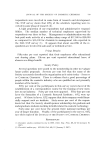
BOOK REWEWS 4[}7 INTERPRETED INFRARED SPECTRA. Vol. 2. H.A. Szymanski. Pp. ix d- 304 d- Ill. (1•3). Plenum Publishing, New York. $12.50. Dr. Szymanski continues this long-term course in the education of the tyro organic spectroscopist, who should ultimately be able with confidence to interpret his own ir spectra and make his own identifications. The pattern of volume 1 of the series [reviewed J.l? 434 (1966)] has been maintained: for successively complex functions, characteristic group frequencies are deduced and detailed correlation tables compiled for further prediction. This second volume begins with the remaining hydrocarbon function not treated in volume 1: the alkynes. A full vibrational analysis is presented for eleven specific alkynes (including deuterium replacement) and then there is more general reference to acetylenic hydrogen and the CC triple bond in a large number of ethynyl and propargyl systems. The annotated spectra of 13 alkynes are reproduced. The only error observed (p. 7) is an assignment to aldehydic, rather than acetylenic, CH. That section, however, only accounts for some 8% of the text: the major part is a remarkably full treatment of the aliphatic hydroxyl function: a family which - as the author recognises - seems to have attracted disproportionately less attention from other compilers. In particular little has been published on diol correlation studies. Dr. Szymanski supports his basic vibration analysis with a correlation table of group frequencies which can be used to identify primary, secondary and tertiary aliphatic alcohols, and proceeds to discuss in helpful detail four environmental factors (inductive effect resonance phenomena hydrogen bonding conformation) which influence the group frequencies. There follows the annotated spectra of 247 alcohols, of which 51 are diols and 15 other substances containing more than two hydroxyl functions. In some cases, by virtue of the correlation deduced, Dr. Szymanski is able to extend the diagnosis of the originator of certain spectra to identify the specific isomer examined or detect components of mixed isomers or indicate the presence of congeneric impurities. Another very useful facet of this volume is the provision of a cumulative index, wherein all compounds whose spectra have been interpreted in the two volumes are listed in ascending complexity of molecular (not "empirical" as wrongly cited in the text) formula. In each case the graphic formula is appended, which facilitates scanning the index for explicit structural features. This is similar to the provision made in Formula index to nmr literature data [reviewed J.18 265 (1967)], although in that text the elements C and H are deliberately the last choice in the ascending complexity sequence. Thus we now have two useful volumes comprehensively analysing the ir spectra of hydrocarbons and the aliphatic hydroxyl function one looks forward to seeing a similarly authoritative coverage of the fascinating subject of the variation observed in the ir spectra for different carbonyl environments. G.F. PHILLIPS
Purchased for the exclusive use of nofirst nolast (unknown)
From: SCC Media Library & Resource Center (library.scconline.org)