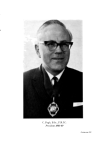
J. Sac. Cosmetic Chemists 19 503-519 (1968) ¸ 1968 Society of Cosmetic Chemists of Great Britain Eyesweet cosmetics and colour science in The 1968 Medal Lecture by BRIAN H. CRAWFORD, D.Sc., Imperial College of Science and Technology, Department of Physics, London, S.W.7, delivered before the Society of Cosmetic Chemists of Great Britain, on 22rid March 1968, with David E. Butterfield, President of the Society, in the Chair. THE CHAIRMAN It is a great pleasure to welcome so many of you to the Society's 4th Medal Lecture. In previous years lecturers have included experts in various disciplines relating to the cosmetic industry. Tonight is no exception and we are privileged to have with us Dr. B. H. Crawford, who is an authority on vision and colour. He has devoted practically a lifetime to research in these fields and his work has rightly gained him an international reputation. Perhaps most significantly for us it has had far reaching practical effects in various fields of vision and colour lighting. Dr. Crawford was in charge of the Colorimetry and Applied Photomerry Section of the National Physical Laboratory until 1966, when he retired to take up a more academic life in the Applied Optics Section at Imperial College. He was chairman of the Colour Group of the Institute of Physics, and has been a member of international committees. Syn0p$1$--A brief outline is given of the four factors which make up colour perception: character of light source, character of object viewed, structure and function of the eye and final seat of perception in the brain. Consideration is then given to the measurement of colour in terms of the trichromacy of vision, both by direct colorimetry and by spectral analysis followed by calculation. The uses and limitations of colour atlases are described, together with an estimate of the number of tints or shades which are significantly different from the point of view of the cosmetic chemist: it is of the order of 100,000. Colour rendering, or the effect of the light source on colour appearance, is given special attention since it can be very deceptive for the fluorescent lamp which is now in such wide use this is especially true with metameric colours, the nature of which is explained. Finally, certain phenomena are des- cribed which are, in a sense, colour illusions: the size of a colour stimulus and its pattern relation to other coloured stimuli can alter its appearance to an extent which is sometimes striking, indeed, almost unbelievable. Such extreme cases are rare, but more subtle effects are common, though often unnoticed except by the artist, who perceives what he sees, not what he thinks he ought to see. INTRODUCTION The cosmetic chemist provides the material basis for a branch of the art of make-believe: to what extent can our knowledge of colour perception 503

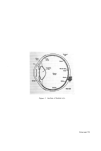
504 JOURNAL OF THE SOCIETY OF COSMETIC CHEMISTS and its mechanism help him in his task? At first sight it would seem that colour science can contribute almost nothing. The argument would be that cosmetic colours are dictated by fashion, that fashion is the imitation of the few by the many, and that these few are original spirits who may do anything they are unpredictable, so where can science come in, since science is a body of knowledge gained in the past? The fashion innovator is only a human being, however, and so it is not impossible that his, or her, behaviour could be psychologically predictable if we knew enough psy- chology. In particular, he has colour perception within a well-defined range: even his world of make-believe has to be seen according to certain rules and regulations, and thus it may be profitable for the cosmetic chemist to have some knowledge of the range and mechanism of colour perception and of the techniques which have been developed for the measure- ment of colour. In the first place, what is colour? Every normal person, neglecting the ten per cent or so who have defective colour vision, has a keen sense of colour: everything around him appears to be "coloured". It is vitally important, however, to make an analysis of the factors which go to make up this "colour". It results from the interaction of four factors--the light without which we can see nothing, the surface or bulk properties of the objects we look at, the eyes with which we look at them, and the brain which is the final seat of perception. Colour does not reside in any one of these factors by itself. LIGHT The light from the sun, our most universal illuminant, or from a tung- sten filament lamp, our commonest artificial illuminant, can be analysed into what appear on first consideration to be different colours, spread out in what is called a spectrum. The only physical attributes which can be attached to the various locations in the spectrum, however, are wave- lengths (or frequencies) which in themselves are not in any sense des- criptions of colours. Neither is colour an attribute of the white screen on which the spectrum is formed: the screen merely re-directs the radiation into the eye of the observer. THE EYE Is "colour" then in the eye? An eye, when no longer wanted by its natural owner, can be excised and taken to pieces. It is found to be very
Purchased for the exclusive use of nofirst nolast (unknown)
From: SCC Media Library & Resource Center (library.scconline.org)