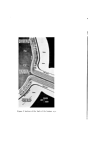
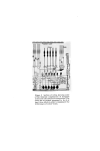
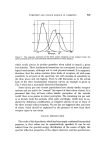
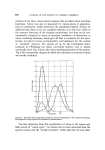
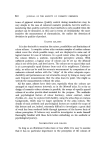
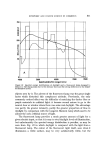
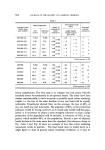
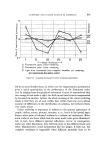
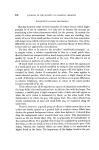
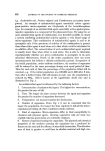
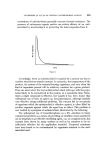
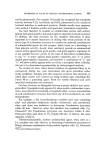
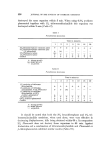
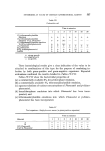
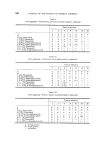
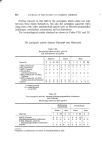
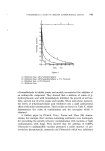
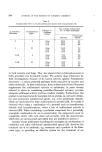
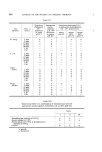
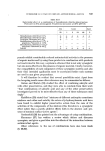
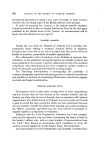
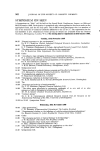
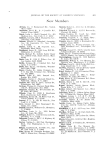
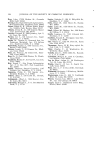
514 JOURNAL OF THE SOCIETY OF COSMETIC CHEMISTS Table I Band luminance Deviations from Spectral band .................... Ratio of unity Excesses limits (nm) luminances outside and number test reference (test/ single bands tolerances source source reference) double bands (per cent) 400-455 (I) 0.431 0.382 1.13 + 13 3 (1.o6) + 6 1 455-510 (II) 7.37 7.51 0.OS -- 2 0 (0.89) --11 6 510-540 (III) 15.0 19.1 0.79 --21 11 (0.94) -- 6 1 540-590 (IV) 48.8 44.8 1.09 q- 9 0 (1.04) •- 4 0 590-620 (V) lS.0 lS.S 0.98 --- 2 0 (1.01) + 1 0 620-760 (VI) 10.3 9.93 1.04 t q- 4 0 Total excesses = 22 400-455 455-510 510-540 540-590 590-620 620-760 0.584 5.92 12.5 55.0 19.8 6.21 0.439 8.07 19.8 44.7 17.6 9.35 1.33 (1.03) 0.73 (0.68) 0.63 (0.93) 1.23 (1.18) 1.13 (0.90) 0.66 q-33 m27 --37 +23 +13 --34 q- 3 --32 --7 +18 --10 23 0 17 27 27 2 13 13 3 5 24 Total excesses =,, 154 colour temperature. The next step is to compare the test source with the standard source for luminosity in six spectral bands. The latter have been chosen experimentally to have as nearly as possible equal colour rendering weight, i.e. the loss of the same fraction of any one band will be equally noticeable. Experiment showed that, on the average, the loss of 40% of any one band was just noticeable. The adoption of 40% as the production tolerance would be wrong, however, as it would only satisfy half the popu- lation: it is necessary to adopt a more stringent tolerance so that a large proportion of the population will be satisfied. A tolerance of 10% is sug- gested, which satisfies 95% of the population. Should a pair of adjacent bands deviate in the same sense from the standard, this tolerance drops to 5%. Table I and Fig. 11 show an example of how this colour rendering assessment works in practice. The final result may be boiled down to a single figure or class of general colour rendering excellence, or it may be

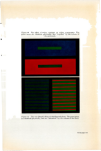
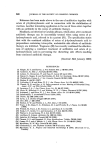
EYESWEET AND COLOUR SCIENCE IN COSMETICS 515 10ø/o 5ø/ø 1.0 lOO/o 0.5 I II III IV v vI • Band Numbers --"-'• (Z) FJuor½sccnt: good co[our rendering • FJuor½scent: poor co,our rendering El Light bJu½ f•uor½sccnt pJus tungsten: ½xccJJcnt col rendering All i•Juminants the same cotour Figure 11 Graphical portrayal of colour rendering assessments. left in its more detailed form, in which case the diagrammatic presentation gives a quick appreciation of the performance of the illuminant under test. In judging from the graphical assessment it must be remembered that two wrongs do not make a right: too little in one band is never compensated by too much in another. Indeed, the whole meaning of the colour rendering bands is that they are of such widths that within them the eye is almost unaware of differences in the distribution of radiation, but between them, very much aware. Colour rendering is important in relation to the general appearance of people, clothes, scenes, pictures, interiors, a.s.o., but it is has special signi- ficance when pairs of coloured surfaces in a scheme are metameric. Meta- meric surfaces are those which look the same under some given illuminant, but, in fact, have different spectral reflectance curves: in consequence, under any other illuminant, they will look more or less different from each other. Manufacturers avoid metamerism like the plague, if they can, but complete avoidance is impossible when different materials have to be
Purchased for the exclusive use of nofirst nolast (unknown)
From: SCC Media Library & Resource Center (library.scconline.org)