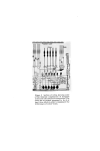
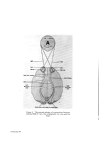
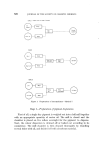
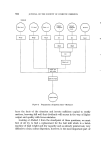
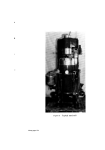
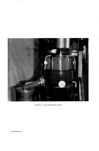
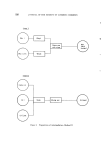
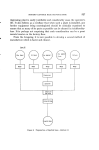
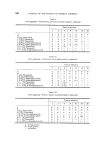
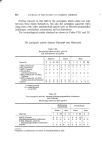
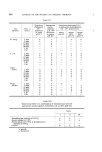
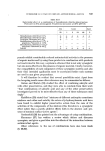
528 JOURNAL OF THE SOCIETY OF COSMETIC CHEMISTS METHOD II This time, as shown by the flow diagrams in Fig. 5, only two basic intermediates are prepared initially. Stage I--Preparation of the wax blend The procedure is as for Method I, except that the blend is stored molten as suggested above. Stage II--Preparation of the Oil Blend This is made by metering the various components into a storage tank fitted with a suitable mixer. When required, the oil is metered to where it is needed rather than being weighed out. The wax and oil blends together with dry pigments and perfume are mixed, as shown by the flow diagram in Fig. 6. Stage IIJ--Preparation of lipstick base A proportion of the oil blend is metered straight into the premix pan attached to the sand mill. The dry pigments are weighed out and stirred in. The slurry is passed through the sand mill straight into the steam pan, fitted with a combined mixer and pump. Any residual colour is flushed from the premix pan and sand mill with the balance of the oil needed. Simultaneously, the wax blend is metered into the steam pan. After mixing thoroughly the base is tested for shade and the perfume is added. It is then pumped into storage trays, using the mixer as a pump. As a matter of interest, because the wax blend is molten and the colour dispersion comes away from the mill at about 60 ø , very little further heat is required in this process. (Received: 14th July 1967.) DISCUSSION MR. K. MARSHALL: Have any attempts been made during the work described, to assess the amount of the grinding media which has undergone reduction to a size where it is possibly present in the product? T•E LECTURER: We normally use a Hegman gauge for testing and our grind runs off this. This indicates that we are not getting gross contamination of sand in the product.

MODERN LIPSTICK BASE MANUFACTURE 529 MR. T. A. BROCK: What are the possibilities of ground sand getting into your lipsticks? THE LECTURER: Initially, the charge of sand in the mill is cleared of "finings" by recirculating oil. When this has been satisfactorily completed, subsequent millings are always passed through a fine safety screen. We have no evidence that sand appears in our product. It certainly does not show up in any way that a consumer could detect. MR. T. A. BROCK: Have you tried checking this by keeping a watch on the rate of loss of sand from the sand mill? TIlE LECTURER: So far the mill has been running about 6 months and there has been no significant loss of sand. Obviously the media must wear away very slightly, but this applies to all methods of milling. As the particles are worn small enough to pass the grinding shell screen, they are caught on the safety screen. MR. R. G. BARNES: There seems to be some misunderstanding concerning the sand mill. May I say to begin with that this is a machine which is in competition with our own equipment but nevertheless I feel it should have fair consideration. The very term "sand" sounds horrible and it makes you feel that you are going to do your lips with sandpaper. In fact a special grade of "Ottowa" sand is used which has a very close particle size. Its shape is also very even. Although I have no knowledge of the sand mill's use in this particular application, I do know that it is used widely in the ink industry, and the effect of sand on the printing roll would be very detrimental indeed. The fact that these machines are widely used indicates that the degree of wear of the sand is very small. MR. G. A. ALLMAN: Where do colour corrections take place? TH• L•CTURER: Should a shade deviate, we prepare a normal lipstick base con- taining a high concentration of the appropriate individual colour, and then add it to the bulk in the appropriate proportion. MR. G. A. ALLMAN: SO you are processing individual colours. TIlE L•CTURER: NO. Normally we work straight from dry colours and treat any shade deviation as exceptional. We have to budget for these exceptions, of course, and over a period it is likely that we will build up a stock of individual lipstick colours in lipstick base, to add if and when needed. MR. A. JEACOCK: What are the constraints in doing the whole operation in one pot? Perhaps it would be feasible to use some type of dispersion mixer•mitting sand--so that you premix, disperse, and then add your molten wax after the dispersion stage. TIlE LECTURER: I'do not know of any machine which will do this. Theoretically, if you can find the rikht dispersing machine, this would be an ideal solution to the problem. In practice, however, the slightest dead spot could be disastrous, and because of the nature of the lipstick raw materials used, it might also be difficult to ensure that the materials flowed properly to the dispersing head. I am thinking par- ticularly of the most difficult part of the process, i.e. getting the colour properly dis- persed. Having passed the colour through a conventional mill, it is known without any doubt, that the end product has been adequately dispersed provided the mill is
Purchased for the exclusive use of nofirst nolast (unknown)
From: SCC Media Library & Resource Center (library.scconline.org)