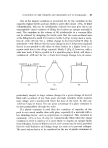
DROP TESTING OF PLASTIC CONTAINERS 13 THE LECTURER: I have no direct experience of these points with PVC bottles. I have a lot of tests on bottles which were being continually developed with changing machine conditions. They are now fairly well settled, and in the future I hope to have some information on how they will change as the material ages. Vibration from travel tests is concerned with the viscosity of the product. Because of the messy nature of drop testing, I confine my drop testing, in the main, to filling the container with water, but we have done work on the impact strength of shampoo sachets, with different viscosity shampoos, and there is no doubt that the more viscous the material in the container, the more resistant the container is to shock. I believe that a gelled product, however, is much worse, transmitting the shock straight through. I have not carried out any drop testing with bottles filled with viscous products. It may be interesting but on the whole I believe water is one of the most stringent test fills. MR. D. A. DEAN: What is the accuracy of fill, as a + 5 cm3 variation on a 90 cm3 bottle could be significant? THE LECTURER: We fill the bottles with the same volume as used in practice we use a volumetric filler to fill all our drop test containers, with a standard fill - in this case 90 cm3. MR. D. A. DEAN: I suggest that customer reaction is more important than just detail of numbers of customer complaints. May I ask if those complainants involving PVC bottles have been questioned as to exact cause? Is there any correlation between customer reaction on glass versus PVC bottles - as related to breakage? THE LECTURER: As far as the complaints are concerned, as a company we have not made any detailed survey, as far as I am aware, of reactions to these particular bottles. As far as sales figures are concerned the product is selling rather better than it was before we put it into a plastic bottle. Whether this has anything to do with PVC or the fact that it is merely plastic, or the fact that it is a different colour, I would not like to say. DR. K. G. JoaNsoN: Just a small supplementary point to Mr. Clarke's comments. This product was originally filled into a glass bottle, and we went on to a bottle almost identical with the one Mr. Clarke has illustrated, but in opaque HD polythene. The sales were virtually unaffected, but one or two large stockists refused to handle the opaque bottle - they insisted that we produce a transparent bottle and for that reason we went on to PVC in the virtually identical container. Since then there is no question that sales have increased very considerably. We had no adverse reaction. We had four customer complaints of breakage with the PVC bottle - we never had complaints of glass bottle breakages, although we know that they break. DR. C. V. SOWTER: You have explained how to derive the height at which 50% of the bottles break, and I can see that the technical purposes are a good reason for doing this but a marketing man is not interested in the fact that only half of the bottles will break. He is more concerned with knowing that, say 1% will break if dropped from 1 m, or something like this. Would you recommend a separate test to provide figures of this sort or would you say that a 50% level of breakage is the only real sensible measurement to make?

14 JOURNAL OF THE SOCIETY OF COSMETIC CHEMISTS T•E LECTURER: I would not say that the 50% level is the only realistic one that one can make, but it is probably the only practical one because of the quantity of bottles necessary. If I wanted to find a level at which 1% broke, I would use the technique described here as the probit technique in order to estimate the spread, but if we think about 1%, it means that for every 100 bottles dropped, one will break at that height, and a single bottle breaking does not give a very good estimate. It means that 5,000 bottles must be dropped. In order to answer your question scientifically I would have to drop several thousand bottles by a probit method and plot the results. MR. C. D. RENFREW: I could perhaps offer another explanation for the very low impact figure you have obtained with the cylindr'cal bottle. In early work on PVC bottles we found that its notch sensitivity was very important in impact testing and that when setting up moulds for blow-moulding, if the two faces of the mould were deliberately offset as little as 0.127 mm this had the same effect as removing ten parts of impact modifier, i.e. if you had a ten parts impact modified material this would reduce the impact strength of the bottle to the unimpact-modified state. I wonder if the mould was not properly aligned in your tests on the cylindrical bottle because it is a dramatically low figure. T•E LECTURER: This is very interesting. Mr. Renfrew, what is a satisfactory temperature for cold drop testing? I have done a certain amount of testing at 10 ø because it is at a low temperature that the difference between an impact modified grade and a non-modified grade really shows up. I have chosen 10 ø as being not too cold to be unrealistic. MR. C. D. RENFREW: I completely agree with you. The effect is even more dramatic at 5 ø where the effect of the impact modifier allows it to give a very significant effect - it is perhaps unrealistic to test at 5 o MR. P. G. S•.TON: We use an injection-moulded polystyrene talc container with a welded bottom. Initial evaluation by drop tests at 1 m in the laboratory gave no failures at the weld, but in use the bottoms dropped off. Do you feel that this should have been predicted by drop tests? T•E LECTURER: It depends how you drop them. We had some problems with a similar container, and we investigated its strength not by drop testing, but by an impact test on the side of the container. We found that the bases popped off very neatly if they were not stuck on very well. I should think in a drop test you are holding the base fairly firmly while it takes the shock. We filled our bottle with talc and dropped it on one corner so that it dropped at roughly 45 o. MR. D. R. CRABTREE: Surely dropping it on its base is the most critical situation because you get the most hydraulic effect which is reduced by dropping it on the corner. T•E LECTURER: I do not see why the hydraulic effect should differ with the point of impact. You are still getting a shock wave through the liquid in fact, you are funnelling it into the corner if you drop it on to its corner. The problem with dropping it on to its corner is the difficulty to avoid imparting rotation and some of the force is lost as rotational energy on impact. By dropping onto the base you get a better
Purchased for the exclusive use of nofirst nolast (unknown)
From: SCC Media Library & Resource Center (library.scconline.org)