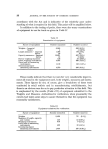
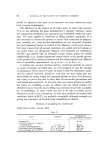
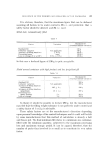
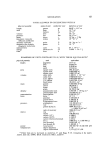
INFLUENCE OF THE WEIGHTS AND MEASURES ACT ON PACKAGING 47 Introduction by the lecturer There are a number of places in this paper where the terms "volume" and "capacity", particularly the latter, appear to be incorrectly used. This is because I am. quoting precisely from the Weights and Measures Act or its accompanying statu- tory instruments and 1 personally feel that in quite a number of cases in that Act the xvord "capacity" is used where it would in fact be re. ore precise to use the word "volume". In page 33 I have stated that vehicles on a highway are not covered by the Act. I have since found that this statement is not entirely true as a Weights and Measures officer m. ay examine equipment and goods on a vehicle provided that vehicle is stationary. He is not, however, permitted to stop it. Also, I have quoted in the same page that only about 40% of premises liable to inspection are believed to be covered each year. This figure I originally obtained for boroughs in the London area where it is still true, but having studied reports from other areas, I noxv believe that for the country as a whole this figure is rather low--it is probably between 50 and 60% and in some counties it m. ay even be in excess of 700//0 . The contents of Tables I-1II refer to the results obtained in a consortium of London boroughs. I have since studied reports from other areas in the provinces and, in general, the pattern which is sho•vn in Tables I-III is reasonably true for the country as a •vhole--the main differences are that the number of faulty instruments and •veights found in the provinces are rather lower than in the London area. I)[SCUSSION Mu. C. lu•: Referring to page 42 and Table IV--in calculating your minimum fill you are accepting a 99.7% confidence limit which, to my mind, implies that you are taking a statistical approach in measuring tolerances. Instead of summing your tolerances, should you not in this case have summed the variances and recalculated the tolerances from the square root of your sum variances? It does seem to me that one could have rather more close tolerances by using statistical approaches with some profit, for frequently one does wish to declare a content and then put above it the minimum one can get away with in order to achieve all round satisfaction. Tu• LF•cxrm•: I have quoted only a suggested method of calculating the declared contents, as there is no fixed rule. The calculation is not statistically based, but is merely derived from totting up the estimated tolerances at each stage, and I would emphasize estimated. If the calculation could be made after the whole process had been running for a sufficiently long time then a statistical calculation could be carried out and it would basically give the results that you have suggested. The problem here, however, is that the calculation of declared quantity has to be made before the product has, in most cases, ever been manufactured in bulk, before any components have been received, or before the filling and packing machinery has been used on this particular product. The weight loss on storage will probably have been estimated by extrapolation from relatively short term storage tests, probably in non-standard components. For these reasons all the tolerances that I have used are in fact estimated, and consequently the calculations here are not statistically

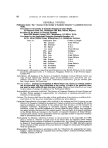
48 JOURNAL OF THE SOCIETY OF COSMETIC CHEMISTS based. It may, of course, be possible after the process has been running for a period to determine accurately all the statistical data necessary in order to recalculate on that basis. MR. C. Puo}t: Are there any rules for saying what excess xvill be tolerated? ThE LECTURV-R: There are no rules for deciding what excess will be tolerated. The Act merely states that one has to be able to justify over-filling as being necessary in order to prevent under-filling. Presumably a calculation similar to that used for finding the minimum fill would suffice, and I believe that Weights and Measures officers tend to take over-filling much less seriously than under-filling. MR. J. M. BLAX•WA¾: Do you really mean that the check weight we should use in controlling the manufacture and production should be in terms of 50 g, 20 g, 10 g and 5 g weights? Tn• L•CTURER: Yes. The Weights and Measures Act (1963) Chapter 31 Schedule 1 tells you exactly what weights and what measures one is permitted to use, and one has to work to those particular weights, which must have been Board of Trade stamped, and only certain specific denominations may be used. DR. S. M. Bu•: You are correct in assuming that the capacity tolerances which glass container manufacturers adopt are traditional and I certainly feel that they can be adjusted. This has arisen very largely because prior to the introduction of the ¾Veights and Measures Act the only legislation that had to be dealt with was concerned with Customs and Excise, particularly on liquors. In that case it was usual with one single product which went into containers of a variety of shapes to take the worst shape, which gave the largest capacity variation in manufacture, and in effect adopt that. MR. L. GATL•: Supporting this question of bottle tolerances I would like to mention a particular bottle where we had two or more years of elaborate statistical data on its dimensions. We then had a delivery which was completely different and would not take the quantity previously specified, although the bottles were within the maker's quoted tolerances. The maker concerned has now agreed to narrow his tolerances. DR. A. W. Mm•To•: Does the Act actually say that you must check-weigh the goods as you are producing them? Tn• L•CtUR•R: The Act does not put an onus on you to do any check-weighing. Whether you carry out check-weighing is entirely your own responsibility but, if, as in most cases, you do check-weigh then it is laid down in the Act that the correct denominations of Board of Trade stamped weights must be used. The equipment used for weighing, such as balances, scales, etc., must also be to an approved pattern and Board of Trade stamped. This also applies to any equipment used for obtaining tare weights of components in departments other than the filling floor.
Purchased for the exclusive use of nofirst nolast (unknown)
From: SCC Media Library & Resource Center (library.scconline.org)