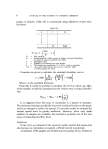
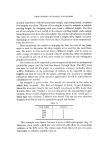
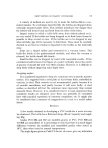
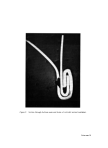
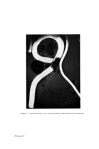
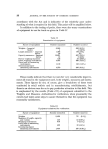
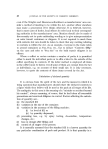
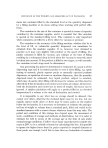
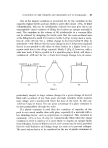
INFLUENCE OF THE WEIGHTS AND MEASURES ACT ON PACKAGING 45 One of the largest variations is accounted for by the variation in the capacity of glass bottles and jars which is quite often about +5%. If filled volumetrically, this can be considerably reduced but may give rise to an unacceptable visual variation of filling level unless an opaque material is used. The variation in the volume of fill attributable to a vacuum filler can be reduced by designing the bottle such that the cross-sectional area at the filling level is small. For instance bottle A (Fig. 1) may show a varia- tion of +0.2 -3.5 cm 3 for a +3mm change in level but bottle B (Fig. 1) only shows +0.2 -0.8 cm 3 for the same change in level. It has been assumed that it is not possible to fill either of these bottles to a higher level in a narrow neck due to the ullage required. Bottle C (Fig. 1), however, with a wide bore neck, if this is possible or if a sprinkler plug is fitted, will show a variation of _+0.5 cm 3 for the _+ 3 mm level change. Design A is, of course, Standard f•11 Maximum ................ •-•Mlnlmu (o) (b) (c) Figure 1. particularly suspect to large volume changes for a given change of level if filled with a product of low flash point and high volatility which requires more ullage, and a standard fill below the base of the neck. In this case +3.5 cm3 may be found. The one great advantage of a glass container is its zero permeability through the walls. If a plastic container is used then the variation of capacity of the pack is very much smaller than with glass, especially if a material with a low shrinkage factor, such as polystyrene, is employed. This variation is commonly + 1% or less. It may be volumetrically filled when the visual variation in level is small or it is more likely to employ an opaque finish than with glass. It may be filled to a level, and vacuum can be used, provided that the wall thickness and design shape are such as to prevent collapse. The most serious factor to be considered in the use of plastic containers is

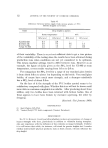
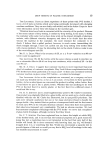
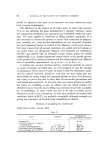
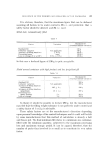
46 JOURNAL OF THE SOCIETY OF COSMETIC CHEMISTS that of permeability. In this respect, considerations raised by the Weights and Measures Act go hand in hand with other technical aspects of the use of plastics. It is obviously necessary to conduct extensive testing to find the correct grade of material, wall thickness, shape, etc. Considerable reductions in losses can often be obtained by increasing the capacity/surface area ratio. Another area where losses occur is the closure of the pack which requires special attention and a simple thing such as a change of wad lining material can sometimes reduce this loss very appreciably. There are several factors involving the use of filling equipment and its control where variations can be reduced. For example, it is not always the most rapid speed of filling that produces the most economical results. It could, for instance, necessitate a higher standard filling level to compensate for increased inaccuracy of filling volume and increased foaming if the product or method of filling promotes this. A change in the method of filling could perhaps reduce foaming. An interesting, if somewhat un- pleasant, outcome of the Weights and Measures legislation is the use by a few publicans of a small quantity of liquid designed to save time in the measurement of beers. Three drops of this liquid will instantly render a "pint" as flat as rainwater. These are but a few of the possible means of assisting us not only to satisfy more closely the requirements of the Weights and Measures Act, but in some cases they may also lead to improved efficiency. (Received: $1st January 1968) REFERENCES (1) Weights and Measures Act (1963). Chapter 31, Part 2 Sections 9 and 10 (H.M. Stationery Office). (2) Statutory Instruments. No. 1710 (1963) (H.M. Stationery Office). (3) Statutory Instruments. No. 1711 (1963). (H.M. Stationery Office). (4) Statutory Instruments. Nos. 1139 and 1140 (1964). (H.M. Stationery Office). (5) Weights and Measures Act (1968). Chapter 31. Part 4. Sections gl to 24. (H.M. Stationery Office). (6) ibid. Chapter 31. Schedule 7. Parts V and VI. Schedule 8. (H.M. Stationery Office). (7) ibid. Chapter 31. Part 4. Sections 29, 32, 48, 49. (H.M. Stationery Office). (8) ibid. Chapter 31. Part 2. Section 9. Part 4 Section gl. (H.M. Stationery Office). (9) ibid. Chapter 31. Part 4 Section 26. (H.M. Stationery Office). (10) Combined Weights • Measures Authorities for Westminster, Kensington and Chelsea, and Hammersmith Report (1967). (11) Northern Dispatch. (3rd November, 1967).
Purchased for the exclusive use of nofirst nolast (unknown)
From: SCC Media Library & Resource Center (library.scconline.org)