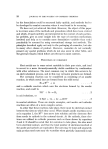
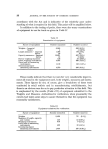
22 JOURNAL OF THE SOCIETY OF COSMETIC CHEMISTS under a metallurgical microscope. The specimen can be etched to deter- mine whether intergranular or uniform corrosion is occurring. Examination under an electron probe analyser can reveal whether traces of a contamina- ting metal are present in a corrosion pit. The position of alloy layers and the state of oxide films can be seen, and such information can be recorded on photomicrographs. Conductivity measurements It is often of interest to measure the conductivity of the solution under test since any factor which increases this will increase the corrosion rate by lowering the total resistance of the corrosion cell. pH Measurements The pH of a solution is an important factor controlling the rate and type of corrosion. For instance, in solutions inhibited with nitrite or chromate, uniform corrosion Occurs in alkaline solutions, whereas pitting corrosion takes place in solutions below pH 3.0 (3). Potential and pH relations determine whether a metal corrodes, becomes passive, or is immune from corrosion, and, as has been mentioned earlier, diagrams giving these relationships for all common metals have been prepared by Pourbaix (4). Polarity Relations If two different metals are in contact with a liquid they will assume different electrical potentials. If they are coupled electrically, a current will flow, and the anode will corrode whilst the cathode is protected. The current flowing and the potentials of the electrodes in such cells can be easily measured, and although the magnitude of the current flowing gives no quantitative indication of the rate of corrosion in a can, it can provide useful qualitative information on the effect of such variables as aeration of the solution, and quantity and type of inhibitors. In some aerosol cans aluminium, steel, tin and lead are all present, and the polarity relations between these metals will help to assess the probability of corrosion. Special effects such as conditions of restricted oxygen access in the bottom seam of a can may be simulated in specially designed cells.

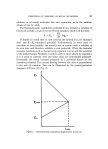
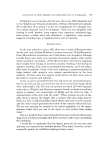
PRINCIPLES OF CORROSION OF METAL CONTAINERS 23 Polarisation Resistance When a metal is placed in a solution, it assumes an electrical potential with respect to the liquid. if a current is now passed between the metal and a counter electrode, the potential of the metal can be changed by a small amount. Stern and Geary (5) have shown that the magnitude of the current required to polarise the metal by a small amount (5-10 mV) is proportional to the rate of corrosion of the metal. A convenient form of the relation is given by:-- A I 2.3 Icorr ([la + AE where is the "polarisation resistance", although this should not be AI thought of as a real resistance, as it is only so called since it has the appropriate dimensions. [la and [•c are the slopes of the logarithmic local anodic and cathodic polarisation curves. These are generally unknown for a particular case, but according to Stern and Weisert (t3) the majority of [I values lie between 0.0t3 and 0.12 V, xvhich would provide a value for the corrosion current, I corr, to within about 20%. This view has been con- firmed by Neufeld (18). Corrosion rates in mg dm q day -• or i.p.y. can quickly be calculated from the corrosion current for any particular metal. This method provides a rapid and convenient means of finding the corrosion rate. A determination will take no more than I{0 s, and so any change of corrosion rate with time can be found. Measurements can be made in glass apparatus under controlled conditions with electrodes made from appropriate metals, or in some cases electrodes can be mounted in the actual containers themselves. it is difficult to make polarisation resistance determinations in some non-aqueous liquids since their low conductivity makes potential measure- ments difficult. The electrodes described by Neufeld (18) are helpful in this instance since the liquid path between reference and working electrode is small, and there is no risk of contamination of the solution by electrolyte from the reference electrode. Other tests A number of other test methods have been evaluated for use in corrosion testing in packaging, but which we do not use for various reasons, such as excessive cost of apparatus, difficulty and length of experimental methods,
Purchased for the exclusive use of nofirst nolast (unknown)
From: SCC Media Library & Resource Center (library.scconline.org)