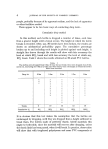
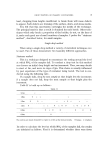
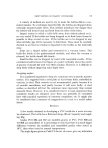
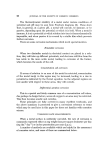
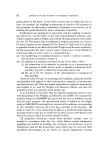
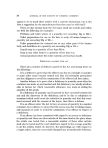
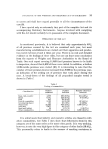
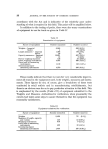
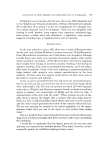
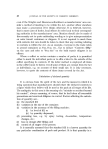
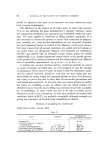
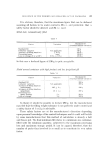
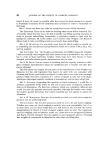
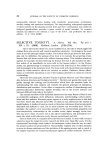
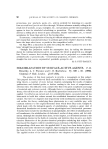
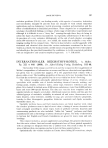
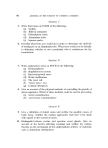
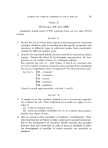
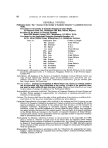
DROP TESTING OF PLASTIC CONTAINERS 5 least, dropping from heights insufficient to break them will cause defects to appear. Such defects are bruising of the surface, dents, and stress marks. It is felt that this uncertainty outweighs the merits of the technique. The principal merit is that a result is obtained for each bottle. Other tech- niques which only break a proportion of the bottles, do not, on the face of it, make such good use of small numbers of samples. I prefer the "staircase method", described below, for small samples. Single drop method When using a single drop method a variety of statistical techniques can be used. Two of these demonstrate two basically different approaches. Staircase method This is a technique designed to concentrate the testing around the level at which 50}/0 of the samples fail. To conduct a drop test by this method one chooses an initial drop height and an increment. Thus, one may decide to start at lm, and move in steps of «m. This choice is usually influenced by past experience of the type of container being tested. The test is con- ducted using the following rule:- If a sample fails, drop the next sample at that height less the increment if a sample does not fail, drop the next sample at that height plus the increment. Table II is built up as follows:- Table II 2.1m x 1.8m 0 x x x 1.Sm 0 0 x X X 0 X x X 1.2m 0 X X 0 x 0 0 X 0 x 0 0 0.9m 0 X 0 0 0 0 0 0.6m 0 The entries are made from left to right, in order as the test proceeds, O----pass X -•failure In order to calculate the level at which 50%/0 of the samples fail, the results are tabulated as follows. First it is determined whether there were fewer

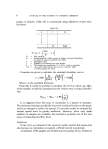
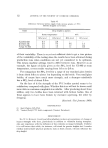
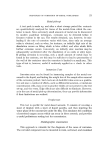
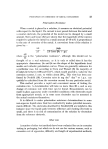
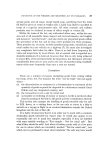
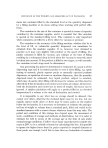
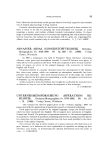
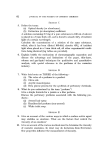
JOURNAL OF THE SOCIETY OF COSMETIC CHEMISTS passes, or failures. Table III is constructed using whichever events were the fewer. Table III f fh zf [ I•(fh) ] H----ho q-d ___ • H = 50% drop hr. ho •- lowest height at which a pass or failure occurred depending on which is used to construct the table. d = Increment used. f = Number of occurrences at each height. h = The heights are numbered, 0, 1, 2, etc. from ho upwards. + • = -• is used when failures are used to construct table. +• when passes are used. Formulae are given to calculate the standard deviation, one is:- s=1.62d Z(•2) [ ZI ] -[-0.029 Where s is the standard de•ation. From this it would be possible to calculate the level at which, say, of the samples would fail assuming that the results were a nomal distribu- tion. (s) H• = Hs0•l.• • It is suggested that this type of calculation is a misuse of statistics. The staircase technique specifically forces the results to lie close to the mean, and is an attempt to reduce the spread. To use such results to estimate the normal spread must be grossly inefficient. However, when only small numbers of samples are available, this method is probably one of the best ways of estimating the 50% level. Probit test In my view, an estimate of the spread is useful, and for this reason and also because no calculation is required, a Probit test (1) is preferred. A minimum of 50 samples are divided into five groups of ten. If there is
Purchased for the exclusive use of nofirst nolast (unknown)
From: SCC Media Library & Resource Center (library.scconline.org)