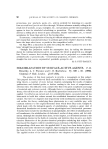
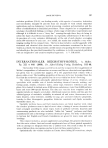
BOOK mW•WS 57 mulation problems (3 & 4), one dealing mainly with aspects of cosmetics, herbicides and insecticides, (chapter 5) and the final one (chapter 7) with certain industrial applications such as detergency, textile processing, emulsion polymerization and the effect of solubilization in analytical procedures. These chapters are a comprehensive catalogue of published findings covering a whole range of individual experiments and although it is difficult to see a "story line" running through them they do bring to notice the types of problems encountered. An especially useful feature of the book is its provision of a very extensive bibliography at the end of each chapter, averaging about 150 references in each case. As a result, the reader has available a very wide- ranging reading list in compact form. The book also includes a useful appendix xvith structural and chemical data about the various surfactants mentioned in the text. Taken as a whole, the book provides a useful means of acquiring the feel of the subject and should give the practical formulator the confidence to taclde associated problems with an imaginative and creative empirical approach. S.V. BRASCH. INTERNATIONALER RIECHSTOFF-KODEX. A. M(iller. Pp. XII q- 448. (1•)138). Dr. Alfred H½'tthig Verlag, Heidelberg. DM 48. The familiar little orange-covered book and the companion first supplement of Miiller's compendium of information on aroma and flaw)ur chemicals and specialities has given way to a jumbo-size (approx. 8"x 11") paperback-style volume with a glossy white cover. The handling properties of this new style may be judged from the fact that the reviexver's copy parted from its cover within one hour's browsing. The volume comprises priucipally alphabetical listings of aroma chemica|s aud specialities with variable sets of details including chelnical formula, melting- and boiling point, density, refractive index, odour type, literature references and sup- pliers. It is claimed to include some 5 000 aroma substances, more than 6 000 perfume bases and some 300 special fiavours. The data are very far from complete and the supplier details are largely out-of-date. Additional numerous tables and lists give for selected groups of materials: solubility in mineral oil and water, fluorescence to uv light, tenacity, odour intensity, stability in soap, pro- and anti-oxidative properties, toxicity to flies, diamagnetic properties, dielectric constants and dipole moments, threshold values, etc. Speciality perfranc bases and their •nanufacturers are listed together with, what the creative perfumers seem to find of most value, a listing of aroma chemicals and bases arranged according to odour types. Lists of perfume solvents, fixatives and sunscreening products are also included. Tables list "named" perfmnes and their •nanufacturers and a chronology of aroma chemicals is given. The body of the book is in German but English and French translations are given for many main and sub- headings. This volume includes a second supplement and perhaps the greatest drawback is that the main volume, first and second supplements have all been printed separately with no attempt to integrate them into a unified work. The result is that for every piece of information one requires one has to look in three separate places. Optimistically the volume includes an Errata sheet listing 22 corrections simply

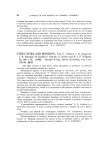
58 JOURNAL OF THE SOCIETY OF COSMETIC CHEMISTS scanning the pages to enter these reveal as many again. There are a fantastic number of obvious trivial errors, so many in fact that one wonders about the accuracy of the factual data. Nevertheless. despite its many shortcomings this book contains an exceptional volume of information and will be found an invaluable source-book for all working with perfume and flavour materials. The binding is not robust enough to stand up to the handling the book will undoubtedly get but an improvement in this direction would most likely result in a substantial increase in price. One cannot help thinking, however, how much better an impression the book would give it if were integrated into a unified whole, instead of being three separate books in one binding, and if most of the trivial errors were edited out. R.P. REEVES. STRUCTURE AND BONDING, Vol. 5. Editors: C. K. Jorgensen, J. B. Neilands, Sir Ronald S. Nyholm, D. Reinen and R. J. P. Williams. Pp. 149 -b Ill. (1968). Springer-Verlag, Berlin, Heidelberg, New York. DM 32. $8.00. The fifth volume in this series which specialises in problems of chemical structure and bonding contains five papers. "Biochemical aspects of iron-sulphur linkage in non-heme iron protein, with special reference to adrenodoxin" (T. Kimura) deals with a class of proteins which serve as oxidation-reduction components in various biological systems involved in anaerobic fermentative metabolism, photosynthesis, and hydroxylation reactions. This class excludes the iron-transferring (e.g. ferritin) and oxygen-transferring (e.g. hemerythrin) non-heme iron proteins, and is also differentiated from the iron flavo- proteins (e.g. succinic dehydrogenase). The main example of the class examined in this paper is adrenodoxin, which is a component in the enzyme complex concerned in steroid hydroxylation. "Reaction of some transition metals with nucleic acids and their constituents" (U. Weser) surveys studies of transition metal interactions with monomer and polymer units of nucleic acids. The biological functions of transition metals in proteins are widely recognised, but there seems as yet to be little evidence to indicate a biological role for them in nucleic acid metabolism. "A perturbation representation of weak covalent bonding" (C. E. Schaffer) is a theoretical discussion of weak covalent bonding between a central ion and a ligator atom. "Problem und Modell der homogenen Katalyse" (W. Strohmeier) discusses problems involved in the design of catalysts of optimal structure for a specific reaction. "Thermodynamics of complex formation between hard and soft acceptors and donors" (S. Ahrland) discusses the nature of the co-ordinate bond in the light of classification of the components in scales of softness. B.G. OVERELL.
Purchased for the exclusive use of nofirst nolast (unknown)
From: SCC Media Library & Resource Center (library.scconline.org)