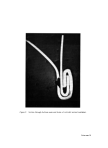
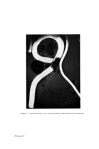
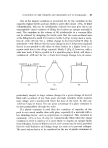
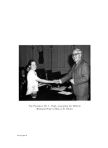
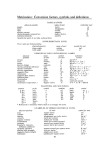
Figure $. Section through valve cup and bead of corroded aerosol container. Facing page 27

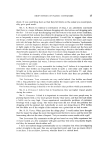
PRINCIPLES OF CORROSION OF METAL CONTAINERS 27 the metals present in the can, and the corroding environment. The effect of inhibitors on the solution/metal system can be assessed by polarisation resistance measurements (16). Some of the points mentioned in the paper are illustrated by the following examples. Fig. oe shows the bottom seam of a tinplate aerosol can. The position of the perforation within the seam of the can is in an area of restricted oxygen access, and it seemed likely that the failure was due to a differential aeration effect. This was confirmed by T-cell tests, when it was found that, although tin was normally anodic to steel in the solution, if the liquid round the steel was deaerated, the steel became anodic to the tin. When an inhibitor was added, it was found that deaeration of the steel no longer caused it to become anodic to the tin. It was confirmed in practice that use of the inhibitor prevented corrosion at the bottom seam. Fig. $ shows a section through the valve cup and can bead of an aerosol container. The cup was made from tinplate and the can from aluminium. It can be seen that perforation has occurred in the aluminium adjacent to the valve cup. It was found that in the product aluminium was cathodic to tin, but anodic to steel. It was therefore concluded that initially tin was dissolved until an area of steel was exposed. This then acted as the cathode for the anodic dissolution of aluminium. The mechanism was confirmed by the appearance of de-tinned areas on the valve cup opposite to the perfora- tions. CONCLUSIONS In this paper it has been possible to give only a superficial summary of the many aspects of corrosion which may occur in packaging. Much work remains to be done in areas where our knowledge is incomplete at the moment, especially in the use of inhibitors, and modifications to formula- tions. However, by use of some of the methods described above, we have been able to gain insight into several corrosion problems, and to make considerable savings in terms of container cost, and also size and duration of tests. (Received: 16th January 196'8) REFERENCES (1) Evans, U. R. The Corrosion and Oxidation of Metals (1060). (Arnold, LoneIon). (2) Pourbaix, M. Thermodyna•nics of dilute Aqueous Solutions (Translation by J. N. Agar). (1040). (Arnold, London). (3) Matsuda, S. and Uhlig, H. H. J. Electrochem. $oc. 111 156 (1064). (4) Pourbaix, M. Atlas of Electroche•nical Equilibria in Aqueous Solutions (1066). (Peragmon, Oxford).
Purchased for the exclusive use of nofirst nolast (unknown)
From: SCC Media Library & Resource Center (library.scconline.org)