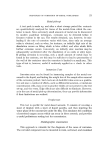
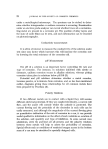
18 JOURNAL OF THE SOCIETY OF COSMETIC CHEMISTS by the formulation could be measured fairly quickly, and methods had to be developed to combat corrosion where it was found to be occurring. We have not yet achieved this ideal. However, the object of this paper is to review some of the methods and procedures which have been evolved and which, if used carefully and interpreted in the context of each particu- lar problem, give us some insight into the type of corrosion mechanisms involved and help us to consider more formulation variables than could practicably be screened by using conventional storage test methods. The principles described apply not only to the packaging of cosmetics, but also to many other classes of product. However, cosmetics do not normally present any special problems which do not also occur in other fields, and the general remarks which follow are relevant in most contexts. PRINCIPLES OF CORROSION Most metals are to some extent unstable in their pure state, and tend to revert to a more thermodynamically stable condition by combination with other substances. The most common way in which this occurs is by an electrochemical process, and in this way corrosion products are formed. The corrosion reaction can be considered as consisting of an anodic reaction, in which metal ions are formed from the solid metal M--•M z+ q- ze ..... 1 and a cathodic reaction which uses the electrons formed by the anodic reaction, and could be 2H + q- 2e-• H2 ..... 2 in acid solutions, or 2 H•O d- O• d- 4e--• 4OH- . .... 3 in neutral solutions. These are simple examples, and anodic and cathodic reactions are often of a more complex nature. In order that these reactions take place, there must be electrical contact between the sites on which they occur. When simple anodic reactions occur as in equation 1, the M z+ ions move into solution and the electrons flow from anode to cathode in the external circuit. At the cathode, these elec- trons are utilised in cathodic processes such as those shown by equations oe and 8. It should be noted that for corrosion to take place, the sites must he in electrical contact, and that the total number of electrons involved at the anode and cathode are equivalent. The sites may be large and separated, such as when steel rusts near the waterline when partially immersed in salt

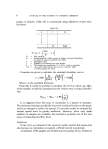
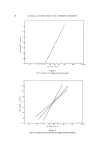
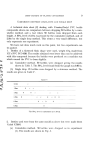
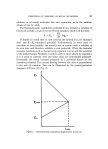
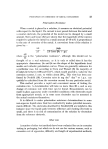
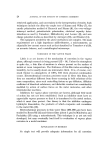
PRINCIPLES OF CORROSION OF METAL CONTAINERS 19 solution, or of nearly molecular size and separation, as in the uniform attack of iron by acids. The thermodynamic equilibrium potential E of a metal in a solution of its ions of activity a is given by the Nernst equation which is of the form RT E =E o•- -•-1og ea It should be noted that at unit activity the system is in its standard state and E-•Eo=standard potential. Unfortunately in most cases of corrosion, at least initially, the metal is not in contact with a solution of its own ions and therefore exhibits a rest potential. When the material corrodes, reactions such as that given by equation 1 occur and the potential of the metal changes. Similarly, reactions such as those shown by equations 2 or $ occur at cathodic sites and some areas are cathodically polarised. Eventually the metal becomes polarised to a potential known as the corrosion potential. The current flowing between the sites is proportional to the rate of corrosion. This can be illustrated by the current/potential diagrams of Evans (1) (Fig. 1). I I Icoe•. Fig•r• 1. Current/potential polarisation diagram [after Evans (1)].
Purchased for the exclusive use of nofirst nolast (unknown)
From: SCC Media Library & Resource Center (library.scconline.org)