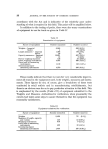
INFLUENCE OF THE WEIGHTS AND MEASURES ACT ON PACKAGING 37 During the year in question for this area there were 148 complaints sent to the Weights and Measures Authorities. Of these, 72 related to foodstuffs, 27 to solid fuel, 15 to petrol, 7 to the use of equipment, t3 to draught beer, 3 to curtain material, and 2 to toothpaste. There was one complaint each relating to snuff, formica, scrap copper, toys, cigarettes, polythene bags, hand cream, a ladies' skirt, ink, flannelette, a nightdress, soap powder, magnetic recording tape, a telephone meter and an airpump. PROSECUTIONS In the area referred to above (10), there were a total of 30 prosecutions for the year, and a further 53 letters of caution were sent. Of the :30 prosecu- tions, 28 resulted in convictions and 2 defendants were acquitted, although in both these cases, there were separate prosecutions against other parties which resulted in convictions. Of the 28 convictions, 14 were for supplying short weight, 13 for having an incorrect quantity marking, 5 for having no quantity marking, 2 for using an unstamped instrument, and 1 for using a false trade description. Three of the cases referring to prepacked goods not being marked with quantity were against manufacturers in the food industry. All other cases were against retail outlets and there were none in the field of cosmetics and toiletries. As far as can be ascertained there has only been one successful prosecu- tion in our ne•u anu [111 IJUii•UliIUU tttu Dctitx tJt ctclOSOl •l sprays which were underweight (11). The store in question was fined oe10 with 5 guineas costs when a Weights and Measures inspector found two faulty aerosol hair sprays on display, one underweight by :39.:34g and the other by 4.5g. A representative of the store told the court: "When aerosols are put on dis- play, there is always the danger that a woman will come along and try them out. It is a national problem which affects stores all over the country, and the stores cannot guarantee that some of the contents will not be lost. We are now pressing for aerosols to be sealed completely by the manu- facturers before they are sent to the shops, to stop women from testing them." This is a problem that aerosol manufacturers may be faced with at some stage but I would have thought that there were less costly ways of satisfying the conditions. I would like to emphasize that the figures given are for one area only and may not represent the national picture. They must, however, act as a reasonable pointer to conditions reigning in many areas.

38 JOURNAl. OF THE SOCIETY OF COSMETIC CHEMISTS MEANS OF SATISFYING THE REQUIREMENTS IN THE COSh'iETIC AND TOILETRY FIELD In order to satisfy any Act fully it is necessary to study the whole document as it relates to one's own business. There are, hoxvever, a number of obvious factors common to the industry. There are the obvious exemptions from the Act on grounds of small size, packing only for export, or packing not for retail sale. I now' intend, as is almost entirely the case, to treat all products of the industry as being prepacked and not sold loose in paper bags as if they were chicken feed! The two areas where, subject to the foregoing exemptions, action must be taken by the manufacturers in all cases are the measurement of quantity and the declaration of quantity. The first area covers all equipment and measures of weight, capacity, etc. in use for trade and the second area covers the position and method of marking as well as the calculation of the quantity to be marked. The measurement of quantity All equipment used for measuring quantity must be to an approved design and must also bear a Board of Trade stamp. This applies to all weighing instruments of all types used for check-weighing on a production line. It should also be noted that if other weighing instruments are used for ancilliary purposes, e.g. in a component store or inspection department for obtaining a tare 5veight of a component prior to setting up a production line check weighing instrument, then this should also be to an approved pattern and be stamped. Most weighing and measuring instruments used in a component inspection department are not, however, concerned directly with determining the quantity which is filled into the container and do not therefore come within the Act. Capacity measures used for determining or checking the quantity filled must likewise be to an approved pattern, constructed from the correct materials and also be stamped. The same applies to all weights used in conjunction with the weighing instruments. These will bear the official B.O.T. stamps and they must all be of denomina- tions permitted by Schedule 3 of the Act. For instance, if a weight of 88 g is being checked, then it is necessary to use weights of 50g, 20g, 10g, 5g, 2 g, and 1 g, or other combinations of these denominations. Other denomina- tions may not be used and it is not possible to have stamped and use a 'made-up' weight of 88 g.
Purchased for the exclusive use of nofirst nolast (unknown)
From: SCC Media Library & Resource Center (library.scconline.org)