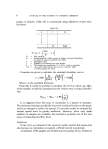
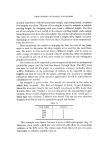
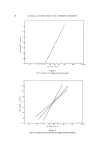
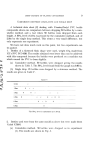
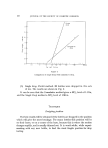
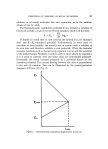
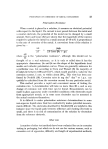
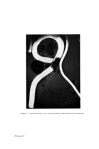
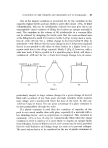
PRINCIPLES OF CORROSION OF METAL CONTAINERS 19 solution, or of nearly molecular size and separation, as in the uniform attack of iron by acids. The thermodynamic equilibrium potential E of a metal in a solution of its ions of activity a is given by the Nernst equation which is of the form RT E =E o•- -•-1og ea It should be noted that at unit activity the system is in its standard state and E-•Eo=standard potential. Unfortunately in most cases of corrosion, at least initially, the metal is not in contact with a solution of its own ions and therefore exhibits a rest potential. When the material corrodes, reactions such as that given by equation 1 occur and the potential of the metal changes. Similarly, reactions such as those shown by equations 2 or $ occur at cathodic sites and some areas are cathodically polarised. Eventually the metal becomes polarised to a potential known as the corrosion potential. The current flowing between the sites is proportional to the rate of corrosion. This can be illustrated by the current/potential diagrams of Evans (1) (Fig. 1). I I Icoe•. Fig•r• 1. Current/potential polarisation diagram [after Evans (1)].

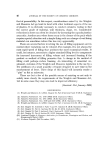
20 JOURNAL OF THE SOCIETY OF COSMETIC CHEMISTS The thermodynamic stability of a metal under various conditions of potential and pH may be seen from Pourbaix diagrams (2). These show that, in general, at a given pH, a metal will corrode, be immune, or be passive, depending upon the potential at which it is held. When a metal is immune, it is at a potential at which solution into ions is thermodynamically impossible, and when passive it is covered by a stable film which prevents further corrosion. There are some corrosion mechanisms which merit special mention. Bimetallic corrosion When two dissimilar metals in electrical contact are placed in a solu- tion, they will take up different potentials, and electrons will flow from the less noble to the more noble metal, leading to corrosion of the former, which becomes the anode of the cell. Concentration cell corrosion If access of solution to an area of the metal is restricted, concentration of the metal ion{s) in this region may be increased, leading to a rise in potential as indicated by the Nernst equation. As the adjacent regions are now anodic with respect to these areas, they will corrode. Differential aeration corrosion This is a special and fairly common case of a concentration cell where, due perhaps to design factors, access of oxygen to an area may be restricted. This then becomes anodic and corrodes. These principles are fully covered in many excellent textbooks, and the above summary is presented to give a convenient reference to terms which may be used later in this paper for those not familiar with corrosion science. CORROSION RATE MEASUREMENTS When a metal surface is uniformly corroded, the rate of corrosion is commonly expressed either as mg weight loss per square decimetre per day (mg dm -• day -•) or inches penetration per year (i.p.y.). A number of methods are available which are helpful in the assessment of corrosion rates, and some of these are summarised below.
Purchased for the exclusive use of nofirst nolast (unknown)
From: SCC Media Library & Resource Center (library.scconline.org)