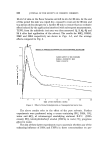
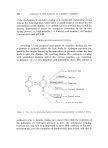
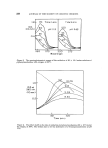
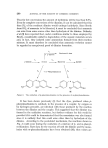
256 JOURNAL OF THE SOCIETY OF COSMETIC CHEMISTS and consumed by coupling and/or hydrolysis:.-- -d [D]/dt =3k 2 [P] [D] q- k 3 [D]* The most favourable conditions for the detection of the diimine are thus when reaction (i) is fast compared with reactions (ii) and (iii). This is the case when ferricyanide is used as the oxidant and the formation of the diimine can then be demonstrated spectrophotometrically (1, 5). I.O O.D. (i0 mm) 0.5 i \ I : I ß I I I i '" 22O 25O 28O Wave length Figure oe. The spectra of A, p-benzoquinonediimine B, p-benzoquinonemonoimine and C, p-benzoquinone in pH 9 aqueous buffer. All solutions were 50 X 10-6 molar. In view of its characteristic uv absorption spectrum (Fig. 2), the spectrophotometric method offers the best means of unequivocal detection *The factor 3 arises since the value of k 2 is for the rate controlling coupling step between one molecule of diimine and one molecule of diamine. In subsequent rapid reactions, two further molecules of diimine are consumed, one for a further coupling step and one as an oxidant, thus regenerating the diamine (6):-- k2 D q- P . .2, 5, 4'-triaminodiphenylamine slow fast D q- 2,5,4'-triaminodiphenylamine Reduced B fast D q- ReducedB . Bq- P

p--BENZOQUINONEDIIMINE 257 of the diimine. This would depend on there being sufficient diimine present at any one time, and on the absence of other species which absorb strongly in the relevant spectral region (240-280 nm). Unfortunately, solutions containing high peroxide concentrations are optically "black" in this region, thus precluding direct observation. However, even if this could be overcome by dilution or by solvent extraction of organic material, kinetic considerations indicate that insufficient diimine would be present for unequivocal results to be obtained. The amount of diimine present in a reaction mixture will be dependent on the relative rates of its formation, i.e. k 1 [P] (assuming a constant concentration of oxidant, i.e. k 1 =k' 1 [Ox]), and of its consumption, i.e. 3k 2 [P] [D• d- k3 [DI. The values of k 2, for the coupling reaction (6), and k3, for the hydrolysis (7), are known. However, no direct measurements on the rate of oxidation of p-phenylenediamine by peroxide are available. According to Tucker (8), the oxidation of the p-diamine (0.1 molar) with peroxide (3% _• 0.9 molar) at pH 9.6 and 25øC gave about 10% of Band- rowski's base in 90 min. Since, under these conditions, reaction (if) is relatively fast compared with (i) and (iii), this data can be used to obtain an approximate value for k 1. Thus, if 10% of the diamine is oxidised in 90 rain, k1=0.0012 min-1. Assuming a normal increase in rate with temperature, this would give a value of k 1 •' 0.002 min-1 at 30øC. At 30øC and pH 9.6, k2=28.7 1 mole-1 min-1 and k3=0.027 min-1 it can be seen that reactions (if) and (iii) compete for the available diimine and that consumption by coupling and hydrolysis will occur in the ratio 3k 2 [Pl/k3, while Bandrowski's base and monoimine will be formed in the molar ratio k2[P]/k 3. Thus at high concentrations of p-diamine ( 10-3 molar), (if) will be the major reaction, while at low concentrations ( 10-3 molar), reaction (iii) will predominate. Assuming, for small conversions of diamine, that •P 1 remains constant and that all reactions can be considered first order, calculation of maximum diimine concentration, and the time at which it pertains, is possible using the equations for consecutive reactions given by Frost and Pearson (9). For the oxidation of 0.1 molarp-diamine at pH 9.6 we get [Dlmax ___ 35X10-6 molar, and for 0.1X10 -3 molar p- diamine at pH 9.6, we get [D]max _• $X10 -6 molar, neither of which could be detected in the presence of the large excess of p-diamine, or its final oxidation products, which would inevitably be present. It is evident that low diamine concentrations fayour the detection of diimine, since they inhibit Bandrowski's base formation. Nevertheless hydrolysis remains a significant reaction for the consumption of the
Purchased for the exclusive use of nofirst nolast (unknown)
From: SCC Media Library & Resource Center (library.scconline.org)