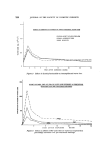
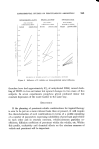
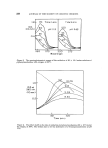
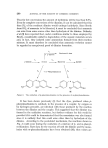
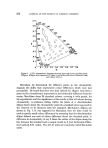
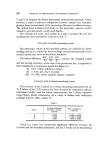
258 JOURNAL OF THE SOCIETY OF COSMETIC CHEMISTS - 70 Time in min Time inmin pH 11,2 pH 9.65 - 5 I • I I 1.2 O.D. (IOmm) 0.6 250 275. 250 275 Wavelength Figur• & The spectrophotometric course of the oxidation of 50 X 10-6 molar solutions of p-phenylenediamine with oxygen, at 80øC. I.O O.D. at 260 nm. (IO mm) 0.5 ' 9.04 8.50 , 50 IOO Tirn½ (min) Figure 4. The effect of pI-I on the rate of oxidation of p-phenylenediamine (50 X 10- 6 molar) by oxygen, at $0øC. The broken line is for the hydrolysis of p-benzoquinonediimine at pH 11.2.

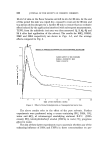
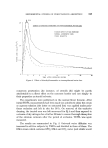
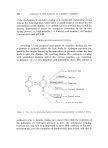
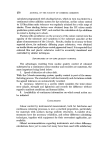
•--BENZOQUINONEDIIMINE 259 diimine. Kinetic studies have shown that while the rate of the coupling reaction (ii) decreases ten times for each unit increase in pH (1, 6), the rate of hydrolysis of the diimine is independent of pH at pH 8 (1, 7). Thus, unless k 1 increases markedly with increasing pH (above pH 9.6) it will not be possible to find reaction conditions under which [D ]max will exceed a few per cent of the initial diamine concentration. We have, in fact, carried out experiments under a variety of conditions, using peroxide as oxidant, and have failed to demonstrate the presence of the diimine by spectro- photometric examination of the reaction mixture or ether extracts thereof. Having noted previously that moderately dilute (N 10-3 molar)solu- tions of p-phenylenediamine develop colour more rapidly when oxidised with molecular oxygen than when peroxide is employed, it was of interest to make a spectrophotometric examination of the oxygen oxidation of very dilute diamine solutions. The results, in Fig. $, prove conclusively that the diimine is formed in these reactions. Thus, for a 50 X 10-6 molar solution of the diamine at pH 11.2, the development of the characteristic spectral features at 255 and 264 nm (Fig. oe) can be observed after a short induction period. The intensity of the absorption increases up to about 70 min, whereafter it decreases due to hydrolysis. A similar pattern emerges at pH 9.65, except that the induction period is reduced and the rate of the subsequent oxidation is somewhat lower than that observed at pH 11.2. Similar series of curves were obtained for reactions at pH 8.5, 9.04 and 10.05. From optical density (260 nm) versus time curves (Fig. 4) it is evident that the rate of oxidation only increases by a factor of -• 5 between pH 8.5 and 11.2, and that there is an increase in the duration of the induc- tion period with increasing pH. The broken line in Fig. 4 is the optical density versus time plot for the hydrolysis of the diimine at pH 11.2, and it is evident that the negative slopes of the later stages of the diamine oxidation curves are consistent with there occurring a concurrent formation and hydrolysis of the diimine. Brody's method (4) of "proving" that the diimine was formed, during the peroxide oxidation of p-phenylenediamine, involved determination of the ammonia liberated during the first hour of the reaction on the assump- tion that ammonia could only be produced by the hydrolysis of the diimine- reaction (iii). As pointed out above, hydrolysis will be in competition with the coupling reaction (ii) and the ratio of the consumption of the diimine by reactions (ii) and (iii) is given by 3k2 [P•/k3. At 30øC, and with the concentrations used by Brody (1% •_0.1 molar p-diamine, 3% peroxide, and pH 9.6) this ratio has the initial value (3 X 28.7 X 0.1)/0.027=318.
Purchased for the exclusive use of nofirst nolast (unknown)
From: SCC Media Library & Resource Center (library.scconline.org)