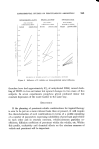
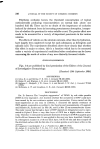
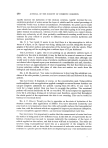
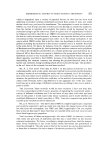
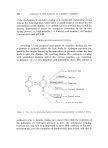
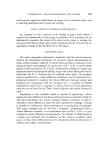
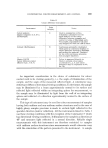
260 JOURNAL OF THE SOCIETY OF COSMETIC CHEMISTS Thus for low conversions the amount of hydrolysis will be less than 0.5%. Even for complete conversions of the diamine, it can be calculated that less than 2% of the resultant diimine would undergo hydrolysis. Since Brody found 5% of ammonia to be liberated, it must be concluded that ammonia can arise from some source other than hydrolysis of the diimine. Dolinsky et al (3) have reported that, under conditions similar to those employed by Brody, considerable oxidative degradation of the organic materials occurs and, in fact, they isolated some ammonium formate from their reaction mixture. It must therefore be concluded that ammonia evolution cannot be regarded as unequivocal proof of diimine formation. k 3 = Bandrowski's base + p- Diamine k I k 2 k4 p-Diamine =_ Diimine .,_ Monoimine • Quinone Figure + m- Phenylenediamine The oxidation of p-phenylenediamine in the presence of m-phenylenediamine. It has been shown previously (1) that the dyes, produced when p- phenylenediamine is oxidised, in the presence of a coupler, by oxygen or by hydrogen peroxide, are identical with those produced by the reaction between the diimine and the coupler. This suggested that the diimine was formed in the oxidation reactions, but further evidence for this would be provided if it could be demonstrated that the monoimine was also formed since it is unlikely that this could arise other than by hydrolysis of the diimine. According to the postulated mechanism, the reactions shown in Fig. fi could occur during the oxidation of a mixture of p- and m-phenyl- enediamines. Rate data for the reaction of both the diimine and the mono- imine with m-phenylenediamine have been obtained (10), thus values are

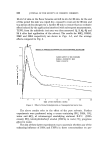
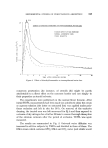
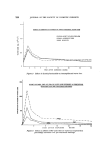
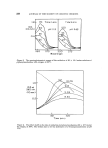
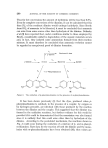
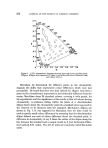
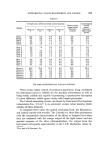
p--BENZOQUINONEDIIMINE 261 I.O O.D. (40 turn) 0..5 A I I 500 600 700 Wavelength Figztre 6. Spectra of the reaction mixtures during the oxidation of equimolar mixtures of p- and m- phenylenediamine by oxygen, at pH 11.2. The diamine concentrations are A, 0.01 molar B, 10-3 molar C, 0.5 X 10⁻³ molar and D, 0.1 X 10⁻³ molar. The curves E and F are respectively the spectra of the indamine dye (g7.5 X 10-6 molar) and the indoaniline dye (8.0 X 10⁻⁶ molar), at pH 11.2. I.O O.D. (40 mm) 0.5 A 500 600 700 Wavelength Figure 7. Spectra of the reaction mixtures during the oxidation of equimolar mixtures of p- and rn-phenylenediamines by hydrogen peroxide (0.25 X 10⁻³ molar), at pH 11.2. The diamine concentrations are A, 0.01 molar B, 10-3 molar and C, 0.5 X 10⁻³ molar.
Purchased for the exclusive use of nofirst nolast (unknown)
From: SCC Media Library & Resource Center (library.scconline.org)