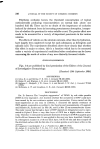
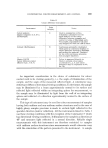
INSTRUMENTAL COLOUR MEASUREMENT AND CONTROL 267 made up into a garment which must, of course, have a uniform colour, and in selecting matching reels of paper for cutting. Colour control in a continuous colouring process An example of such a process is the dyeing of paper sheet which is carried out continuously as the paper is produced. It is necessary for an instrument to monitor the colour of the sheet as the paper is leaving the conveyor belt before reeling. Any colour variations must be corrected by an appropriate change in the dye flow rate to the paper. INSTRUMENTATION The colour measuring instrument commonly used for colour tolerance work is the tristimulus colorimeter. It produces colour measurements in terms of three numbers called X, Y and Z, which are the co-ordinates of the system of colour measurement set up by the C.I.E., or R, G and B which may be easily converted to X, Y and Z. Colorimeter readings on sample and standard cannot be substracted directly to give the colour difference between them since the X, Y, Z system is not a uniform colour space. The readings may be inserted into a colour difference formula or may be processed by a graphical treatment to produce the colour difference between sample and standard, for comparison with the tolerance set. A number of reliable colorimeters which have a response to colour which is in close agreement with the eye are listed in the Table I which indicates the salient features of each. Equipment is also available which is capable of producing a direct display of colour difference and three such instruments are listed in Table II. The first instrument, the Colour Analysis Display Computer (C.A.D.C.) calculates colour differences when fed with colorimeter readings. Colorede is suitable for continuous colour monitoring of a moving piece of material. The colour readings may be fed into a computer, programmed with a colour difference formula, or an instrument such as the C.A.D.C. to give continuous colour difference measurements. The Hunter D 25M measures a colour and calculates the co-ordinates of the colour in uniform colour space, so that colour differences may be obtained by direct subtraction of control and sample measurements.

268 JOURNAL OF THE SOCIETY OF COSMETIC CHEMISTS Table I Tristimulus colorimeters Angles of illumina- Instrument C.I.E. tion Pattern Price Notes illuminant I =Incident size category I V----Viewing Coloreye C I=diffuse 27ram M Normally includes Signature (small V=85 ø also 10 or 16 narrow sphere model) band spectral filters, and so functions also as an abridged spectrophotometer. Some directional effects which may be overcome using rotating accessory. Coloreye A,C. 1----diffuse 50ram N As above but Signature (large V=85 ø to relatively non- sphere model) 150ram directional. UV source available for L.S. model to enable measurements of fluorescence to be made. Colormaster A,C. I---- 45 ø 13m to L Marked directional Model V V----90 ø 45m effects which may be overcome by using rotating accessory. Elrepho A,C. I----diffuse 30m L Normally includes 7 V----90 ø spectral filters and I so functions as an I abridged spectro- photometer. With special xenon source can be used for fluorescent measure- ments. Relatively non-directional. Spectromat A,C. I • diffuse 10m to BI Direct print-out of FS-3A V=90 ø 40m X Y Z tristimulus values. Abridged spectrophotometer I (33 filters). Xenon t light source fitted as I standard. Relatively non- directional. The Color-Eye Signature is manufactured by Kollmorgen Inc. (I.D.L.), the Colormaster by Manufacturers Engineering Equipment Corporation, U.S.A., the Elrepho by Carl Zeiss, West Germany, and the Spectromat FS-3A by Pretema A.G. Sxvitzerland. (The price categories are: L about oe1,500, M about oe2,500, N over oe3,000.
Purchased for the exclusive use of nofirst nolast (unknown)
From: SCC Media Library & Resource Center (library.scconline.org)