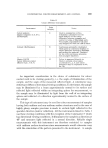
INSTRUMENTAL COLOUR MEASUREMENT AND CONTROL 269 Table II Colour difference instruments Instrument Colour analysis display computer (C.A.D.C.) (Kollmorgen) Colerede (Kollmorgen) Hunter D•O5 M Colour difference meter (Hunter Lab., U.S.A.) Price category Notes Used in conjunction with a tristimulus colorimeter for the rapid analysis of the colour difference between a sample and control in terms of MacAdam units. Very stable, repeatability 0.2 units and designed to work on a 24 hr basis Continuous automatic colorimeter which gives a continuous display of colour difference between a standard and production material. Designed for use with continuous processes such as paper machines. Colour is measured directly in Hunter uniform colour space co-ordinates L, a, b, and colour difference may be expressed as AL, Aa, Ab. An important consideration in the choice of colorimeter for colour control work is its viewing geometry, i.e. the angie of illumination of the c,,,,,nmc,c, may sample. and the anglo of •ho measured r•O•*,•a l•,,,, A '"•' * • -I ................ ,•11 • •-•.u liblib. • either have diffuse or directional viewing conditions. In the former, the sample may be illuminated by a beam approximately normal to its surface and reflected light collected within an integrating sphere for measurement, or the sample may be illuminated by light from the wall of an integrating sphere and collected at a direction approximately normal to the surface of the sample. This type of instrument may be used for colour measurement of samples having both uniform and non-uniform surface structures and in the case of highly glossy samples provision is made to exclude light reflected in the specular direction (mirror reflection). All the instruments listed in Table 1 use these viewing conditions with the exception of the Colormaster V which has directional viewing conditions. It illuminates •he sample in a direction at 45 ø and measures light reflected in a normal direction. Reliable single measurements with this instrument are therefore restricted to samples with uniform surface structures since measurements would otherwise vary with the orientation of the pattern presented to the instrument. A sample

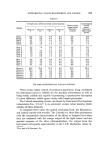
270 JOURNAL OF THE SOCIETY OF COSMETIC CHEMISTS cell which can be rotated, can, however, be fitted to the Colormaster to over- come this difficulty, an average measurement for all orientations being thereby obtained. Tests have been carried out on the Colormaster with rotating accessory, Color-Eye Signature and the Elrepho to establish the reliability with which colour measurements can be reproduced on different types of textile materials. These results are given in Table III. Table III Over-all reproducibility of different instruments on different textile substrates Over-all Reproducibility (1964 C.I.E. Units) Type of fabric Colormaster V with rotating head Indian head cotton Wool flannel Wool slubbing Nylon stocking Cellulose acetate (face side) Cellulose acetate (reverse side) Ceramic tiles 0.31 0.33 1.14 0.37 0.81 0.64 0.10 Color-eye Signature (Large sphere) 0.43 0.44 0.51 0.92 1.01 0.68 0.30 Zeiss Elrepho 0.15 0.35 0.10 The reproducibility is expressed as the mean standard deviation for repeat readings on a number of coloured patterns. A 1964 C.I.E. unit is about 2-13 traces, or just noticeable colour difference steps for textile materials. It is shown by the figures that the instrument reliability is very much dependent on the surface nature of the sample being measured. The more uniform the surface the better is the instrument reliability. For example, the reproducibility of the Colormaster V coloff- meter without rotating accessory on ceramic tiles is as good as 0.1 C.I.E. units. It is therefore necessary, before commencing instrumental colour tolerance work, to establish that the colorimeter selected has a measurement variation on the material to be controlled, which is considerably better than the size of tolerance of interest. COLOUR DIFFERENCE CALCULATION TECHNIQUES Any colour can be specified in terms of three reflectance values X, Y, Z which are related to the way in which that colour is perceived by the
Purchased for the exclusive use of nofirst nolast (unknown)
From: SCC Media Library & Resource Center (library.scconline.org)