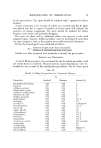
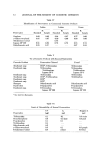
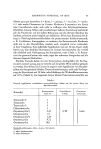
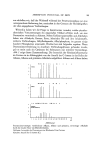
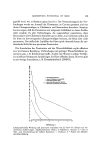
J. Soc. Cosmet. Chem., 26• 75-81 (February 1975) Identification of Preservatives in Cosmetic Products by Chromatography Thin-layer CLIFTON H. WILSON, Ph.D* Synopsis-A rapid, sensitive method for the IDENTIFICATION of PRESERVATIVES in COSMETICS consists of extracting the cosmetic with alcohol and developing an ali- quot of the extract on a THIN-LAYER CHROMATOGRAPHY (tic) plate of silica gel GF2s4. The preservatives are visualized on the plate by short wavelength UV light, iodine vapor, and/or several indicator sprays, and identified by comparison of Rt values with known standards. Twenty-five preservatives •vere characterized by this method. The prc- servatives in nine commercial cosmetic products were identified by the method described. The limit of detectability is approximately 0.1-0.5 t•g on a tlc plate, using a benzene-acetone solvent system. INTRODUCTION Chemicals with preservative properties are widely used in cosmetic prod- ucts. These chern:cals include ha]ogenated phenols, hydroxybenzoates, for- ma]dehyde-re]eas]ng compounds, and a few heterocyclic compounds such as dehydroacetic acid. Mo t of these compounds absorb in the ultraviolet region of the spectrum. Derry et al. (1) published a method for detecting several preservatives in cosmetics with a detectability limit of 0.1%. The method involves separaEon by extraction and partition chromatography followed by spectrophotometric examination. Many preservatives, however, are used at concentrations of less than 0.1% and therefore could not be detected by this method. The present study was undertaken to develop a rapid screening procedure to identify preservatives in eosinerie products at levels below 0.01%. -- •Division o• Cosmerles Technology, Food and Drug Administration, o.00 C Street, S.W., Washington, D.C. 209.04. 75

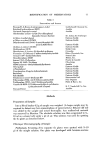
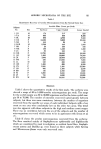
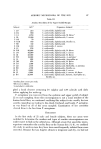
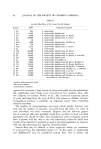
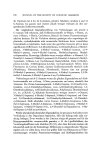
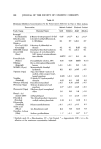
76 JOURNAL OF THE SOCIETY OF COSMETIC CHEMISTS Several reports in the literature demonstrate the use of thin-layer chroma- tography (tlc) for identification of preservatives. The esters of p-hydroxyben- zoic acid have been separated by tic on silica gel G plates (2). Bark and Graham reported the tlc of 69 halogenated phenols on alumina plates using eight eluent systems (3). Baker and Booth separated halogenated salicylani- lides on cellulose plates (4). More recently, tic separation of several bacterio- cides on silica gel GF254 was reported by Koenig (5) and by Braber et al. (6). Gunner determined methylenedioxy compounds by tic-direct densitometry on Adsorbosil©* plates (7). These reports provide the basis for the current investigation. EXPERIMENTAL Apparatus and Materials Apparatus used included a short wavelength UV light (Mineralight UVS 11'), tic developing tank lined with filter paper, and spray apparatus ( Chromafiex sprayerS). All preservatives were commercial grade and are listed in Table I. The solvent systems used were benzene-acetone (8:2) and chloroform-methanol (9:1). Tlc plates (20 x 20 cm), both precoated by Analtechõ and prepared in this laboratory • using silica gel GF254,** were used. Thickness in both cases was 250 bt. The F2• refers to fluorescence indicator added to silica gel. Indicator Reagents These included 4-aminoantipyrine-potassium ferricyanide (A), diazotized benzidine (B), and 4~methyl umbelliferone (C), each prepared as described by Stahl (8). Chromotropic acid reagent (D) was prepared by carefully adding 15 ml of concentrated sulfuric acid to a solution of I g of sodium chromotropate in 15 ml of water. After spraying, the tic plate was heated at 110-120øC for 10- 30 min to achieve color development. Acetylacetone reagent (E) was prepared as an aqueous solution by com- bining 0.2 ml of acetylacetone, 0.3 ml of glacial acetic acid, and 15.4 g of ammonium acetate in 100 ml of di_stilled water. After spraying, the tic plate was heated at 110øC for 10 rain to achieve color development. Iodine vapor (F) was prepared by adding several crystals of iodine to a large beaker (about 2 1.) and warming on a steam bath. The tic plate was held over vapors so that vapors contact silica gel surface. *Applied Science Laboratories Inc., State College, Pa. *Ultraviolet Products, Inc., San Gabriel, Calif. 91778. $Kontes Glass Co., Vineland, N.J.. No. K-422540 •SBrinkmann Instruments, Inc., Westbury, N.J. 11590. **E. Merck, Dormstadt, W. Germany.
Purchased for the exclusive use of nofirst nolast (unknown)
From: SCC Media Library & Resource Center (library.scconline.org)