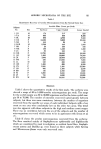
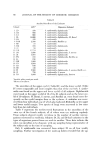
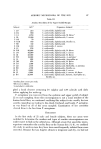
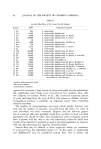
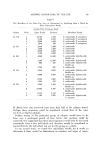
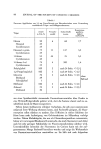
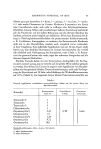
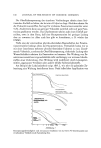
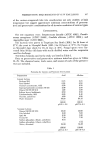
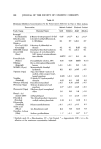
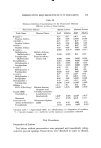
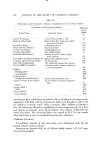
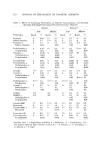
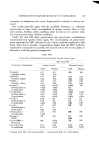
AEROBIC MICROFLORA OF THE EYE 89 Table V The Microflora of the Outer Eye Area as Determined by Swabbing Once a Week for Four Consecutive Weeks Aerobic Plate Count per Swab Week Upper Eyelid Eyebrow Microflora Found Subject 22 CM 23 'ru 24 BD 25 DA 26 EB 1 12,700 1,360 S. epidermidis P. aeruginosa 2 3,100 2,400 S. epidermidis P. aeruginosa 3 5,000 4,400 S. epidermidis P. ae•tginosa 4 1,800 1'80 S. epidermidis P. aeruginosa i 2,000 1,900 S. epidermidis 2 1,600 1,500 S. epidermidis 3 2,200 4,500 S. epidermidis 4 4,100 4,000 S. epidermidis i 6,200 14,400 S. epidermidis diphtheroids Bacillus sp. 2 1,700 12,700 S. epidermidis diphtheroids 3 860 400 S. epide•nidis diphtheroids Bacillus sp. 4 1,700 600 S. epidermidis 1 6,800 2,980 S. epidermidis diphtheroids Bacillus sp. 2 3,700 5,800 S. epidermidis diphtheroids Bacillus 3 2,500 1,900 S. epidermidis diphtheroids 4 1,800 450 S. epidermidis i 8,500 4,100 S. epidermidi• diphfi•eroids Bacillus sp. 2 17,000 4,700 S. epidermidis diphtheroids Bacillus sp. 3 2,140 2,110 S. epidermidis 4 1,100 1,200 S. epidermidis diphtheroids A. anitratus M. [lavus were also recovered from more than half of the subjects tested. Perhaps these organisms could be considered normal flora of the outer eye for Los Angeles subjects. Further testing of this particular group of subjects would have to be clone over a prolonged period of time before this question could be answered. One might find that these microorganisms would only be recovered consistently from a few individuals and therefore would be considered as normal flora for the individual, but not for the group as a whole. In our second study, we tested five individuals weekly for 4 weeks to determine if there would be fluctuations in numbers and types of micro-

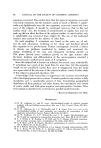
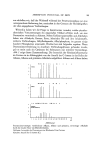
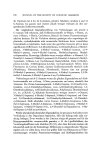
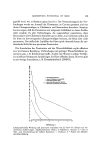
90 JOURNAL OF THE SOCIETY OF COSMETIC CHEMISTS organisms recovered. The results show that the types of organisms recovered were fairly consistent, but the numbers varied as much as 30-fold. S. epider- midis and diphtheroids were the two organisms recovered consistently from most of the subjects. It should be mentioned, however, that in this and another study (11), the wearing of nonmedicated or regular face and eye make up did not affect the flora of the subiects studies. As noted earlier, only S. epidermidis was recovered from subject 23. The use of the medicated cleanser may account for the absence of other flora. On each sampling, P. aeruginosa was found on the outer eye of sub- ject 22, and subsequent swabbing of her cheek and forehead showed this organism to be predominant. Further investigation revealed a history of chronic ear problems manifested by itching and occasional dis- charge. Swabbing of her ears and subsequent streaking directly on TSA plates showed heavy confluent growth on the agar surfaces after 24 hours. Isolation and differentiation of the microorganisms revealed a fiourescent and a nonfiourescent strain of P. aeruginosa. Since this subject had a chronic ear infection for several years, undoubtedly P. aeruginosa was a part of her facial flora for some time. Yet this organism would not be considered normal flora since it disappeared from her facial area upon relief of the infection of the external auditory canals. Further study of this subject is presented elsewhere (12). A knoxvledge of the normal flora is important to the cosmetic microbiologist when developing preservative systems. Cosmetic products may receive a daily inoculation over a considerable period of time. Considering geographical distribution of these products and other factors, the inoculations may consist of yeasts, molds, and both gram-negative and gram-positive bacteria. Tran- sient organisms should not be overlooked as possible product inocula. (Received September 10, 1974) REFERENCES (1) D. W. Anderson, Jr., and M. Ayers, Microbiological profile of selected cosmetic products with and without preservatives after use, ]. Soc. Cosmet. Chem., 23, 863- 73 (1972). (2) D. W. Anderson, Jr., J. F. McConvil]e, and C. B. An.•er, Son•e c-•ments on the microbiological profile of used automatic eye cosmetics by examination of both applicator and product, Cosmet. Perfu,m., 88, 8, 29-30 (1973). (3) D. W. Anderson, Jr., J. F. McConville, and C. B. Anger, Microbiological pro- file of used eye cosmetics by examination of product only, Ibid., 88, 8, 25-27 (1973). (4) L. A. Wilson, J. W. Kuehne, S. W. Hall, and D. G. Ahearn, Microbial contamina- tion in ocular cosmetics, Amer. ]. Ophthalmol. 71, 1298-1202 (1971). (5) C. E. Myers and F. M. Pasutto, Microbial contamination of cosmetics and toiletties, Can. ]. Pharm. Sci., 8, 19-23 (1973). (6) M. J. Pickett, University of California at Los Angeles, Personal communication, 1974. (7) C. A. Evans, W. M. Smith, E. A. Johnston, and E. R. C,i]bert, Bacterial flora of the normal skin, ]. Invest. Dermatol., 15, 305-24 (1950).
Purchased for the exclusive use of nofirst nolast (unknown)
From: SCC Media Library & Resource Center (library.scconline.org)