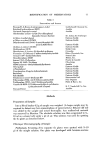
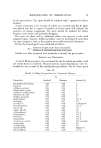
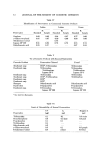
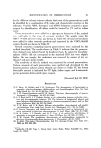
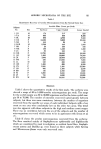
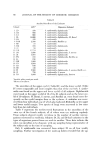
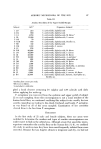
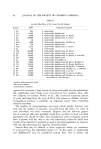
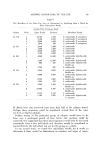
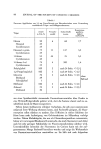
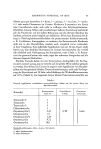
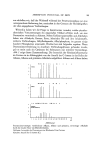
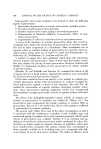
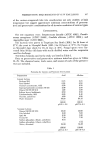
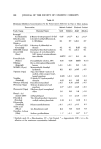
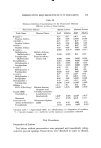
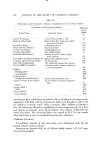
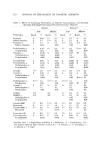
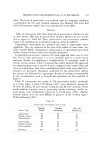
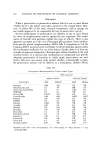
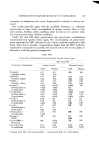
PRESERVATIVE REQUIREMENTS OF O/W EMULSIONS 113 tions. The level of preservative was reduced until the minimum inhibitory concentration for the most resistant organism was attained. The level that killed all organisms •vithin 7 days was considered to be the MIC. RESULTS Table II summarizes M[C data obtained on prescrvatives effective in one or more lotions. MIC data for preservative mixtures effective in one or more lotions appear in Table III. Those preservatives and preservative mixtures found to be unsatisfactory in all lotions tested are listed in Table IV. Organoleptic observations are included and noted as superscripts where applicable. •Ihey are explained at the base o[ the tables. In some cases (no- tably Vancide 89RE combinations), deterioration of aged lotions prevented further testing of lotions which were initially satisfactory. In preparing preservative mixtures, the basic approach taken was to com- bine t vo or more preservatives so as to eliminate gaps in m'•crobko_ogical spectrum, thereby accomplishing a complementary or synergistic mode of activity for the mixture. Table V presents data which illustrate this approach by comparing preservative activity of each compound when tested alone and when in combination. Only those combinations which show some kind of in- teraction are presented. Organisms unaffected by the preservative and/or the mixture are indicated by superscripts. Results of mixtures recommended by the manufacturers, such as Germall plus parabens, are also reported in Table V. Table VI summarizes the results of 174 preservation studies conducted on 4 lotion types. A total of 57 lotions (33%) were adequately preserved. Of these 57 lotions, 33 were anionic emulsions and 24 were nonionic. These results indicate a greater ease in preserving anionie emulsions. Acidic an- ionic lotions were satisfactorily preserved in 18/44 eases (41%) alkaline nonionic lotions were the most difficult to preserve of the 4 lotion types- 10/44 satisfactory (23%). Table VI Preservation According to Lotion Type Number Lotion Type Tested Acid anionic 44 Alkaline anionic 42 Total anionics 86 Acid nonionic 45 Alkaline nonionic 43 Total nonionics 88 Number Per cent Satisfactory Satisfactory __ 18 41 15 36 33 38 14 31 10 23 24 27 All lotions 174 57 33

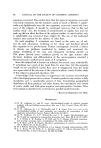
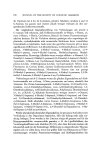
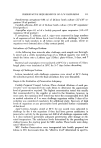
114 JOURNAL OF THE SOCIETY OF COSMETIC CHEMISTS DISCUSSION When a preservative or preservative mixture failed in one or more lotions (Tables II-IV), the failure most often occurred in the unaged lotion. How- ever, in about 30% of the tests, elevated temperature and/or storage for one month appeared to be responsible for loss of preservative activity. Several combinations of preservatives are effective in one or more lotions by virtue of complementary activity against the test organisms. The combi- nation of Germall with parabens typifies this type of activity. There is also apparent synergism as in the case of Bronopol plus parabens. Some combina- tions provide partial complementation. EDTA kills P. aeruginosa in 3 of the 4 Irgasan-EDTA mixtures tested, but failure to kill all challenge species makes this combination ineffective for any of the lotions. Finally, there is at least one example of apparent antagonism (Bronopol plus sodium Omadine in the acid nonionic lotion). It is obvious that combinations of compounds may provide adequate preservation of formulas in which single preservatives are inef- fective. However, one cannot easily predict whether a theoretically accepta- ble preservative mixture will be effective in a formulation additive effects, Table VII Preservatives Recommended for Various Lotion Types MIC Level (%) Anionic Lotion a Nonionic Lotion a Preservative Acid Alkaline Acid Alkaline Bronopol 0.05 NR 0.1 NR Dehydroacetic acid 0.1 NT NR NT Dioxin (Giv-Gard DXN) 0.1 0.1 0.15 0.2 DMDMH 0.1 0.1 NR 0.1 Dowicil 200 0.075 D 0.1 l) 0.1 0.1 Formaldehyde 0.05 0.05 0.075 0.075 Hibitane NR NR 0.1 NR MDMH 0.2 0.2 NR NR Nipastat 0.225 NR NR NR Noxyfiex 0.25 0.2 0.5 0.2 Ott•asept NR 0.38 NR NR Phenonip 0.5* NR NR NR Phenoxetol 1.0 1.0 1.0 NR Phenylethyl alcohol 1.0 1.0 NR NR Polycide A 0.15 0.1 0.15 0.1 Polynoxylin NR NR NR 0.3 S orbic acid 0.1 NT 0.15 NT Oreadinc, sodium 0.1' NR 0.1' 0.1' aSymbols used: NR = Not recommended NT = Not tested D: May discolor * = Ap- proximate MIC.
Purchased for the exclusive use of nofirst nolast (unknown)
From: SCC Media Library & Resource Center (library.scconline.org)