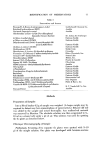
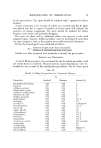
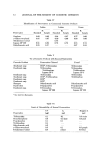
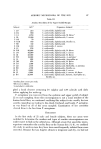
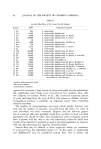
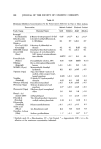
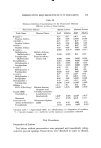
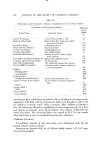
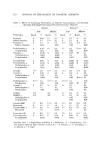
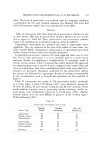
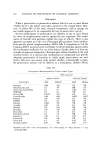
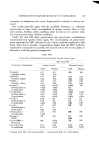
PRESERVATIVE REQUIREMENTS OF O/W EMULSIONS 115 synergism, or antagonism may occur. Experimental evaluation is always nec- essary. Our results generally agree with the available literature, i.e., adequate preservation is more easily accomplished in anionic systems than in non- ionic systems. Further, acidic conditions allow for the use of a greater num- ber of preservatives than alkaline conditions. Tables VII and VIII show preservatives and preservative combinations recommended for specific lotion types. The concentrations of preservative given represent the MIC obtained by the various methods employed in this study. Note, that in practice, concentrations higher than the MIC wottld be employed to compensate for possible loss of preservative due to heat, light, or interaction with other product components. Table VIII Preservative Combinations Recommended for Various Lotion Types Preservative Combination MIC Level (%) Anionic Lotion a Nonionic Lotion a Acid Alkaline Acid Alkaline Bronopol q- 0.1' 0.1' NR NR Omacline, sodium 0.05 0.05 DMDMH q- 0.1' 0.1' 0.1' 0.1' Oreadinc, sodium 0.05 0.05 0.05 0.05 MDMH q- 0.2* 0.2* 0.2* 0.2* Oreadinc, sodium 0.05 0.05 0.05 0.05 Bronopol q- 0.01•8 0.013 TM 0.005 NR Methylparaben q- 0.038 0.025 0.1 Propylparaben 0.009 0.006 0.025 Formaldehyde q- 0.013 0.018 0.038 0.038 Methylparaben q- 0.05 0.075 0.15 0.15 Propylparaben 0.013 0.018 0.038 0.038 Germall q- 0.38 0.5 0.5 0.5 Methylparaben q- O. 15 0.2 0.2 0.2 Propylparaben 0.038 0.05 0.05 0.05 Germall q- 0.5* 0.5* NR NR Methylparaben q- 0.1 0.1 Butylparaben 0.02 0.02 • lethy]paraben q- 0.15 NR NR NR Propylparaben 0.038 Hibitane q- NR NR 0.1 NR EDTA 0.05 Vancide 89RE q- NR 0.075 NR NR Phenoxetol 0.375 Preservative 68 q- 0.13 0.19 0.25 0.19 Formaldehyde 0.013 0.019 0.025 0.019 Symbols used: NR = Not recommended * --= Approximate MIC D = May discolor.

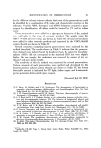
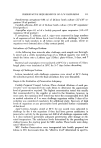
116 JOURNAL OF THE SOCIETY OF COSMETIC CHEMISTS The authors would be guilty of extreme negligence were they not to point out that the data given here cannot be extrapolated to all oil-in-water emul- sions. These data were obtained using model systems with relatively low levels of emulsifiers Any significant increase in concentration of emulsifier may require an increase in concentration of preservative or may even contra- indicate an otherwise satisfactory preservative or preservative system. Per- haps, to a lesser degree, particular types of anionic or nonionic emulsifiers will also determine whether or not a preservative is effective. Hence, the "effective" levels of preservatives given in this report should be considered only as a guide to be interpreted according to the particular formulation in question. Following a selection based on types and concentra- tions of emulsifiers, pH, and other pertinent characteristics of the formula, the suitability •of the preservative must be demonstrated by a satisfactory re- sponse in a challenge or preservation test (13-15) if the formulator is to be assured of a microbiologically acceptable product. Finally, the authors wish to emphasize that rather strict standards of ac- ceptance have prevailed in this study, viz., less than 7 days survival at the MIC and less than 3 days at higher concentrations. Although less sevcre re- quirements, e.g., a longer survival time or microbiostasis of one or more species, would result in a greater number of acceptable compounds and re- duced levels of preservatives in a formula, the strength of the protection aga-'nst microbial spoilage would be greatly reduced. ACKNOWLEDGlX•ENTS The authors gratefully acknowledge the suggestions of Dr. Arnold D. Marcus and the cooperation of Messrs. Ara Nersesian, Richard Alonso, Fred Hubner, and Taras Durbak in developing and formulating the lotions used in this investigation. (Received January 15, 1974) REFERENCES (1) I. R. Gucklhorn, Antimicrobia!s in cosmetics series, MIg. Chem. Aerosol News, 40-42 (1969-1971). /2) N. K. Patel, Interaction of some pharmaceuticals with macromolecules. III, Can. .1. Pharm. Sci., 2, 77-80 (1967). (3) N. K. Patel• and H. B. Kostenbauder, Interaction of preservatives with macro- molecules. I, ]. Amer. Pharm. Ass., 47, 289-93 (1958). (4) M. G. deNavarre, The interference of nonionic emulsifiers with preservatives with special references to cosmetics, ]. Soc. Cosynet. Chem., 8, 371-80 (1957). (5) D. L. Wedderburn, Preservation of toilet preparations containing nonionics, Ibid., 9. 215 (1958). (6) Martin Barr, and L. F. Tice, The preservation of aqueous preparations containing non•onic surfactants. II, .1. Amer. Pharm. Ass., 46, 445-51 (1957). (7) G. Schuster, and H. Modde, Examination of the efficiency of preservatives and anion- active emulsifiers, Amer. Perrum. Cosynet., 84, 37-46 (1969). (8) D. N. Entrekin, Relation of pH to preservative effectiveness. I, J. Pharm. Sci., 50, 743-6 (loC61).
Purchased for the exclusive use of nofirst nolast (unknown)
From: SCC Media Library & Resource Center (library.scconline.org)