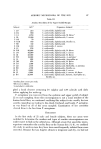
76 JOURNAL OF THE SOCIETY OF COSMETIC CHEMISTS Several reports in the literature demonstrate the use of thin-layer chroma- tography (tlc) for identification of preservatives. The esters of p-hydroxyben- zoic acid have been separated by tic on silica gel G plates (2). Bark and Graham reported the tlc of 69 halogenated phenols on alumina plates using eight eluent systems (3). Baker and Booth separated halogenated salicylani- lides on cellulose plates (4). More recently, tic separation of several bacterio- cides on silica gel GF254 was reported by Koenig (5) and by Braber et al. (6). Gunner determined methylenedioxy compounds by tic-direct densitometry on Adsorbosil©* plates (7). These reports provide the basis for the current investigation. EXPERIMENTAL Apparatus and Materials Apparatus used included a short wavelength UV light (Mineralight UVS 11'), tic developing tank lined with filter paper, and spray apparatus ( Chromafiex sprayerS). All preservatives were commercial grade and are listed in Table I. The solvent systems used were benzene-acetone (8:2) and chloroform-methanol (9:1). Tlc plates (20 x 20 cm), both precoated by Analtechõ and prepared in this laboratory • using silica gel GF254,** were used. Thickness in both cases was 250 bt. The F2• refers to fluorescence indicator added to silica gel. Indicator Reagents These included 4-aminoantipyrine-potassium ferricyanide (A), diazotized benzidine (B), and 4~methyl umbelliferone (C), each prepared as described by Stahl (8). Chromotropic acid reagent (D) was prepared by carefully adding 15 ml of concentrated sulfuric acid to a solution of I g of sodium chromotropate in 15 ml of water. After spraying, the tic plate was heated at 110-120øC for 10- 30 min to achieve color development. Acetylacetone reagent (E) was prepared as an aqueous solution by com- bining 0.2 ml of acetylacetone, 0.3 ml of glacial acetic acid, and 15.4 g of ammonium acetate in 100 ml of di_stilled water. After spraying, the tic plate was heated at 110øC for 10 rain to achieve color development. Iodine vapor (F) was prepared by adding several crystals of iodine to a large beaker (about 2 1.) and warming on a steam bath. The tic plate was held over vapors so that vapors contact silica gel surface. *Applied Science Laboratories Inc., State College, Pa. *Ultraviolet Products, Inc., San Gabriel, Calif. 91778. $Kontes Glass Co., Vineland, N.J.. No. K-422540 •SBrinkmann Instruments, Inc., Westbury, N.J. 11590. **E. Merck, Dormstadt, W. Germany.

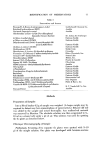
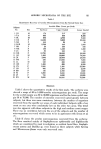
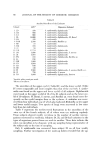
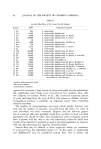
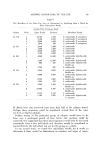
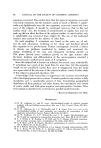
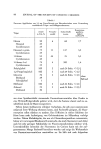
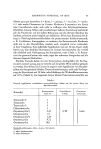
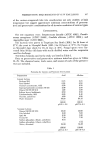
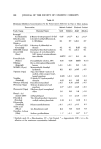
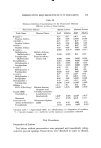
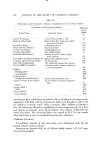
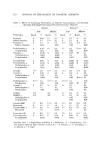
IDENTIFICATION OF PRESERVATIVES Table I Preservatives and Sources 77 Bronopol©--2-Bromo-2-nitropropane- 1,3-diol Butylated hydroxytoluene (BHT) Carvacrol-Isopropyl-o-cresol Chlorhexidine acetate-l,6-Di (N-/•-chlorophenyl diguanido) hexane diacetate 4-Chloro-3-methyl phenol p-Chloro-m-xylenol (PCMX) Dehydroacetic acid (DAA)-3-acetyl-6-methyl-2H- 9yran-2,4(3H)-dione Dichloro-m-xylenol (DCMX) Dichlorophene (DCP) Dimethoxane-6-Acetoxy-2,4-dimethyl-rn-•lioxane Fluorsalan-3,5-Dibromo-3'-trifiuoromethylsalicylanilide Germall 115©-Imidazolidinylurea Hexachlorophene (HCP) Irgasan CF3©-Cloflucarban Irgasan DP 300•-Trichlosan MDM hydant oin- Methyloldimethylhyclant oin Octyl gallate o-Phenylphenol Propylparaben-Propyl-p-hydroxybenzoate Resorcinol Salicylanilicle Tetrabromo-o-cresol-Deoclorant K© Tribromsalan (TBS)-3,4',5-Tribromosalicylanilide Trichlocarban (TCC)-3,4,4'-Trichlorocarbanilide Vantide 89 RE©-N-Trichloromethylthio-4-cyclohexene- 1,2-clicarboximide (Captan) Zinc pyrithione Goldschmidt Chemical Co. Analabs Analabs Dr. Sylvan H. Newberger Eastman Kodak Eastman Kodak Eastman Kodak Eastman Kodak Sindar Corp. Givaudan Pfister Chemicals, Inc. Sutton Labs l•itene, Inc. Procter & Gamble Ciba-Geigy Analabs Eastman Kodak Eastman Kodak Eastman Kodak Eastman Kodak Eastman Kodak Biocosmetics Ltd. Fine Organics Pfaltz & Bauer, Inc. R. T. Vanderbilt Co., Inc. Analabs Methods Preparation o• Samples Into a 50-ml beaker 0.2 g of sample was weighed. (A larger sample may be required to detect very low concentrations of preservatives.) Ethanol (25 ml) was added to the sample and mixed thoroughly. Any undissolved material was removed by filtration. The alcoholic solution was then evaporated to 5- 10 ml on a steam bath under a iet of air. This solution was used for spotting the tic plates as described below. Thin-layer Chromatography o• Sample Preliminary Screening-Two separate tlc plates were spotted with 5-10 •1 of the sample solution. One plate. was developed with benzene-acetone
Purchased for the exclusive use of nofirst nolast (unknown)
From: SCC Media Library & Resource Center (library.scconline.org)