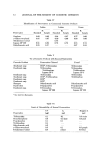
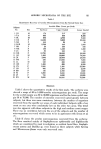
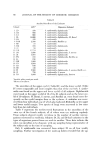
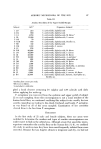
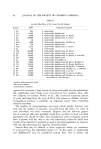
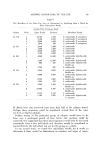
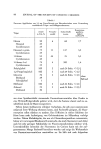
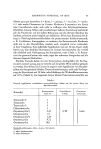
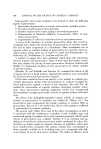
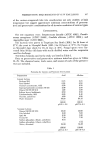
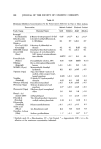
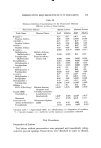
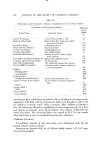
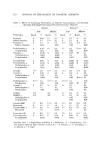
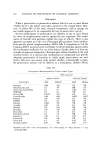
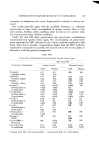
8J JOURNAL OF THE SOCIETY OF COSMETIC CHEMISTS Table IV Identification of Preservatives in Commercial Cosmetic Products ............................. Lotion Lotion Cream Rr Br Rr Preservative Standard Sample Standard Sample Standard Sample Pffrabdn• 0.60 0.62----- 0.64 0.67 0.57 0.60 p-Chloro-m-xylenol 0.66 0.67 0.69 0.69 0.60 0.60 Tetrabromo-o-cresol ...... 0.78 ...... Irgasan DP 300 0.81 0.82 0.78 0.78 (•.• 0.74 Dehydroacetic acid 0.15 0.17 ...... 0.27 0.24 Table V Tlc of Cosmetic Products with Known Preservatives Cosmetic Product Preservative Claimed Found Deodorant soap Deodorant soap Deodorant soap Deodorant soap Deodorant soap Deodorant soap Shampoo Hand lotion Deodorant soap HCP ø, Tribromsalan Tribromsalan, Trichlocarban, Irgasan CF-3 Tribromsalan HCP •, Trichlocarban HCP ø HCP • Dehydroacetic acid Propylparaben Tribromsalan, Irgasan DP 300 Tribromsalan Tribromsalan, Trichlocarban, Irgasan CF-3 Tribromsalan Trichlocarban Dehydroacetic acid Propylparaben Tribromsalan, Irgasan DP 300 See text for discussion. Table VI Limit of Detectability of Several Preservatives Preservative UV L (t•g) (t•g) Reagent A Tribromsalan 0.1 0.1 Hexachlorophene 0.5 0.1 faint Propylparaben 0.1 0.1 Trichlocarban 0.1 ... Dehydroacetic acid 0.5 ... p-Chloro-m-xylenol 0.5 0.1 Tetrabromo-o-eresol 0.5 2 faint 015 violet - 0.5 pink ß ß , 0.5 blue

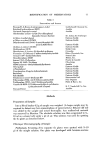
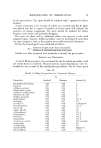
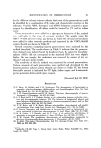
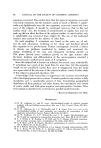
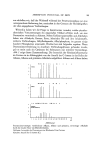
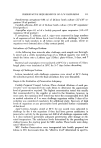
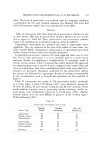
IDENTIFICATION OF PRESERVATIVES 81 for the different solvent systems indicate that most of the preservatives could be identified by a combination of R l value and characteristic reaction to the indicator. Vancide •9RE, Bronopol, and MDM hydantoin required a spray reagent for identification all others could be located by UV and/or iodine vaDor. Those nroservat v• woro •qdded To a shampoo to de•erm ne {f the method ,•-a •nll,-ab•e *• •1•:• f"r)• of eo,metlo n,-oduot. The results nsin• the CHC1-x•oOTl •ol"ent •,,•tem are qhqwn in Table lIl. Several p•eqervatives were added to other cosmetic products and examined by the CHCla-MeOH system. Results are shown in Table IV. Several cosmetics containing known preservatives were analyzed by the method described. The results shown in Table V indicate that the preserva- fives claimed were indeed found. In deodorant bars, Rl values for hexachlor- ophene (HCP) did not correspond to the standard HCP but were slightly higher. On one sample, the surfactant was removed by means of ion ex- chan,•e* and gave better results. The sensitivity of this tlc method was examined for several preservatives. Various amounts of each preservative were spotted and developed by the benzene-acetone solvent system. Results are shown in Table VI the lowest detectable amount is indicated for UV light, iodine vapor, and 4-aminoanti- pyrine-potassium ferricyanide spray reagent. (Received July 16, 1974) REFERENCES (1) P. Derry, M. Holden, and S. H. Newburger. The determination of bacteriostats in cosmetics: p-hydroxybenzoates, dichlorol•hene, and hexachlorophene, Proc. Sci. Sect. Toilet Goods Ass., No. 36, 25-28 (Dec. 1961). (2) J. W. Copius-Peereboom and H. W. Beekes. Thin-layer chromatography of preserv- ing agents, J. Chromatogr., 14, 417-23 (1964). (3) L. S. Bark and R. J. T. Graham, Studies in the relationship between molecular struc- ture and chromatographic behavior. VII. The behavior of halogenareal phenols and some halogeno-alkyl-substituted phenols on alumina-impregnated papers, and on thin layers of alumina, Ibid., 24, 347-56 (1966). (4) F. W. Baker, and G. E. Booth, Halogen salicvlani]ides: photochemical and analyti- cal techniques, Proc. Joint Con[. Cosmet. Sci., Washington, D.C., 54-74 (1968). (5) H. Koenig, Separation and identification of bacterioc des based on halo•ena•ed aro- matic comr)ounds by thin-layer chromatogra•)hv, Z. Anl. Chem., 246, 747-51 (1969). (6) M. B. Graber, I. I. Domsky, and M. E. G•nn, A tlc method for identification of germicides in personal care products, J. Amer. Oil Chem. Soc., 46. 529-31 (1969). (7) •S. W. Gunner, The quantitative determination of methylenedioxy compuonds by thin-layer chromatography-direct densitometrv, ]. Chromato•r.. 40, 85-t1969•. (8) E. Stahl, Thin-Lager Chromatography, 2nd Ed., Springer-Verlag, New York, N.Y., 1969, pp. 8•6, 8•8, 886. *Amberlite CK-400 Type 1, Strong Basic Anton Resin, Fisher Scientific Co., Pitts- burgh, Pa. 15219.
Purchased for the exclusive use of nofirst nolast (unknown)
From: SCC Media Library & Resource Center (library.scconline.org)