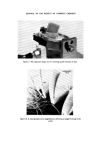
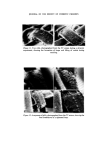
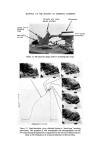
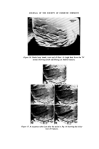
J. Soc. Cosmet. Chem. 26, 289-297 (1975) ¸ 1975 Society of Cosmetic Chemists of Great Britain Hair breakage: microscope as a the scanning electron diagnostic tool A. C. BROWN and J. A. SWIFT* Presented on 28th August 1974 in London, at the 1FSCC Vlllth International Congress on 'Cosmetics--Quality and Safety' organized by the Society of Cosmetic Chemists of Great Brita#t Synopsis Physical techniques for studying the mechanical properties of HUMAN HAIR have been well established for many years and since the introduction of the SCANNING ELEC- TRON MICROSCOPE (SEM) 8 years ago, there has been some attempt to correlate, retrospectively, the structural appearance of deformed fibres with data obtained during mechanical straining experiments. A logical development is to combine these two techniques so that both physical and structural data could be collected simultaneously, thereby enabling a more detailed and accurate assessment of the breakdown of structural components to be made. The SEM, because of its great depth of focus, wide range of magnification and large area for specimen manipulation, has been adapted for conducting dynamic experiments in situ. In addi- tion, the manner in which the visual information was processed made direct recording of the results onto VIDEOTAPE possible. A number of simple mechanical specimen stages have been constructed for use in examining the structural deformation of hair fibres under various conditions of mechanical stress. The incorporation of d.c. micromotors into the SEM allowed accurate control of sample movement during experiments and miniature strain gauges were used so that continuous recordings of the changes in strain could be made. The nature of the structural breakdown in human hair during COMBING has been investi- gated, together with the changes taking place as a result of natural weathering. INTRODUCTION As the fashion for long hair has grown more popular in recent years so interest in hair weathering has increased. An opinion poll conducted * Unilever Research, Isleworth Laboratory, Unilever Ltd, 455 London Road, Isleworth, Middlesex. 289

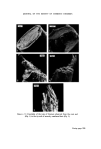
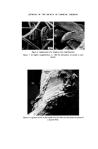
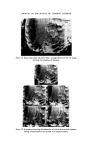
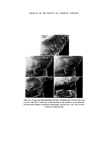
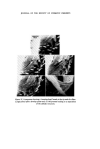
290 JOURNAL OF THE SOCIETY OF COSMETIC CHEMISTS recently (1) showed that 36•o of all women between the ages of 16 and 24 had long hair and of those interviewed, 71•o would have grown their hair longer had it not been for the problems involved. It is significant that two of the most widespread problems associated with long hair are the tendency for tangles to form during combing and the presence of split ends. Human head hair has a growth cycle• of between 3 and 6 years and reaches a final length before natural shedding, and providing it is not cut, of 50-80 cm. During this growth period the exposed fibres undergo pro- gressive change which is generally referred to as weathering. The predominant cause of this deleterious change is thought to be sunlight and this results in a variation in the chemical and physical properties from the root to the tip of the fibres (2-4). In addition, cosmetic treatment and handling during brush- ing and combing increase the effects of environmental exposure. It is well known that in extreme cases of over-treatment with certain cosmetic agents or over-exposure to sunlight, premature fracture of the hair may occur resulting in a condition referred to by dermatologists as trichorrhexis nodosa (5-7). This is commonly known as 'paint brush hair' because of the longi- tudinal fibrillation or separation of the hair cortex which gives each hair the appearance of the bristles of a paint brush. It is interesting to note that these structural characteristics are similar to those encountered in the split tips of moderately weathered hairs. The present paper is concerned with a study of the fracture of human hair and an investigation of those processes which lead to longitudinal splitting of weathered hair. Because of its moderately high resolution, its wide range of magnifications and high depth of focus, the scanning electron microscope (SEM) has been used exclusively in this work. Novel techniques have been devised for stressing fibres in the microscope in such a way that the fracture process can be followed continuously at high magnification and the results recorded on video tape. Although the video tape results will be shown at the actual Symposium it is only possible in the present published paper to show a representative selection of static photographs. AN EXAMINATION OF HAIRS FRACTURED FROM ROOT TO TIP The hair of six young women was chosen for use in our experiments. The hair was in excess of 50 cm length and varied in the extent of weathering as assessed by loss of surface cuticle and the presence of split ends (8). Hair
Purchased for the exclusive use of nofirst nolast (unknown)
From: SCC Media Library & Resource Center (library.scconline.org)