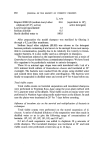
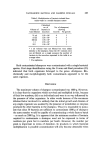
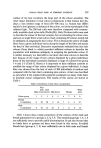
WATER-BORNE BACTERIA AND SHAMPOO SPOILAGE 285 Table I. Multiplication of bacteria isolated from mains-water in a model shampoo system Calculated no. of No. of shampoost Volume of bacteria in showing water filtered inoculum Growth No growth '1 ml 1.55 x 10: 0 5 10 ml 1.55 x 10 a 0 5 100 ml 1.55 x 10 • 0 5 1 1 1.55 x l0 s 0 5 101 1.34 x 10⁶ 2 3 * 1 ml volumes were not filtered but were added directly to the shampoo. Since the 10 1 volumes were not all filtered on a single occasion the number of bacteria in the inoculum expressed in the table is an average value. t Five replicates. Both contaminated shampoos were contaminated with a single bacterial species. First stage identification using the Cowan and Steel procedure (25) indicated that both organisms belonged to the genus Alcaligenes. Bio- chemically and morphologically both contaminants appeared to be the same organism. DISCUSSION The maximum volume of shampoo contaminated was 1000 g. However, it is clear that the organisms which survived and multiplied in this, because of their low numbers, did so as individuals and were in no way influenced by the presence of other organisms. In other words because of the enormous dilution factor involved it is unlikely that the initial growth and division of any single organism was assisted by the presence of metabolites or enzymes produced by other bacteria in the shampoo. Thus it is reasonable to postu- late that since 50 bacteria are sufficient to contaminate 1000 g of shampoo the same number would be capable of contaminating a whole factory batch --as much as 2000 kg. It is apparent that the minimum number of bacteria required to contaminate a shampoo need not be expressed in terms of numbers per gram but in numbers per batch. However, the number per gram is important in terms of detection. In products in which bacterial multiplication is possible contamination will only become detectable when

286 JOURNAL OF THE SOCIETY OF COSMETIC CHEMISTS the concentration of contaminants has reached a level to which the chosen method of analysis is sensitive. In the case of total viable counts using the pour plate technique this means that a product containing less than, say, 30 organisms g-X would be unlikely to be found to be contaminated. This has important implications when selecting the time after manufacture at which a product should be sampled for contaminants. For example, the experi- ments reported here show that in the model shampoo system E. cloacae had a generation time (the time required for the bacterial population to double in size) of between 70 and 92 min. Now in a manufacturing unit where batches of 2000 kg of shampoo are made there would need to be a total of 6.0 x 10⁷ bacteria present for contamination to be detectable in the bulk, i.e. 30 bacteria per gram. Contamination would not be detectable until at least 30 h after manufacture if the original inoculum was 50 bacteria and the generation time 90 min. Even with an initial inoculum of 5 x 10⁵ bacteria, more than 10 h would elapse before detectable numbers of organisms would be present. Thus except in those cases where gross contamination of a product has occurred microbiological examination of either the bulk product or the product in the final container immediately after manufacture is unlikely to reveal the presence of bacteria. Thus products should be examined not only on the day of manufacture but also some days later 7 days would be a convenient period. In view of our observation that in a model shampoo with a low inoculum bacteria become detectable within 24 h, an incubation period of 7 days might seem excessively long. However, in some products the phase of rapid multiplication, the logarithmic phase, may be preceded by a lag phase in which no multiplication occurs and also the generation time may, under less favourable conditions, be considerably longer than 90 min. Since it may take a further 7 days for the results of microbiological examination to be known it may be thought necessary in the future to pre- vent distribution of finished products until 2 weeks after manufacture. How- ever, this will depend upon experience, the ease or otherwise of recalling products once they have left the factory and the risk the manufacturer is prepared to take. The ability of small numbers of bacteria to contaminate large volumes of shampoo helps to explain the occasional observation that contamination may be found in some packs from a batch but not others. If the original inoculum is very small or unevenly dispersed then only a certain proportion of all packs will contain bacteria capable of multiplying and giving rise to detectable numbers of contaminants. The length of the logarithmic phase, i.e. the time required for contaminants in a product to achieve their maximum
Purchased for the exclusive use of nofirst nolast (unknown)
From: SCC Media Library & Resource Center (library.scconline.org)