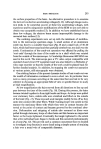
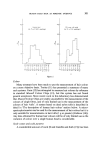
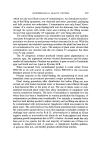
300 JOURNAL OF THE SOCIETY OF COSMETIC CHEMISTS Hair is an appendage of the skin corresponding anatomically with the epidermis. It consists of a shaft, a root and bulbous extremity embedded in the hair follicle. Hair and wool, in their natural unstretched state, belong to a group of proteins called the a-keratins. Keratins occur as the principal constituents of the horny layer of the epidermis and of related appendages such as horns, hooves, scales, hair and feathers, that are derived from the skin. Keratin fibres are very complex both at the histological level and at the chemical level owing to the multiplicity of protein molecules which are effectively cross-linked to give an integral structure. A microscopic examina- tion of a hair cross-section reveals the outer cuticular fibrous portion, an inner darker portion, the cortex, and in the centre of the cortex a central canal called the medulla. The outer cuticular layer takes the form of fine scales which cover the surface of the hair and act as a protective layer. The colour of the hair fibre is due to pigment granules (melanin), found princi- pally in the cortex, and to the presence of air bubbles in the medulla. The basic techniques that have found application are as follows: Morphology of hair Diameter In an early paper Wynkoop (4) concludes that hair shaft diameter bears little or no relationship to the age of an individual. Trotter (5) and Trotter and Dawson (6) came to similar conclusions in a later study. A more de- tailed examination (Kind (7)) of human head hair diameters revealed that there is little correlation between hair shaft diameters and a given individual. The variation of head hair diameters over an individual head was very similar to the variation of hair diameters over the population (Fig. 1). The diameter of hair is known to vary over the length of an individual fibre but recent work (Fouweather (8)) has shown that the variation of hair diameters along an individual fibre is not a useful parameter for hair characterization. Medullary index Owen (9) has demonstrated that the medullary index or fraction (the ratio of width of medulla to the width of the hair) is of little or no use in the characterization of human head hairs. However, the medullary index is known to be a means of discriminating between some animal species (e.g. cat from dog) (Kind (10)).

HUMAN HEAD HAIR AS FORENSIC EVIDENCE 301 3O •'ø l 20- Grand total (as % of 500 readings) 4O 3O 0 ¸000 000 0000 0 00000000 0000 0 --• C,dl"q d' •0 LD r'• OD Oh 0 -- C,,.I 2o 28-year-old male (as % of 50 readings) ,o[ F -I O00000000 O0 I I I I I I I I I I I O00000000 O0 I z lz Figure 1. Colour Many attempts have been made to put the measurement of hair colour on a more objective basis. Trotter (11) has presented a summary of many such systems. Garn (12) has attempted to measure hair colours by reference to standard Munsell Colour Chips (13), but this system has not found general acceptance. More recent work in this laboratory has demonstrated that Munsell Colour Chips are totally unsuitable for the measurement of the colours of single fibres, and of only limited use in the measurement of the colours of hair 'tufts'. A system based on dyed nylon tufts is described in detail in 'The description of human hair colour' section below. A micro- spectrophotometer can be used for the measurement of hair colour but it is only suitable for measurements on hair tufts (1 g or greater) (Unilever (14)). Any data obtained for human hair colours will be of only limited use as the variation of colour over a single human head is considerable. Scale counts and scale patterns A considerable amount of work (9 and Gamble and Kirk (15)) has been
Purchased for the exclusive use of nofirst nolast (unknown)
From: SCC Media Library & Resource Center (library.scconline.org)