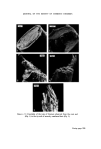
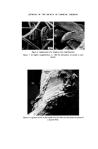
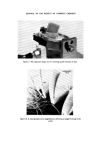
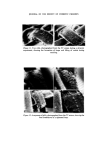
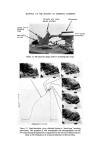
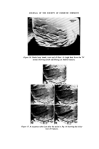
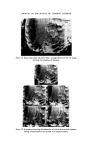
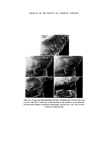
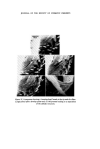
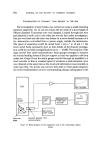
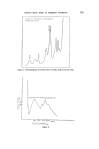
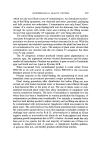
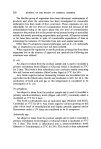
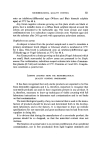
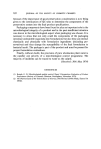
HAIR BREAKAGE 295 structure. This is illustrated by the example in Fig. 15 where the chart trace shows irregularities near the yield point which relate directly to structural failures in the cuticle and cortex of the fibre as the fracture developed. In examining loop breaks, hair was obtained from the same women as for our earlier fracture experiments. Two types of loop breakings were studied. The first type, which we will refer to as the 'static loop', was pro- duced when both ends of the hair were pulled so that no slipping of the hair on the wire occurred. The second type was a 'running loop' where one end of the hair was fixed to the specimen stage and the other end held firmly in the extending stage and pulled. In this case the hair moves slowly over the wire as the hair elongates under load. Several interesting effects were observed. For static loops, the type of fracturing process and the final structure of the fibre end at break, for hairs from the various women and for various positions along each hair, were in good accord with the results described in Section 1 of this paper (i.e. Figs 1-5). At the root end, stretching of the cuticle about the loop was observed, usually accompanied at moderate loads by cuticle cell lifting (Fig. 16). Fracture usually began in this region as a split through the cell layers of the cuticle along a circumferential segment (Fig. 17). When this split had propagated about halfway round the fibre with the exposure of the underlying cortical surface, the rest of the fracture was catastrophic, the cortex fracturing transversely or in low transverse steps. At the tips of weathered hairs where little or no cuticle remained, the fracture process was initiated by the separation of surface fibrils from the cortex (Fig. 18). As the load increased further, separation of fibrillar elements from the cortex occurred (Fig. 19). At this stage some gross longitudinal splitting of the fibre occurred with more and more cortical fibrils rupturing until the two parts of the fibre separated abruptly. Running loops always resulted in longitudinal splitting of the hair irrespective of whether root or tip segments were examined. At the root end the fracture began transversely through the cuticle but split longitudinally once this crack had reached the middle of the fibre (Fig. 20). At the tip the fracture started in much the same way as for the static loop but longitudinal splitting was accentuated (Fig. 21).

296 JOURNAL OF THE SOCIETY OF COSMETIC CHEMISTS CONCLUSIONS It is clear from the experiments that we have performed that tangling of hair during combing seriously damages the hair surface. In particular it appears that the types of fracture that result from this treatment yield longitudinal splitting. This splitting process occurs far more readily at the tips of hairs than at their roots and we must therefore conclude that the weathering the hair has received has facilitated the ease of splitting. On the other hand it is possible that combing and mechanical atrophy of the hair are essential requirements for splitting and that in the absence of mechanical perturbation splitting will not normally occur. In addition to reaching these conclusions we believe that we have demonstrated the value of the scanning electron microscope as a-diagnostic tool. ACKNOWLEDGMENT We are indebted to Miss Paulene McCarthy for her technical skills in the use of the scanning electron microscope. (Received: 29th April 1974) REFERENCES (1) Split ends--protein diet for a hair problem? Beauty Business Suppl. to Chem. and Drug. 4 15th April 1972. (2) Beyak, R., Kess, G. S. and Meyer C. F. Elasticity and tensile properties of human hair. Part 2. Light radiation effects. J. Soc. Cosmet. Chem. 22 667 (1971). (3) Robbins, C. R. Weathering in human hair. Text. Res. J. 37 337 (1967). (4) Robbins, C. R. and Kelly, C. H. Amino acid composition of human hair. Text. Res. J. 40 891 (1970). (5) Papa, C. M., Mills, O. H. and Hanshaw, W. Seasonal trichorrhexis nodosa: role of cumu- lative damage in frayed hair. AMA Arch. Dermatol. 106 888 (1972). (6) Chernovsky, M. E. and Owens, D. W. Trichorrhexis nodosa: Clinical and investigation studies. Text. Res. J. 94 577 (1966). (7) OwE•qs, D. W. and Chernovsky, M. E. Trichorrhexis nodosa: In Vitro reproduction. Text. Res. J. 94 586 (1966). (8) Swift, J. A. and Brown, A. C. The critical determination of fine changes in the surface architecture of hair due to cosmetic treatment. J. Soc. Cosmet. Chem. 23 695 (1972). (9) Sikorski, J., Moss, J. S., Hepworth, A. and Buckley, T. Specimen preparation for dynamic experiments in the scanning electron microscope. Proc. 2nd Stereoscan Colloquium 25 (1969) (Engis Equipment Co.). (10) McKee, A. N. and Beattie, E. L. Preliminary studies of the fractography of fibres and polymeric materials in the scanning electron microscope. Text. Res. J. 40 1006 (1970).
Purchased for the exclusive use of nofirst nolast (unknown)
From: SCC Media Library & Resource Center (library.scconline.org)