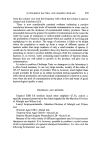
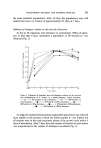
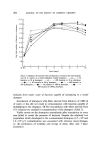
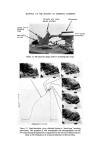
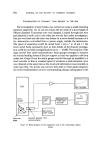
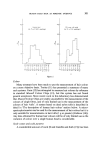
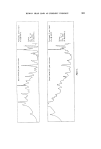
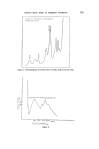
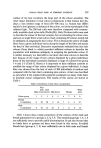
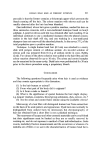
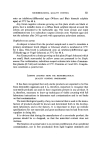
304 JOURNAL OF THE SOCIETY OF COSMETIC CHEMISTS The tensile and elastic properties of hair have been studied using sophis- ticated equipment in constant temperature and constant humidity environ- ment. However, the results indicate that these measurements are unlikely to provide a means of hair characterization. The equipment used is based upon similar equipment used to study the tensile and elastic properties of plastics and other elastomers. Fatty acids in hair sebum The free fatty acids in hair sebum were analysed by GLC after conversion to their methyl esters using diazomethane. The variation between individuals was little greater than the daily variation of an individual and was not pursued further. A similar result was obtained when the glycerides in hair sebum were hydrolysed and the fatty acids so produced methylated. A typical chromatogram is shown (Fig. 3). At least 50 fibres are required to produce a satisfactory analysis. Trace element analysis This is an extensive field and will not be discussed in this paper in any detail save to point out that it is one of the more promising techniques for hair characterization. However, problem areas still exist with regard to the interpretation of the results because of the correlation between elements, the variation of the elemental composition over the head, along the length of the hair fibre and also across the hair diameter. Low temperature luminescence of hair At 77øK a tryptophan-like fluorescence and phosphorescence emission can be observed (King (22)) using 10 x 1 cm lengths of hair (Fig. 4). By measuring the relative intensities of the phosphorescence and fluorescence emissions, it is possible to distinguish between numerous animal species, e.g. the species cat, cow and vole can be distinguished from one another. How- ever, there is a large coefficient of variation within individual species and cat and dog hairs are normally indistinguishable using this technique. Similar problems arise with human head hairs. The species discrimination achieved

HUMAN HEAD HAIR AS FORESNIC EVIDENCE 305 Column: 5', 15% DEGS on Chromosorb G Temperoture: 180øC Figure 3. Chromatogram of methyl esters of fatty acids from hair (50). .• 70 g 60 Fluorescence--."---.,-Ph osp h o resoence ---.,- i I I I 360 400 440 460"•.....Blonk Emission wavelength X Figure 4.
Purchased for the exclusive use of nofirst nolast (unknown)
From: SCC Media Library & Resource Center (library.scconline.org)