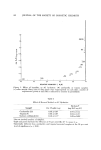
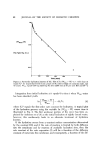
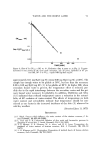
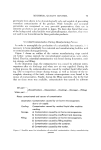
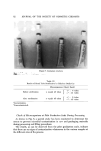
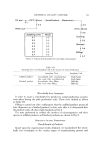
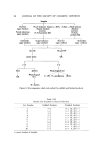
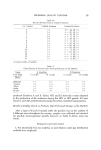
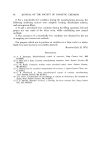
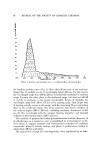
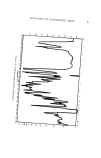
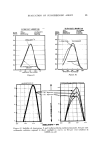
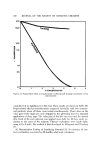
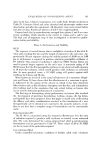
88 JOURNAL OF THE SOCIETY OF COSMETIC CHEMISTS &o $o 4o Figure 1. Sunburn and tanning curve: (-) erythemal flux (e) tanning flux ! the fmniliar sunburn curve (Fig. 1). More than 95 per cent of the total ery- thereal flux of sunlight occurs at xvavelengths below 320 nm. For this reason, the wavelength range from 290 to 320 nm is termed the erythemal or sunburn range. Tanning also takes place in the erythemal range, but does not fall off as rapldly as erythema in the longer wavelengths. Kreps (3) identifies the wavelength range from 320 to 375 nm as the tanning range. Only 24 per cent of tanning actually occurs in this range, with the remaining 76 per cent taking place in the erythemal region. The ideal sunscreen will absorb radiation in the sunburn region (290 to 320 nm), exhibiting maximum absorbance at 308 mn (4) (the wavelength with the greatest burning intensity), and transmit radiation in the tanning region (320 to 375 nm). The synthesis of propoxylated ethyl p-aminobenzoate and the discovery of its effectivcness as a sunscreen were accomplished in several phases as fol- lows: phase 1, organic synthesis and instrumental evaluation of candidate compounds phase 2, toxicity testing and phase 3, performance testing to substantiate efficacy and safety. The animal tests (except for comedogenicity) were conducted by an inde-

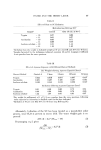
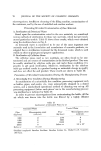
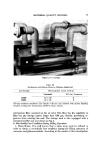
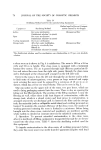
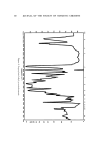
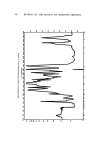
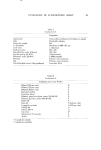
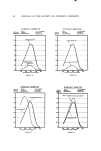
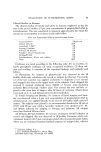
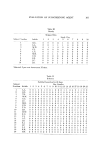
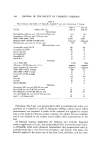
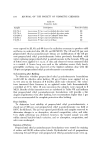
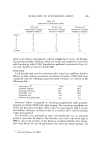
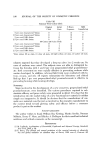
EVALUATION OF SUNSCREENING AGENT 89 pendent laboratory.* All the clinical and performance studies on humans and the comedogenicity study on rabbits were conducted by another laboratory.? EXPERIMENTAL Phase 1-Initial Screening The first phase of the research program concerned the synthesis of com- pounds, which were expected to absorb in the optimum uv region. Pro- poxylated ethyl p-aminobenzoate was selected for further development be- cause it absorbs in the correct uv region and exhibits desirable physical prop- erties. Infrared (ir) spectra, nuclear magnetic resonance (NMR) spectra, and gas chromatographic analysis (GCA) substantiate that propoxylated ethyl p-aminobenzoate is a mixture of 2 moles of N, N-dihydroxypropyl and 1 mole of N-monohydroxypropyl ethyl p-aminobenzoate. NMR spectra show that the hydroxypropyl moiety in the mono- and di-compounds contains both primary and secondary hydroxyls. To further substantiate the actual composition of propoxylated ethyl p-aminobenzoate, pure mono and di hydroxypropyl sub- stituted ethyl p-anfinobenz.oates were synthesized, analyzed, and reblended in various mole ratios. Ir spectra, NMR spectra, and GCA .of a 2 di to 1 mono blend matched propoxylated ethyl p-aminobenzoate exactly. The ir spectra of propoxylated ethyl p-aminobenzoate, N, N-dihydroxypropyl, and N-mono- hydroxypropyl ethyl p-aminobenzoate are shown in Figs. 2, 3, 4, respectively. Table I contains the important physical properties, and Table II contains solubility data on propoxylated ethyl p-aminobenzoate. It should be understood that it is not essential for a compound to exhibit maximum absorbance at 308 nm, but only that the absorption peak be suffl- ciently broad to encompass the sunburn range of 290. to 320 nm and narrow enough to transmit the tanning range. Figs. 5, 6, 7, 8, 9, and 10 compare pro- poxylated ethyl p-aminobenzoate absorption with other sunscreens. Propoxy- lated ethyl p-aminobenzoate exhibits maximum absorbance at 308 to 311 nm, xvhich is the region of the greatest burning intensity, and compares very favor- ably with the most active sunscreens in use today. It will be noted in Fig. 7 that PABA, which is generally recognized as a very effective screen, has a somewhat less favorable absorption at 310 nm, although it is very active at 290, where comparatively little burning and .tanning take place. The compari- son with 2-ethoxyethyl-p-methoxycinnamate (Fig. 10) does not tell the whole story until one exposes both compounds to direct sunlight for various periods of time. Fig. 11 shows the dramatic effect of solar energy on the cinnamate with the obvious resulting formation of new compounds. Propoxylated ethyl *Food and Drug Research Laboratories, Inc., Conshohocken, Penn. '• Ivy Research Laboratories, Inc., Philadelphia, Penn.
Purchased for the exclusive use of nofirst nolast (unknown)
From: SCC Media Library & Resource Center (library.scconline.org)