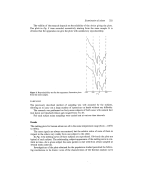
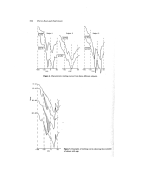
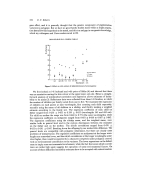
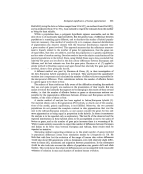
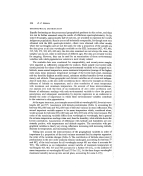
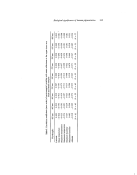
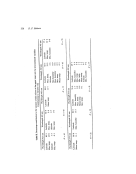
Biological significance of hutnan pigmentation 337 The predominance of latitude and the subordinate roles of the other variables is clearly shown by the first order partial correlation coefficients at the four wavelengths for which there are most samples. The correlation with latitude diminishes very slightly, if at all, after exclusion of the effects of maximum temperature or maximum humidity, diminishes rather more but still remains appreciable after the exclusion of mean tempera- ture. Clearly the latitudinal correlation owes little to these three variables. Excluding the effects of latitude, the correlations with mean temperature diminish very markedly, those : with maximum temperature or maximum humidity rather less. :• The regression equations of reflectance on the relevant environmental variables at each wavelength (both sexes combined) show that these account for a remarkably high •:• proportion of the total variance. Only for the two longest wavelengths does this drop below 97•o, though exact comparison is precluded by the different number of samples available at each wavelength. There is no doubt at all about the dominating influence of the latitudinal associations, nor of the appreciable independent contribution of maximum or mean temperature at ß '. wavelengths 425 to 475 nm. Humidity makes a negligible contribution to the variance at •: wavelengths below 595 nm, the effect being restricted to maximum humidity at the three .•:, longest wavelengths. The remaining environmental variables make negligible contribu- tions. Particularly interesting is the contrast between the shorter and longer wavelengths in the importance of temperature and humidity. These results indicate a remarkably close relationship of mean pigmentation with •i!:.: ' environmental variables, and in particular a dominating association with latitude. It is reasonable to argue therefore, that some factor associated with latitude has a strong •.• biological influence. Of the environmental variables associated with latitude, the amount :,.• of ultraviolet radiation received at the earth's surface varies inversely with latitude, while temperature is also strongly associated the effect of both at a given locality is, of course, modified by other variables such as cloudiness or altitude. Temperature is already taken into account in the present analysis, the latitude association of reflectance values is independent of it, so it seems most likely that ultraviolet radiation is the factor respon- sible for the latitudinal association of pigmentation. BIOLOGICAL SIGNIFICANCE Protection against ultraviolet radiation Darwin (12) suggested selective advantage of the Negro's black skin through the pro- tection it afforded against the harmful rays of the sun. The ultraviolet parts of the spectrum in particular, while at minimal exposures they have some beneficial effects, at greater doses promote injury in the form of sunburn and carcinogenesis. The carcino- genic wavelengths lie between 2537 and 3341A, while erythema is induced increasingly rapidly at wavelengths of less than 3200, reaching a maximum at 2800A. However, the relationship of pigmentation to solar radiation is not simple. Much of the radiation reaching the surface of the body does not reach the deeper melanin-containing layers. It is scattered, reflected, and absorbed in the outer horny layer of the skin (though in dark skins this layer too contains some melanin). However, some radiation reaches the deeper layers. When sheets of the stratum corneum from Africans and Europeans in Nigeria, shown to be similar in thickness to each other, were placed on a photographic plate and

338 D. F. Roberts exposed to ultraviolet irradiation, the European specimen showed pronounced pene- tration, whereas the degree of penetration in the darker African skin was much less (13). Comparing darker Europeans with fair, Mackie & McGovern (14) found that the fairer absorbed more radiant energy in the dermis, while the darker absorbed the greater part in the basal layer. Deeper penetration of ultraviolet radiation into the dermis in less melanized whites has also been demonstrated in several more recent studies (15, 16, 17). Moreover, the positive results of ultraviolet therapy in whites with rickets show that active rays do penetrate deeply enough to affect at least the superficial capillary circu- lation or to stimulate the nerve endings. Other experimental studies of differential pene- tration have shown that while transmission of invisible rays is reduced, wavelengths of 3650A penetrate white human skin 2.2 mm thick. Pronounced penetration into the corium and subdermal layers requires rays of over 4000A. A considerable proportion of ultraviolet rays at 2500A reaches the corium, but rays at 2700-2800A are practically all absorbed in the epidermis, and Negro skin absorbs particularly in the region from 2537 to 2800A. While the photoprotective role of melanin is a complex phenomenon, involving attenuation of radiation by scattering, effective absorption, and dissipation of the damaging rays as heat, the barrier of melanin in the basal epidermal layers is obviously effective. There are other lines of evidence besides the experimental. The fate of those dwellers in the tropics who have little or no melanin is instructive. Adult albinos in tropical areas develop a thickening (absent in young children) of the horny layers of the skin, a less efficient barrier than an abundance of melanin. Second, there is the evidence of cancer development. The rarity of cutaneous cancers in dark-skinned as compared with light- skinned subjects has often been noted. Those Europeans who are affected tend to be out- door workers whose face and dorsum of hand (exposed areas) are the most frequent sites, while in whites in the United States there is a latitudinal north-to-south gradient in the increase of these tumours. The selective effect of protection against these turnouts is likely to be small, for they are relatively infrequent and they occur mainly in the later years of life after reproduction has ceased. Another type of turnour is the melanoma, also rare but selectively more severe since it can occur in young adults this is a pigmented turnour which in Europeans arises from pigmented spots in the epidermis, and in Negroes from relatively unpigmented regions of the body. While cases are rare in Europe, there were 395 mela- noma cases in 20 000 white Australian patients, all of whom had lived a long time in Australia, and this high prevalence could well be related to excessive exposure to sun- light. Melanomas are said to be rarer in Negroes, yet malignant melanoma, next to squamous-cell cancer, is the commonest form of malignant disease seen in east and central Africa, and in Bengal it is much more common than in Europe. Most of the squamous-cell cancers are due to malign:ant changes in chronic tropical ulcers of the legs and the epitheliomata associated therewith, while the malignant melanomas occur mostly on the foot on its unprotected plantar surface. The extent to which radiation is involved, in that injury exposes the deeper tissues to it, is not clear. There is, however, considerable confirmatory evidence from animal experiments on the relation of pig- mentation to cancer. The protective function of melanin it seems is twofold. First in the short-term the melanized epidermis protects the deeper layers of the dermis against immediate damage, and secondly in the long-term it affords protection against cancer. Short-term damage can be prevented to some extent by secondary pigmentation in the form of sun tan, but the long-term effects seem affected more by primary pigmentation.
Purchased for the exclusive use of nofirst nolast (unknown)
From: SCC Media Library & Resource Center (library.scconline.org)