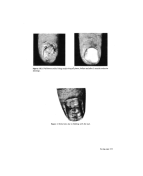
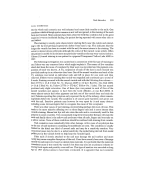
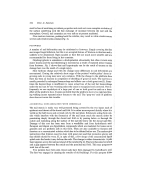
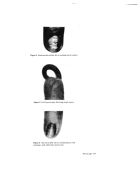
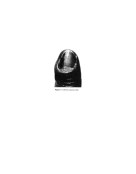
Nail disorders 355 hydrofluoric acid is sprayed on the surface and then washed off with water. The operators wear protective gloves. On this occasion the glove leaked and the patient became aware of a burning sensation and on removing the glove found that four fingers were wet. He rinsed the hand but the next day he noted that the nails on the four fingers had all become separated from their beds. The damage in this case was not to the matrix. The second patient worked in a laboratory and got splashed with hydrofluoric acid when it was poured down the sink. It is possible that the fluid was more concentrated than in the other patient. In this case both thumb nails suffered damage to the matrix so that there was temporary interference with nail growth. With both paraquat and hydrofluoric acid the degree of contamination was quite minor and they must act as very potent chemicals interfering with keratinization. EFFECTS OF WATER OR SOAP AND WATER •:•::•: The normal nail plate probably holds about 15•o of water vapour and takes up a good deal more when in direct contact with water. It becomes saturated at about 30•o and the nail plate is then opalescent and quite soft. The excess is quickly lost to the atmosphere on removal from water and the nail returns to its normal state. Under very dry conditions the percentage of water in the nail falls below 15•o and it then becomes brittle. A number of things can happen if nails are constantly exposed to water and there is frequent alternate wetting and drying. The first is loss of the cuticle and progress to chronic paronychia. The first organism to cause damaged encouraged by the moist conditions is often the staphylococcus. This probably helps to destroy the cuticle. Candida, usually Candida albicans, quickly takes over and is difficult to eradicate. Its presence leads to the bolstering of the dorsal nail fold (Fig. 7) which is a characteristic of this condition and it may also cause a small amount of pus formation. Gram negative organisms then appear, usually pseudomonas and proteus and these are responsible for the dark discoloration of the nail edge (Fig. 7). As a late development the whole nail organ may show shrinkage. The most important part of treatment is to keep the hands dry. Instead of chronic paronychia or in addition to it the nail may become loosened from the nail bed. Many of the cases of so-called idiopathic onycholysis are probably due to soap and water. The warm moist space below the nail encourages infection and various : '11:'• organisms, fungal and bacterial, may be cultured from the subungual debris. There is often some discomfort and occasionally the nail may become dark green or black due to over growth of Pseudomonas aerugionosa. This may cause great anxiety to the patient. A curious feature of a nail which is loose from its bed is the fact that it grows faster than its neighbours and has to be cut more often. The third apparent effect of water on the nails is splitting especially into layers. This is ,very common in housewives especially in winter. It is probably due to repeated wetting and drying causing softening and hardening and leading to loss of adhesion between the nail cells. There is some evidence that the nail is formed in layers and perhaps there is less adhesion between the layers than between individual cells. Acknowledgments I wish to thank my numerous colleagues who refer nail patients to me, the Photographic Departments of the Institute of Dermatology & Westminster Medical School for the illustrations.

356 Peter D. Samman References 1 2 3 nails. Journal of Allergy 28 84 (1957). Almeyda, J. Platform Nails (letter). Brit. Med. J. 1 176 (1973). Samman, P. D. and Johnston, E. N.M. Nail damage associated with handling of paraquat and diquat. Brit. Med. J. 1 818 (1968). Calnan, C. D. Reactions to artificial colouring materials. J. Soc. Cosmetic Chem. 18 215 (1967). Fisher, A. A., Franks, A. and Glick, H. Allergic sensitization of the skin and nails to acrylic plastic
Purchased for the exclusive use of nofirst nolast (unknown)
From: SCC Media Library & Resource Center (library.scconline.org)