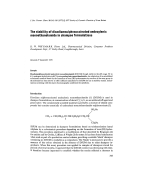
J. Soc. Cosmet. Chem. 28 343-349 (1977)¸ 1977 Society of Cosmetic Chemists of Great Britain The stability of disodiumsulphosuccinated undecylenic monoethanolamide in shampoo formulations D. W. WHYMARK Fisons Ltd., Pharmaceutical Division, Consumer Products Development Dept., 37 Derby Road, Loughborough, Leics Received 27 September 1976 Synopsis Disodiumsulphosuccinated undecylenlc monoethanolamide (DSUM) though stable in the pH range 5.0 to 6'5, undergoes hydrolysis at pH 7 forming undecylenic monoethanolamide. An adaptation of an established colorimetric method based on the formation of iron (III) hydroxamates by reaction of the ester group in the molecule has been shown to offer sufficient specificity for DSUM for use in stability studies. Simul- taneous screening with thin layer chromatography confirmed the specificity. Introduction Disodium sulphosuccinated undecylenic monoethanolamide (1) (DSUM) is used in shampoo formulations, at concentrations of about 1 •o w/w, as an antidandruff agent and preservative. The commercially available material is probably a mixture of related com- pounds but consists essentially of undecylenic monoethanolamide sulphosuccinate (I). SOaNa CH2 --- CH'(CH2)8'CO'NH'CaHaO•.C'CH•.'CH COaNa DSUM can be determined in shampoo formulations based on triethanolamine lauryl sulphate by a colorimetric procedure depending on the formation of iron (III) hydro- xamates. The procedure employed is a modification of that described by Bergmann (2) for amides and by Goddu, LeBlanc & Wright (3) for esters. It has been found satisfactory when used as part of a production control scheme, providing a suitable 'blank' shampoo containing no DSUM is available as a comparison. The 'blank' is necessary to provide a measure of the colour obtained in the absence of DSUM due to other shampoo in- gredients. When this assay procedure was applied to samples of shampoos stored for periods of several months, it appeared that the DSUM content was decreasing with time. It therefore became important to establish whether the results reflected a decrease in 343

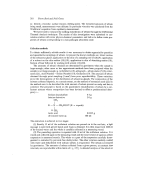
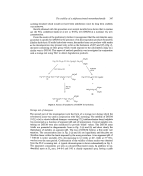
344 D. W. Whymark DSUM content or a change in some other ingredient of the formulation. Thus the reason for the loss of DSUM, the routes of breakdown of DSUM and the specificity of the analytical method all required investigation. The results of these investigations are reported in this paper. Routes of breakdown of DSUM--preliminary studies The most probable route of breakdown of DSUM was thought to be by hydrolysis. Both the ester and amide functions in the molecule are susceptible to hydrolyric attack. Fig. 1 depicts two routes of breakdown by hydrolysis. The products of alkaline hydrolysis are II and III. A white precipitate (a yellow oil if the reaction mixture is hot) is formed. The infrared spectrum of this material clearly showed the presence of an amide group (absorption bands centred at 3450, 1633 and 1550 cm -x) and the presence of hydroxyl and a double bond could also be inferred, though less certainly. Bands due to sulphonate (1250 cm -x) and ester groups (1740 cm -x) present in the original material were missing. This information is consistent with structure II, undecylenic acid monoethanolamide. It then follows that the other product is III, trisodium sulphosuccinate which is water soluble and was not isolated from the reaction mixture. When II is treated with alkaline hydroxyammonium sulphate and subsequently with iron (III) chloride solution as in the colorimetric assay procedure (see below), no colour is produced. It is clear, then, that the ester function in DSUM is alone responsible for the chromogenic response in the assay procedure, the amide function playing no part in colour formation since the conditions are not sufficiently vigorous (2), (4). Acid hydrolysis leads to a loss of surface activity in dilute solutions (0' 15/o w/v) as measured by a biphasic cetrimide titration in which an in- dicator (methylene blue) is distributed between chloroform and dilute sulphuric acid solution to give an equal depth of colour at the end point. This loss of surface activity amounted to 505/o at pH 2.65 in 24 h, and was accompanied by a loss of ester function, measured by the colorimetric procedure (see below) of less than 10•o. This shows that while the ester function is not readily attacked under cold acidic conditions some other part of the molecule does undergo change. Experimental COLORIMETRIC DETERMINATION OF DSUM IN SHAMPOO Reagents All reagents were of analytical reagent grade where possible. M Hydroxyammonium sulphate 3-5M Sodium hydroxide solution 3'5M Hydrochloric acid Iron (III) chloride stock solution A 0.444M solution in 0'IM hydrochloric acid. Iron (III) chloride reagent Dilute 5.0 ml Iron (III) chloride stock solution, filtered if necessary, and 1.0 ml 3.5M hydrochloric acid to 25 ml with distilled water. Alkaline hydroxylamine Reagent Mix equal volumes of M hydroxylamine sulphate solution and 3'5M Sodium hydro- xide. Prepare a fresh solution daily.
Purchased for the exclusive use of nofirst nolast (unknown)
From: SCC Media Library & Resource Center (library.scconline.org)