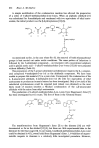
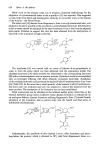
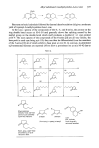
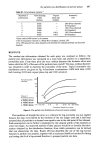
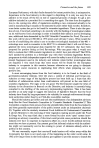
630 Bruce A. McAndrew Careful hydrolysis and decarboxylation under basic conditions removed the 13-ethoxy- carbonyl group to yield Hagemann's Ester [7] in 61•o yield. Use of acidic reaction conditions to effect hydrolysis and decarboxylation produced material contaminated with 3-methylcyclohex-2-en-l-one [8]. Hagemann's Ester [7] is a vinylogous 13-keto-ester i.e. a double bond has been intro- duced between the ester group and the carbonyl function consequently the corresponding ambidentate anion should be capable of reaction at the O-atom, C-2 and C-4. Further- more, if dianion formation can be induced [2], the position (C-6)* analogous to the methyl group of ethyl acetoacetate should be activated. By altering the reaction conditions, there- fore, it should be possible to alkylate at different sites round the ring. When Hagemann's Ester [7] was treated with sodium ethoxide in ethanol, followed by an alkyl halide, alkylation occurred predominantly at the 2-position (3) to yield the substituted product [9]. In the present study, alkylation has been carried out using a CO•EI [•"•i)KOH/E,OH • - 4 COzEt R • NoOEt/EtOH m R 9 IO • (ii)RX ,, R o • R , I /CO2El ? ! • • {i) KOH / E._•tOH • series of straight chain primary bromides (butyl, pentyl, hexyl), and one substituted primary bromide (iso-amyl), all of which gave satisfactory yields of alkylated keto-esters [9]. When a secondary halide (sec-amyl bromide) was used, a much lower yield of alkyl- ated product was obtained (4). The one allylie halide used (3-methylbut-2-enyl chloride =prenyl chloride) reacted appreciably faster, and produced the highest yield of alkylated ester. * It should be pointed out that Hagemann's Ester [7] and related [3-keto-esters have been deliberately numbered as substituted cyclohexenones - so ensuring that the numbering of the C-atoms is self-consistent.

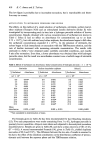
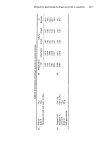
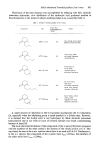
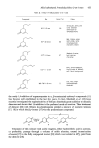
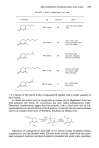
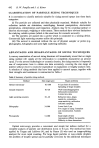
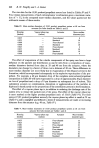
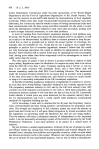
A lkyl substituted 3-methylcyclohex-2-en-l-ones 631 Hydrolysis of the ester function was accomplished by refluxing with 10•o alcoholic potassium hydroxide slow distillation of the carboxylic acid produced resulted in decarboxylation to the desired 2-alkyl-3-methylcyclohex-2-en-l-one [10] (Table 1). Table I. 2-Alkyl-3-methylcyclohex-2-en-l-ones Yield (%) Compound Bp, (from Hagemann's 0 dour Ester) Very strong, minty, some 69ø/O' 7 mm :59 phenolic/chemicol notes. 8 Iø/0' 4 mm 44 Less minty, some salicyla•e / benzoate cha racterisfics, 0/• no minty notes 84ø/0.7ram :59 increasing amyl salicylote character.
Practic 90 ø / O. 5 mm 49 No minly notes, faint amyl salicylate character some fatty, buttery, josmonyl character. 0•/ herbalamylwithnotes aimos celery, 97ø/0'5 mm 63 together salicylate character.
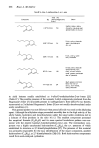
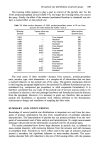
Some A small amount of alkylation in the C-4 position accompanies the C-2 alkylation (5), especially when the alkylating group is small (methyl) or a [I-halo-ester. However, it is claimed that the 4-alkyl ester is not hydrolysed by dilute alcoholic potassium hydroxide (5) and in our work no trace of isomeric ketones was found contaminating ketones of type [10]. The most characteristic feature of the compounds of the 2-series [10] (when compared with the members of the other series) is the absence of the vinylic proton at C-2. This can clearly be seen in the n.m.r. spectra where there is no peak at 85.6-5-8. Furthermore, in the u.v. spectra, the compounds of the 2-series have %max _•235mp: the members of the other series have %ma,, -• 224mp.
Purchased for the exclusive use of nofirst nolast (unknown)
From: SCC Media Library & Resource Center (library.scconline.org)