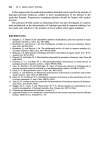
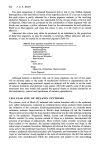
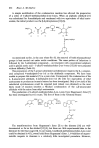
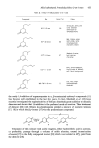
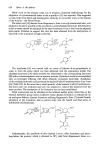
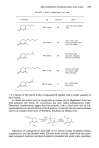
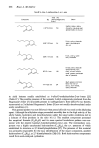
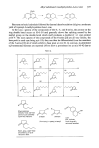
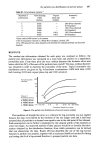
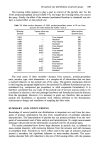
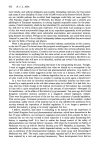
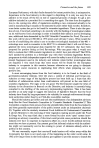
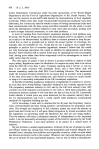
632 Bruce •4. Mc•4ndrew A simple modification of the condensation reaction has allowed the preparation of a series of 5-alkyl-3-methylcyclohex-2-en-l-ones. When an aliphatic aldehyde [11] was substituted for formaldehyde and condensed with two equivalents of ethyl aceto- acetate, the initial product was the 13-hydroxyketone [12] (6). E•OzC R H COzE• t 0" ' 0 0 4 II 4 12 OH H2S04/CH3CO2 R As mentioned earlier, in the case where R-=H, the removal of both ethoxycarbonyl groups is best carried out under acidic conditions. The same pattern of behaviour is followed by the 5-substituted compounds - on treatment with concentrated sulphuric acid in glacial acetic acid- 5-alkyl-3-methylcyclohex-2-en-l-ones [13] (6) were prepared without difficulty (Table II). The preparation of the 5-prenyl substituted cyclohexenone requires the [5, 7-unsatur- ated compound 4-methylpent-3-en-l-al as the aldehydic component. We have been unable to prepare this material (7) in a pure state. Consequently the condensation of the tt, [5-unsaturated aidehyde, 4-methylpent-2-en-l-al (8) with two equivalents of ethyl acetoacetate to produce an isomeric ketone has been investigated. Only a low yield of the substituted cyclohexenone could be expected (and indeed was obtained) as the most likely mode of reaction involves a Michael condensation of the tt,[5-unsaturated aldehyde with the anion from ethyl acetoacetate. The production of 4-alkyl-3-methylcyclohex-2-en-l-ones from Hagemann's Ester [7] has been investigated by two routes. The first of these is the 'Dienone Route'. C02Et /• C02Et • OH OH •so-'- ,,o----L • benzene • I V •- benzene o 7 N---o 14 /•--o 15 ••OH HCl/THF 16 The transformations from Hagemann's Ester [7] to the dienone [16] are well- documented as far as the alcohol [15] (9), but there are little experimental data in the literature for the final stage (10). In our hands, 3-methyl-4-methylenecyclohex-2-en-l-one could be obtained in 45•o overall yield from Hagemann's Ester. l, 6-Addition of organo- metallic reagents to dienones is a relatively little investigated procedure. However,

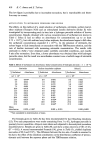
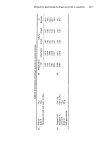
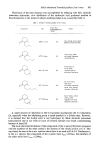
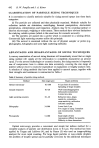
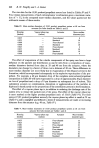
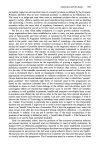
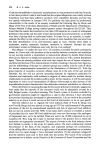
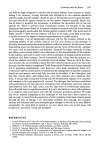
Alkyl substituted 3-methylcyclohex-2-en-l-ones Table 17. 5-Alkyl-3-methylcyclohex-2-en-l-ones 633 Compound Bp. Yield (%) Odour 910/I. 2 mm ,5,5 94ø/0.6 mm 53 110ø/I.6mm 47 113ø/ 1.3mm 45 78 ø-79 ø/l'Omm 5 Strong, dry[celery and nutty (walnut) reminiscent of dihydrojasmone. Less intense, some celery notes some d i hydrojasmone character present. Weakest of series, faint jasmine character. Fatty, almost aldehydic (reminiscent of Adoxal), sofl floral background. Oily, nutty, slight di hydrojasmone character. the ready 1,4-addition of organocuprates to a, iS-unsaturated carbonyl compounds (11) has become well established in the last few years. In fact, Marshall et al. (12) have recently investigated the regioselectivity of lithium dimethylcuprate addition to alicyclic dienones and shown that 1,6-addition is the preferred mode of reaction. Thus treatment of dienone [16] with lithium di-n-butylcuprate yielded a mixture of isomeric ketones [17, 18] in which the J•,7-isomer [17] was the predominant compound. H• • 16 17 18 Treatment of this mixture with acidic reagents, either hydrochloric acid in acetone, or preferably, passage through a column of acidic alumina, caused isomerization of enone [17] to the fully conjugated isomer [18] which was isolated in 49•o yield from the dienone [16].
Purchased for the exclusive use of nofirst nolast (unknown)
From: SCC Media Library & Resource Center (library.scconline.org)