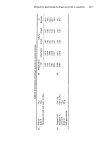
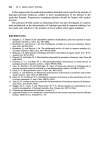
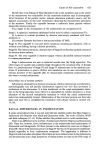
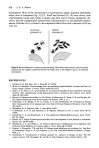
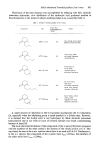
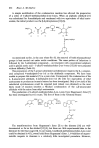
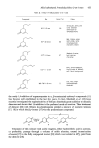
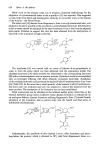
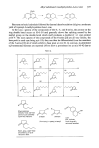
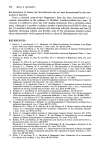
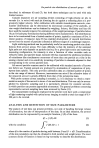
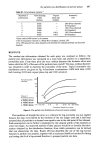
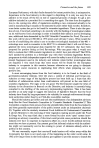
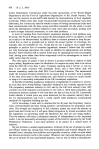
634 Bruce A. McAndrew While work on the dienone route was in progress, improved methodology for the alkylation of a, 13-unsaturated esters at the a-position (13) was reported. This suggested a route, both more direct and bearing great similarity to our earlier work, to the ketones of the 4-series - the 'Ketal Route'. The ketal ester [14] derived from Hagemann's Ester is an a, 13-unsaturated ester, and alkylation should be possible at the a-position to yield alkylated ketal ester [19]. Reaction at this a-centre should be enhanced by the steric hindrance to the T-site from the adjacent spiro-centre. Evidence to support this view has been obtained from the methylation of ester [19] at the a-position in high yield (14). The ketal-ester [14] was treated with an excess of lithium di-iso-propylamide in order to form the anion which was then alkylated with the appropriate iodide. The alkylated ketal-ester [19] which resulted was hydrolysed to the corresponding keto-ester [20] with p-toluenesulphonic acid in aqueous acetone. Hydrolysis could be accomplished only on prolonged refluxing with dilute ethanolic potassium hydroxide distallation of the resulting carboxylic acid produced the desired 4-alkyl-3-methylcyclohex-2-en-l-one [21] (Table III). At the same time a small quantity of the isomeric 6-alkyl-3-methylcyclo- hex-2-en-l-one was produced and care was required to remove this material from the main product. The mechanism of its formation has not been established. Ethyl acetoacetate can be alkylated at the terminal methyl group rather than at the internal methylene group under conditions where dianion formation is induced (2). In an analogous fashion, dianion formation utilizing Hagemann's Ester [7] should furnish alkylation at the 6-position, and so permit entry into the fourth and final series of substituted cyclohexenones. r" yti)isoPra NLi 0 •T--•-'-F• o" • - 7 22 (i) KOH / Et OH (•i)A 23 Unfortunately, the specificity of this reaction is poor. After hydrolysis and decar- boxylation, the product, which is obtained in 505/o yield from Hagemann's Ester, is a

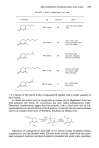
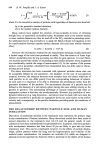
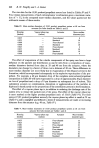
Alkyl substituted 3-methylcyclohex-2-en-l-ones 635 Table •. 4-AIkyl-3-methylcyclohex-2-en-l-ones Compound Bp. Yield (%) Odour • Soft, nutty with o lemon 82ø/I ß 4 mm 34 note. 0 72 ø/0.15 mm 4.5 Soft, nutty, some floral character lemon note still present. 75 ø / 0'4 mm •9 Soft, floral, some 'tea-leaf' character lemon note retained. 84 ø / O' I m m 40 Soft, dry, reminiscent of mustard slight lemon character. • 82 ø/2- 0 mm 27 herbal-fl faintly nutty.
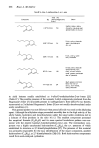
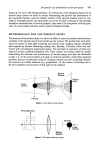
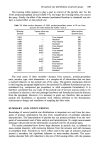
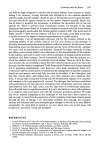
Soft, 0 •' 2:1 mixture of the desired 6-alkyl compound [23] together with a smaller quantity of the 4-isomer. To obtain the 6-alkyl series of compounds, an isomer [24] of Hagemann's Ester has been prepared (15) which, for convenience, has been called isoHagemann's Ester. Theoretical considerations suggest that this molecule, both a •-keto-ester and an e,•- unsaturated ketone, should alkylate at the 6-position. In practice this has been confirmed only by an isolated observation of Wichterle, Prochazka & Hofman (16). Alkylation of isoHagemann's Ester [24] via its sodium enolate proceeded without complications, and the alkylated esters [25] were easily isolated. Apart from the preny- lated compound, hydrolysis and decarboxylation proceeded best under acidic conditions
Purchased for the exclusive use of nofirst nolast (unknown)
From: SCC Media Library & Resource Center (library.scconline.org)