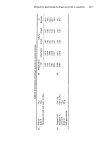
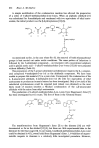
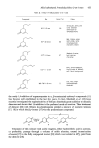
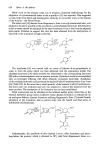
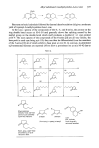
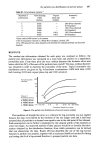
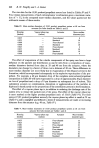
636 Bruce A. McAndrew Table •T. 6-Alkyl-5-rnethylcyclohex-2-en- I-ones Compound Bp. Yield (%) (from isoHacjemann's Ester) Odour I I O*/6.0mm 50 Herbal, celery celery character develops and predominates on dry out. 106'/5.0ram 51 Faint celery character again developincj on dry out. I0 8* / 5' 5 mm 55 Faint, celery, some nutty character. 81'/0. I mm 48 77*/0.5 mm 54 Herbal, celery character almost entirely lost nutty, almost lactone notes present, reminiscent also of jasmonyl. Much greener and more floral than rest af series faint herbal, celery character. to yield ketones readily established as 6-alkyl-3-methylcyclohex-2-en-l-oncs [23] (Table IV). The possible presence of the isomeric 2-alkyl compounds, produced from the Hagemann's Ester [7] invariably present in isoHagemann's Ester [24] (17) was thereby surmounted as 2-alkylated Hagemann's Esters [9] are not readily decarboxylated under acidic conditions (1). This general pattern was not followed when prenyl chloride was used as the alkylating agent. Although the alkylation stage proceeded smoothly due to the high activity of the allytic halide, hydrolysis and decarboxylation under the usual acidic conditions led to a mixture of three products in the ratio 16:1:3. The smallest component possessed the empirical formula (Cz2HzsO) and its mass spectral breakdown pattern was con- sistent with the desired 6-prenyl-3-methylcyclohex-2-en-l-one. The intermediate com- ponent was a highly unsaturated hydrocarbon (C•2H•2), the u.v. spectrum of which established its structure as 2,7-dimethylnaphthalene [27]. The presence of this material was primarily responsible for the easy identification of the major component, another hydrocarbon (Cx2Hze), as 2,7-dimethyltetralin [26] (18). Both hydrocarbon components result from acid-catalysed cyclisation.

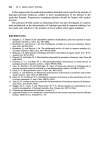
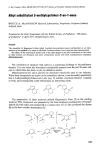
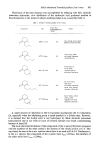
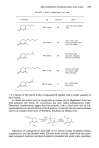
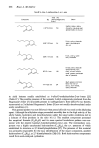
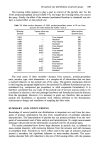
Alkyl substituted 3-methylcyclohex-2-en-l-ones COzEt 26 27 637 Recourse to basic hydrolysis followed by thermal decarboxylation did give a moderate yield of 6-prenyl-3-methylcyclohex-2-en-l-one. In the n.m.r. spectra of the compounds of the 4-, 5-, and 6-series, the proton on the ring double bond occurs at /55.6-5.8 and generally shows fine splitting caused by the methyl group on the double bond which itself produces a doublet (J _• 1 cps) centred at/51-9. The mass spectra of the compounds of the 6-series [23] are all very similar, the base peak in each case being m/e 110 they can thus be differentiated from the members of the 5-series [13] all of which exhibit a base peak at m/e 82. In contrast, 4-substituted a, ll-unsaturated ketones are reported (19) to show a prominent ion at m/e M-42 due to Table ._V_.. (5) (I) (Z) (3) (61 ,r r (71 _ Dihydrojasmone intensely floral and fresh with fruity and somewhat myrrh-like undertone. Warm, spicy, sweet-floral and diffusive, yet quite tenacious odour. Unknown Unknown Lyral soft, delicate, (R=n-butyl, n-pentyl, n-hexyl) floral (muguet) extremely tenacious.
Purchased for the exclusive use of nofirst nolast (unknown)
From: SCC Media Library & Resource Center (library.scconline.org)