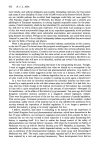
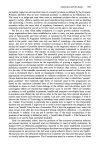
On particle size distributions of aerosol sprays 643 described in references (6) and (7), but both these techniques can be used with only limited success. Cascade impactors are air sampling devices consisting of high-velocity air jets in cascade (i.e. in series) with each jet directing the air against a collecting plate at a pro- gressively higher velocity. After calibration with suitable monodisperse aerosols, size- number distributions can be determined by microscope counting of the particles, or size-weight distributions can be obtained by weighing. Sciarra, McGinley and Izzo (8) have used the cascade impactor for estimation of the weight percentage of particles below 10 gm for hairspray formulations having different valve characteristics. Size distributions have to be constructed from a limited number of points, typically a maximum of five. A recent analysis of impactor data (9) has enabled development of smooth distribution curves from the masses of particles collected at different stages of a multistage impactor. Light scattering methods can be particularly useful in monitoring particle size distri- butions from aerosol sprays. The main difficulty is that the intensity of the scattered light pulse not only depends on particle size but, for a given light source and scattering/ measuring configuration, the intensity is also a function of other variables such as refractive index and particle shape. Jaenicke (10) has examined the additional problems of coincidence (the simultaneous occurrence of more than one particle at a time in the sensing volume) and cross-sensitivity (counting of particles in channels adjacent to that corresponding to the correct particle size). All aerosol particle counters need to be calibrated with standard aerosols of known size before use. Typical aerosols are produced by atomisation of suspensions of poly- styrene latex spheres. This only provides calibration data at a limited number of points in the size range of interest. Moreover, inaccuracies can arise if the refractive index of the measured aerosol is greatly different from that of the polystyrene latex. With probe systems correct sampling is essential, i.e. it is necessary to obtain a repre- sentative sample of the aerosol in terms of size and distribution. This can only be accom- plished by isokinetic sampling and it is particularly relevant for cosmetic aerosols, in which particles can possess appreciable momentum. The general problems concerning representative aerosol sampling have been reviewed by Fuchs (11). The measurement techniques employed in the present work have used a compromise of light scattering coupled with optical array imaging to enable a total size range of 0'3- 300 gm to be covered. ANALYSIS AND DEFINITION OF SIZE PARAMETERS The analysis of size data can present problems, not only of handling the large volume of information, but also of interpretation of the data. In an ideal situation, the aerosol distribution can be represented by an analytic function, f (D) of the form df = f (D) dD (1) with the condition f (D) dD = 1 (2) where dfis the number of particles having radii between D and D + dD. Transformation of the size parameters can then be obtained in both number and weight terms. The most common choice of function is based on log-normality to describe the distribution:

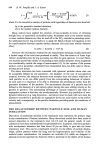
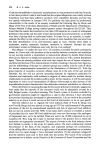
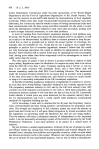
644 R. W. Pengilly and J. A. Keiner F (2g) • In bg exp -- •n • • _] d (lnO) (3) where F is the cumulative number of particles with logarithms of diameters less than InD. bg is the geometric standard deviation Dn is the number median diameter. Many authors have applied the criterion of log-normality in terms of obtaining straight lines on logarithmic-probability scales. Parameters such as the number-median or mass-median diameter can then be read off at the 50•o cumulative percentage point. An additional test for log-normality is to apply the Hatch-Choate (12) equation to test for transformation between number median diameter (Dn) and mass median diameter (Din): In (Dn) = In (Din) + 3 In s fig (4) However the information obtained by the measurement technique usually represents a limited range of the total sizes produced in reality. Thus the criterion of linear loga- rithmic-probability plots for log-normality can often be quite spurious. Vos and Thom- son recently queried the validity of calculating a mass median diameter whose magnitude was considerably outside the range of measurement (13). In the opinion of the present authors, such a parameter, calculated from extrapolated data, has little value in charac- terising aerosol sprays. The above discussion has been concerned with spherical particles whose sizes can be completely defined by one parameter- the diameter. In the case of non-spherical material, however, the situation becomes more complex since the kinetic behaviour of such particles in air can differ greatly from the corresponding behaviour of spheres. In such cases it is important to be able to determine the aerodynamic rather than the geometric diameters of the particles. The aerodynamic diameter of a particle may be defined as the diameter of a unit density sphere having the same settling velocity as the particle in question. The outstanding advantage of cascade impactors and other air segregation systems is that they size aerodynamically. However, any prediction of aero- dynamic behaviour (e.g. lung deposition - see below) must be made with care since the diameters recorded by a particular air segregation device are only relative to the airflow velocity and, consequently, to the particle orientation prevailing under the conditions of measurement. THE RELATIONSHIP BETWEEN PARTICLE SIZE AND HUMAN INHALATION Deposition of particulate material in the respiratory tract represents the primary stage in any consideration of human inhalation. Many theoretical models have been made of aerosol deposition in the respiratory tract (14-17) and the general results of such calculations have been substantiated by experimental tests. In general, only those particles with aerodynamic diameters less than about 10 •tm are likely to pass into the lower respiratory tract. This can be complicated, however, by the effects of particle density, shape, airflow patterns within the lung, and the hygroscopicity and volatility of the material under consideration. Air samplers are available (18) which are designed to separate air-borne material into fractions likely to penetrate to the depths of the human
Purchased for the exclusive use of nofirst nolast (unknown)
From: SCC Media Library & Resource Center (library.scconline.org)