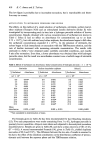
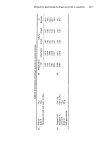
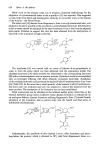
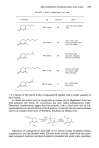
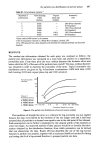
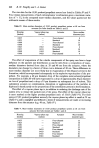
648 R. W. Pengilly and J. A. Keiner The size data for the 15/85 product/propellant aerosol are listed in Tables IV and V. Four repeat measurements of each valve/actuator combination gave a maximum varia- tion of d- 5 % in the computed mass-median diameters, and the values quoted are the arithmetic means of these results. Table IV. Mass-median diameters of 15/85 product propellant system at 48 cm from actuator (for fuller details see Tables 1 and 2) Housing Vapour phase tap Actuator Mass-median (inches) (inches) diameter (gm) 0-025 m Four-channel 9 0.025 -- Standard 10 0.080 -- Four-channel 11 0.080 -- Standard 10 0.025 0.013 Four-channel 8 0.025 0.013 Standard 10 0.080 0.013 Standard 10 0.080 0.013 Four-channel 9 The effect of evaporation of the volatile components of the spray can have a large influence on the particle size distribution as can be seen from a comparison of mass- median diameters derived from data at 28 and 48 cm from the actuator, where the diameters can change by a factor of three over a distance of 20 cm. These differences in mass-median diameter are most likely due to evaporation of the ethanol solvent in the formation, which has evaporated subsequently to the explosive vaporisation of the pro- pellant. For example, a 40 p,m diameter drop of the complete resin/solvent/propellant composition in Table Ilb will have evaporated to a drop of approximately 20 •tm diameter on loss of propellant and a drop of 9 •tm diameter on subsequent loss of solvent. This calculation assumes no condensation, disruption or agglomeration of the particles in flight and is based purely on the proportions of the constituents present in the formulation. The effect of a vapour phase tap is, in addition to reducing the discharge rate of the system (21), to reduce the particle size of the spray. The effect of the vapour phase tap is most marked at the higher product/propellant ratio of 35/65 (Table VI). For finer sprays (15/85 product/propellant aerosol), the vapour phase tap effect is small at 28 cm (Table V), and is negligible and difficult to detect if measurements are made at increasing distances from the actuator (e.g. 48 cm, Table IV). Table V. Mass-median diameters of 15/85 product propellant system at 28 cm from actuator (for fuller details see Tables 1 and 2) Housing Vapour phase tap Actuator Mass-median (inches) (inches) diameter (lam) 0.025 -- Four-channel 33 0-025 -- Standard 38 0.080 -- Four-channel 33 0.080 -- Standard 35 0.025 0.013 Four-channel 28 0.025 0.013 Standard 32 0.080 0.013 Four-channel 30 0.080 0.013 Standard 30

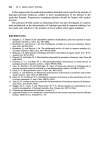
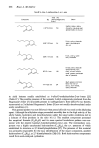
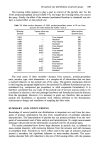
On particle size distributions of aerosol sprays 649 The housing orifice appears to play a part in control of the particle size: for the 35/65 product/propellant aerosol (Table VI), the larger the housing orifice, the coarser the spray. Finally, the effect of the actuator (mechanical breakup or standard) can also have a marked effect on the particle size. Table VI. Mass-median diameters of 35/65 product/propellant system at 28 cm from actuator (for fuller details see Tables 1 and 2) Housing Vapour phase tap Actuator Mass-median (inches) (inches) diameter ([tm) 0.025 -- Four-channel 200 0'025 -- Standard 200 0.080 -- Four-channel 205 0.080 -- Standard 210 0.025 0.013 Four-channel 125 0.025 0.013 Standard 180 0.080 0'013 Four-channel 195 0-080 0.013 Standard 120 0.0l 8 -- Four-channel 187 0.018 -- Standard 194 0.018 0.013 Four-chanenl 112 0.018 0.013 Standard 143 0.032 -- Four-channel 200 0.032 -- Standard 202 0.032 0.013 Four-channel 134 0'032 0'013 Standard 163 The total result of these variables- distance from actuator, product/propellant ratio, actuator type, valve dimensions- is a complex set of interactions that can have a marked influence on the particle size of the spray. The general conclusions derived in the foregoing paragraph might have to be reassessed if a different formulation type was considered (e.g. compressed gas propellant, or solid suspension formulation). It is therefore considered that any study of the particle size of aerosol systems needs to be considered in relation to the total package (hardware and formulation) and the distance from the sprayhead. Moreover, it is necessary to point out, therefore, that an aerosol particle size distribution or parameter cited without reference to the formulation, valve/actuator design, and conditions of sampling has little value. SUMMARY AND CONCLUSIONS Knowledge of aerosol particle size distributions is important not only from the view- point of product optimisation but also from considerations of potential inhalation characteristics. The determination of particle size can present problems from the view- point of measurement and of data analysis and interpretation. No single measurement technique will provide all the information on particle size for all product types. The results presented have shown large decreases in particle size, as reflected by mass-median diameter, with increasing distance from the actuator and with increases in propellant level. Variations in valve orifices and in the type of actuator employed present a secondary but significant influence on mass-median diameter. The mass- median diameter falls with reduction in the size of the housing orifice, with the presence
Purchased for the exclusive use of nofirst nolast (unknown)
From: SCC Media Library & Resource Center (library.scconline.org)