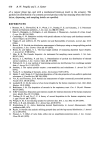
650 R. W. Pengilly and J. A. Keiner of a vapour phase tap, and with a mechanical break-up insert in the actuator. The particle size distribution of a cosmetic aerosol product only has meaning when the formu- lation, dispensing, and sampling details are specified. REFERENCES 1 Brunner, M. J., Giovacchini, R. P., Wyatt, J.P., Dunlap, F. E. and Calandra, J. C. Pulmonary disease and hairspray polymers. J. Am. med. Ass. 184 851 (1963). 2 Ripe, E., Hanngren, A., Holmgren, A. and Johansson, J. Thesaurosis---Analysis of a Case. Scan& J. resp. Dis. 50 156 (1969). 3 Cambridge, G. W. Inhalation toxicity with special reference to hair-spray and deodorant aerosols. Aerosol Report, 12 273 (1973). 4 Tregan, R. and Lefebvre, M. The particle size and flammability of aerosols. Aerosol Age, 11 18 (1966). 5 Rance, R. W. Particle size distribution measurement of hairsprays using an image splitting particle size analyser. J. $oc. Cosmet. Chem. 23 197 (1972). 6 Bexon, R. and Ogden, T. L. The focal length method of measuring deposited liquid droplets. J. Aerosol Sci. 5 509 (1974). 7 May, K. R. The Cascade Impactor: An instrument for sampling coarse aerosols. J. Sci. Instr. 22 187 (1945). 8 Sciarra, J. J., McGinley, P. and Izzo, L. Determination of particle size distribution of selected aerosol cosmetics. J. $oc. Cosmet. Chem. 20 385 (1969). 9 Picknett, R. G. A new method of determining aerosol size distributions from multistage sampler data. J. Aerosol Sci. 3 185 (1972). 10 jaenicke, J. The optical particle counter: cross-sensitivity and coincidence. J. Aerosol $ci. 3 95 (1972). 11 Fuchs, N. A. Sampling of Aerosols. Atmos. Environment, 9 697 (1975). 12 Hatch, T. and Choate, S. P. Statistical description of the size properties of non-uniform particulate substances. J. Franklin Inst. 207 369 (1929). 13 Vos, K. and Thomson, D. B. Particle size measurement of eight commercial pressurised products. Powder Tech. 10 103 (1974). 14 Landahl, H. D. On the removal of air-borne droplets by the human respiratory tract. Bull. Math. Biophys. 12 43 (1950). 15 Beeckmans, J. M. The deposition of aerosols in the respiratory tract. Can. J. Physiol. Pharmac. 43 157 (1965). 16 ICRP Committee. Deposition and retention models for internal dosimetry of the human respiratory tract. Health Phys. 12 173 (1966). 17 Taulbee, D. B. and Yu, C. P. A theory of aerosol deposition in the human respiratory tract. J. appl. PhyMol. 38 77 (1975). 18a Wright, B. M. A size-selecting sampler for airborne dust. Brit. J. ind. Med. 11 284 (1954). 18b Wells, A. B. and Alexander, D. J. Aerosol Age, 21 20 (1976). 19 Knollenberg, R. G. Active Scattering Aerosol Spectrometry, in Aerosol Measurements, NBS publication 412, 1974. 20 Raabe, O. Particle size analysis utilising grouped data and the log-normal distribution. J. Aerosol Sci. 2 289 (1971). 21 Flanner, L. T. Effect of valve body orifice size on propellant/concentrate ratio. J. Soc. Cosmet. Chem. 21 661 (1970).

J. Soc. Cosmet. Chem. 28 651-658 (1977)¸ 1977 Society of Cosmetic Chemists of Great Britain Oosmetics and the uture R. J. L. ALLEN* The 1977 Medal Lecture by Professor R. J. L. Allen, delivered before the Society of Cosmetic Chemists of Great Britain on 3 March 1977, with D. F. Williams Esq., President of the Society in the Chair. When, early last year, your President was kind enough to suggest that I should give the 1977 Medal Lecture my first reaction was to disqualify myself. My background is in biochemistry, nutrition and food science, and it appeared to me improbable that as a comparative newcomer to the scene I could contribute much that would be of interest to members of the Society. My doubts were strengthened when I looked back through numbers of the Journal to see who had spoken to you in previous years and about what. I found that twelve distinguished authorities in the biological and physical sciences, as well as experts in cosmetics, had pretty well covered the field in a series of lectures of outstanding quality and breadth of learning. Contributions by Bullough on the re- juvenation of the skin, Polano on the effects of detergents, your Patron Lord Todd on the interface between organic chemistry and cosmetic science, Wilkinson on cosmetic function and public expectation and Ebling on sex hormones, to name only some, seemed to have left little for me to say. However, your President is very persuasive, and when after a short discussion we parted, I found that I had in fact somehow agreed to undertake what was clearly a rather formidable task. It seemed to me on reflection that I ought to try to turn to advantage my limited direct experience with cosmetics, and put to you for consideration some points that, as a relative outsider, seemed to me to be worth discussing in relation to cosmetics in, say, the remaining quarter of this century. The first difficulty I encountered was to define my subject. What are cosmetics? The very word itself is hedged with ambiguity. To the layman, it often seems to mean mainly decorative products such as lipsticks and mascara (from the Greek kosmein, adorn) but for cosmetic chemists the term embraces toiletties, and this wider definition now has a firm legal basis through the Cosmetic Products Direcfive (1) soon to be incorporated into United Kingdom law. However, that is not all because the definition in the Directive extends to products on the borderline with medicines. Lastly, it must be admitted that the very word 'cosmetic' in popular use can have a pejorative connotation, as when we speak of 'cosmetic changes' as merely patching up and calcu- lated to deceive, although I am not for a moment suggesting that this applies to the description 'cosmetic chemist'! I hope you won't think me impertinent if I say that per- haps an effort should be made even at this late date to find a word that would define * Beecham Group Ltd., Brentford, Middlesex. 651
Purchased for the exclusive use of nofirst nolast (unknown)
From: SCC Media Library & Resource Center (library.scconline.org)