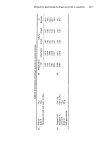
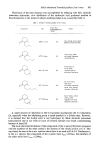
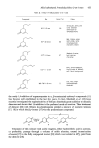
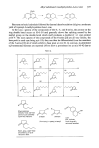
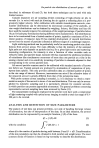
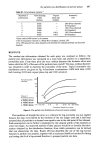
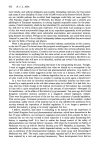
Alkyl substituted 3-methylcyclohex-2-en-l-ones 635 Table •. 4-AIkyl-3-methylcyclohex-2-en-l-ones Compound Bp. Yield (%) Odour • Soft, nutty with o lemon 82ø/I ß 4 mm 34 note. 0 72 ø/0.15 mm 4.5 Soft, nutty, some floral character lemon note still present. 75 ø / 0'4 mm •9 Soft, floral, some 'tea-leaf' character lemon note retained. 84 ø / O' I m m 40 Soft, dry, reminiscent of mustard slight lemon character. • 82 ø/2- 0 mm 27 herbal-fl faintly nutty.
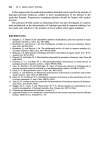
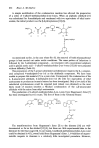
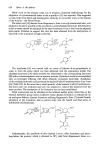
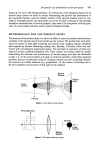
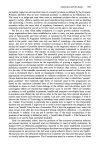
Soft, 0 •' 2:1 mixture of the desired 6-alkyl compound [23] together with a smaller quantity of the 4-isomer. To obtain the 6-alkyl series of compounds, an isomer [24] of Hagemann's Ester has been prepared (15) which, for convenience, has been called isoHagemann's Ester. Theoretical considerations suggest that this molecule, both a •-keto-ester and an e,•- unsaturated ketone, should alkylate at the 6-position. In practice this has been confirmed only by an isolated observation of Wichterle, Prochazka & Hofman (16). Alkylation of isoHagemann's Ester [24] via its sodium enolate proceeded without complications, and the alkylated esters [25] were easily isolated. Apart from the preny- lated compound, hydrolysis and decarboxylation proceeded best under acidic conditions

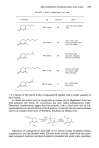
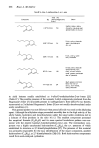
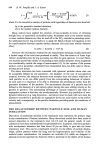
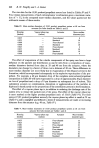
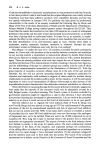
636 Bruce A. McAndrew Table •T. 6-Alkyl-5-rnethylcyclohex-2-en- I-ones Compound Bp. Yield (%) (from isoHacjemann's Ester) Odour I I O*/6.0mm 50 Herbal, celery celery character develops and predominates on dry out. 106'/5.0ram 51 Faint celery character again developincj on dry out. I0 8* / 5' 5 mm 55 Faint, celery, some nutty character. 81'/0. I mm 48 77*/0.5 mm 54 Herbal, celery character almost entirely lost nutty, almost lactone notes present, reminiscent also of jasmonyl. Much greener and more floral than rest af series faint herbal, celery character. to yield ketones readily established as 6-alkyl-3-methylcyclohex-2-en-l-oncs [23] (Table IV). The possible presence of the isomeric 2-alkyl compounds, produced from the Hagemann's Ester [7] invariably present in isoHagemann's Ester [24] (17) was thereby surmounted as 2-alkylated Hagemann's Esters [9] are not readily decarboxylated under acidic conditions (1). This general pattern was not followed when prenyl chloride was used as the alkylating agent. Although the alkylation stage proceeded smoothly due to the high activity of the allytic halide, hydrolysis and decarboxylation under the usual acidic conditions led to a mixture of three products in the ratio 16:1:3. The smallest component possessed the empirical formula (Cz2HzsO) and its mass spectral breakdown pattern was con- sistent with the desired 6-prenyl-3-methylcyclohex-2-en-l-one. The intermediate com- ponent was a highly unsaturated hydrocarbon (C•2H•2), the u.v. spectrum of which established its structure as 2,7-dimethylnaphthalene [27]. The presence of this material was primarily responsible for the easy identification of the major component, another hydrocarbon (Cx2Hze), as 2,7-dimethyltetralin [26] (18). Both hydrocarbon components result from acid-catalysed cyclisation.
Purchased for the exclusive use of nofirst nolast (unknown)
From: SCC Media Library & Resource Center (library.scconline.org)