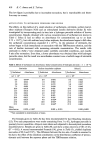
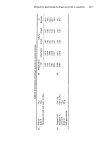
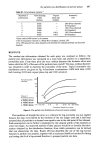
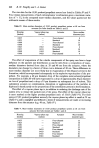
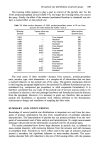
On particle size distributions of aerosol sprays 649 The housing orifice appears to play a part in control of the particle size: for the 35/65 product/propellant aerosol (Table VI), the larger the housing orifice, the coarser the spray. Finally, the effect of the actuator (mechanical breakup or standard) can also have a marked effect on the particle size. Table VI. Mass-median diameters of 35/65 product/propellant system at 28 cm from actuator (for fuller details see Tables 1 and 2) Housing Vapour phase tap Actuator Mass-median (inches) (inches) diameter ([tm) 0.025 -- Four-channel 200 0'025 -- Standard 200 0.080 -- Four-channel 205 0.080 -- Standard 210 0.025 0.013 Four-channel 125 0.025 0.013 Standard 180 0.080 0'013 Four-channel 195 0-080 0.013 Standard 120 0.0l 8 -- Four-channel 187 0.018 -- Standard 194 0.018 0.013 Four-chanenl 112 0.018 0.013 Standard 143 0.032 -- Four-channel 200 0.032 -- Standard 202 0.032 0.013 Four-channel 134 0'032 0'013 Standard 163 The total result of these variables- distance from actuator, product/propellant ratio, actuator type, valve dimensions- is a complex set of interactions that can have a marked influence on the particle size of the spray. The general conclusions derived in the foregoing paragraph might have to be reassessed if a different formulation type was considered (e.g. compressed gas propellant, or solid suspension formulation). It is therefore considered that any study of the particle size of aerosol systems needs to be considered in relation to the total package (hardware and formulation) and the distance from the sprayhead. Moreover, it is necessary to point out, therefore, that an aerosol particle size distribution or parameter cited without reference to the formulation, valve/actuator design, and conditions of sampling has little value. SUMMARY AND CONCLUSIONS Knowledge of aerosol particle size distributions is important not only from the view- point of product optimisation but also from considerations of potential inhalation characteristics. The determination of particle size can present problems from the view- point of measurement and of data analysis and interpretation. No single measurement technique will provide all the information on particle size for all product types. The results presented have shown large decreases in particle size, as reflected by mass-median diameter, with increasing distance from the actuator and with increases in propellant level. Variations in valve orifices and in the type of actuator employed present a secondary but significant influence on mass-median diameter. The mass- median diameter falls with reduction in the size of the housing orifice, with the presence

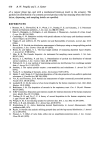
650 R. W. Pengilly and J. A. Keiner of a vapour phase tap, and with a mechanical break-up insert in the actuator. The particle size distribution of a cosmetic aerosol product only has meaning when the formu- lation, dispensing, and sampling details are specified. REFERENCES 1 Brunner, M. J., Giovacchini, R. P., Wyatt, J.P., Dunlap, F. E. and Calandra, J. C. Pulmonary disease and hairspray polymers. J. Am. med. Ass. 184 851 (1963). 2 Ripe, E., Hanngren, A., Holmgren, A. and Johansson, J. Thesaurosis---Analysis of a Case. Scan& J. resp. Dis. 50 156 (1969). 3 Cambridge, G. W. Inhalation toxicity with special reference to hair-spray and deodorant aerosols. Aerosol Report, 12 273 (1973). 4 Tregan, R. and Lefebvre, M. The particle size and flammability of aerosols. Aerosol Age, 11 18 (1966). 5 Rance, R. W. Particle size distribution measurement of hairsprays using an image splitting particle size analyser. J. $oc. Cosmet. Chem. 23 197 (1972). 6 Bexon, R. and Ogden, T. L. The focal length method of measuring deposited liquid droplets. J. Aerosol Sci. 5 509 (1974). 7 May, K. R. The Cascade Impactor: An instrument for sampling coarse aerosols. J. Sci. Instr. 22 187 (1945). 8 Sciarra, J. J., McGinley, P. and Izzo, L. Determination of particle size distribution of selected aerosol cosmetics. J. $oc. Cosmet. Chem. 20 385 (1969). 9 Picknett, R. G. A new method of determining aerosol size distributions from multistage sampler data. J. Aerosol Sci. 3 185 (1972). 10 jaenicke, J. The optical particle counter: cross-sensitivity and coincidence. J. Aerosol $ci. 3 95 (1972). 11 Fuchs, N. A. Sampling of Aerosols. Atmos. Environment, 9 697 (1975). 12 Hatch, T. and Choate, S. P. Statistical description of the size properties of non-uniform particulate substances. J. Franklin Inst. 207 369 (1929). 13 Vos, K. and Thomson, D. B. Particle size measurement of eight commercial pressurised products. Powder Tech. 10 103 (1974). 14 Landahl, H. D. On the removal of air-borne droplets by the human respiratory tract. Bull. Math. Biophys. 12 43 (1950). 15 Beeckmans, J. M. The deposition of aerosols in the respiratory tract. Can. J. Physiol. Pharmac. 43 157 (1965). 16 ICRP Committee. Deposition and retention models for internal dosimetry of the human respiratory tract. Health Phys. 12 173 (1966). 17 Taulbee, D. B. and Yu, C. P. A theory of aerosol deposition in the human respiratory tract. J. appl. PhyMol. 38 77 (1975). 18a Wright, B. M. A size-selecting sampler for airborne dust. Brit. J. ind. Med. 11 284 (1954). 18b Wells, A. B. and Alexander, D. J. Aerosol Age, 21 20 (1976). 19 Knollenberg, R. G. Active Scattering Aerosol Spectrometry, in Aerosol Measurements, NBS publication 412, 1974. 20 Raabe, O. Particle size analysis utilising grouped data and the log-normal distribution. J. Aerosol Sci. 2 289 (1971). 21 Flanner, L. T. Effect of valve body orifice size on propellant/concentrate ratio. J. Soc. Cosmet. Chem. 21 661 (1970).
Purchased for the exclusive use of nofirst nolast (unknown)
From: SCC Media Library & Resource Center (library.scconline.org)