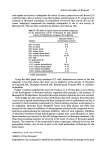
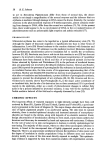
22 D.M. Bryce et al. The following formulation was chosen to represent a typical hygiene spray: Talc 399 (Whittaker, Clark and Daniels Inc.) Bronopol Perfume Propellant l l (I.C.I. Ltd) Propellant 12 (I.C.I. Ltd) to % w/w 0.500 0.075 0.100 39.325 100 Crystalline Bronopol was passed through a micro-mill to obtain the necessary reduction in particle size, the material subsequently passed through a 250 mesh screen sieve. The iron content of the Bronopol was 7 ppm and no evidence of discolouration was evident after 5 months storage at room temperature. Particle size analysis of the talc showed 98.7% less than 15 I•m. The above formulation was packed into an internally lacquered aluminium monobloc can fitted with a standard valve. The can fill was 64 g. Samples were placed on storage test at room temperature and 37øC, and were examined at regular intervals over a period of 3 months. Chemical assays were carried out using an adaptation of the t.l.c. system described earlier. The results showed that no decomposition of Bronopol had occurred. No corro- sion of the container was observed. Microbiological assays were carried out using the method described for the alcoholic deodorant spray formulation. The results obtained after three months storage are shown in Table XI. Table XI. Antibacterial activity of Bronopol and chlorhexidine in a hygiene spray formulation after 3 months storage at room temperature and 37øC Test organism Temperature of storage Diameter of zone inhibition (+ 13 mm disc) in mm Sample 1 Sample 2 Sample 3 (containing Bronopol (containing chlorhexidine (containing initially at initially at neither biocide) 0.075% w/w) 0.075% w/w) Room Room temperature 37 ø Room temperature 37 ø temperature 37 ø $taph. aureus 8452 30 25 14 15 15 14 $taph. aureus FDA 32 22 15 15 13 13 $taph. albus NCTC 7944 31 24 14 14 13 13 Esch. coli NCTC 5934 21 21 13 13 13 13 Proteus vulgaris NCTC 4635 23 21 13 13 13 13 Ps. aeruginosa 1 OS 26 22 13 13 13 13 Candida albicans 239 13 13 16 16 13 13 Further microbiological tests were carried out with samples which had been stored at room temperature and 37øC for 6 months. Although these tests were only qualitative, a similar pattern of activity to that observed after 3 months was obtained. CONCLUSIONS Bronopol has been shown to possess a wide spectrum of antibacterial activity. Its activity against Gram-negative organisms, particularly Ps. aeruginosa, is greater than that of most other antibacterial and preservative agents.

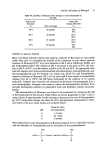
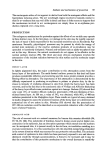
Activity and safety of Bronopol 23 Bronopol is most stable under acid conditions, although it demonstrates high anti- bacterial activity over a wide pH range. The mode of decomposition has been studied in detail, and a number of the decomposition products identified. The assay methods described are capable of estimating Bronopol in many formulations at its normally used levels, the sensitivity of the methods is dependent upon the nature of the formulations in certain cases levels as low as 5 ppm can be assayed. Bronopol is generally used as a preservative in formulations at levels between 0.01 and 0.1 •o. Animal toxicity studies and human patch tests have demonstrated the safety of Bronopol when used at these concentrations. In particular, no evidence of human skin sensitisation has been obtained at these levels. Bronopol has been shown to be an effective antibacterial agent in a range of formula- tions including shampoos, skin creams and sprays and bath products. Many of the ingredients used in such products have been shown to have little or no effect on the antibacterial activity of Bronopol, although compounds containing sulphydryl groups are antagonistic to its activity. ACKNOWLEDGMENTS The authors wish to acknowledge the assistance of the following staff of The Boots Company Limited in the production of the data included: Dr D. F. Spooner (micro- biology) Mr E. L. Crampton (chemistry) Mr D. A. Elvidge, the late Mr C. Vickers, and Mr J. S Wragg (analysis) Dr P. C. Risdall and Miss M. M. Sutton (toxicology) and Mr K. G. Jackson and Dr D. P. Stokes (formulation). In addition, the authors wish to thank Dr C. D. Calnan, Institute of Dermatology, University of London and Professor H. I. Maibach, Department of Dermatology, University of California for their help in the completion of the human skin studies. REFERENCES 1 Hodge, E. B., Dawkins, J. R. and Kropp, E. A new series of antifungal compounds. J. Am. Pharrn. Ass., Sci. Ed. 43 501 (1954). 2 Zsolnai, T, Versuche zur Entdecktmg neuer Fungistatika. II. Nitro-verbindungen. Blochem. Pharmac. s 287 (1961). 3 Croshaw, Betty, Groves, M. J. and Lessel, B. Some properties of Bronopol, a new antimicrobial agent active against Pseudomonas aeruginosa. J. Pharrn. Pharmac. 16 Suppl., 127T (1964). 4 Clark, N. G., Croshaw, Betty, Legetter, B. E. and Spooner, D. F. Synthesis and antimicrobial activity of aliphatic nitro compounds. J. Med. Chem. 17 977 (1974). 5 Morse, L. J. and Schonbeck, L. E. Hand lotions, a potential nosocomial hazard. New. Engl. J. Med. 278 376 (1968). 6 Sykes G. and Smart, R. Preservation of preparations for application to the skin. Am. Perfurn. Cosmet. 84 45 (1969). 7 Smart, R. and Spooner, D. F. Microbiological spoilage in pharmaceuticals and cosmetics. J. $oc. Cosmet. Chem. 23 721 (1972). 8 Malcolm, S. A. and Woodroffe, R. C. S. The relationship between water-borne bacteria and shampoo spoilage. J. Soc. Cosmet. Chem. 26 277 (1975). 9 Tenenbaum, S. The significance of pseudomonads in cosmetic products. Am. Perfum. Cosmet. 86 47 (1971). 10 Thomas, M. J. and Majors, P. A. Animal and human microbiological safety testing of cosmetic products. J. Soc. Cosmet Chem. 24 135 (1973). 11 Marples, R. R. and Kligman, A.M. Methods for evaluating topical antibacterial agents on human skin. Antimicrob. Agents Chernother. $ 323 (1974).
Purchased for the exclusive use of nofirst nolast (unknown)
From: SCC Media Library & Resource Center (library.scconline.org)