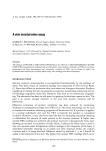
j. Soc. Cosmet. Chem., 30, 333-343 (November 1979) Transepidermal water loss from dry and normal skin J. L. LEVEQUE, J. C. GARSON and J. de RIGAL Groupe de Physique, Laboratoires de Recherche de L'OREAL, I, avenue de Saint- Germain 93600 AULNA Y- sous- BOIS, FRANCE. Received April 30, 1977. Synopsis In order to study the physical and chemical properties of the STRATUM CORNEUM (S.C), a new method for the MEASUREMENT of TRANSEPIDERMAL WATER LOSS has been developed. The method is based on the increase of the dielectric permittivity of air with increase in water vapor content. The method is very sensitive and affords a means of investigating the phenomenon of transepidermal water loss with a good degree of precision and thus of examining the clinical problem of "DRY SKIN." MEASUREMENT OF TRANSEPIDERMAL WATER LOSS (TEWL) INTRODUCTION If we pull off an adhesive paper which has been applied to the skin, we tear off some cornified cells from the epidermis. By repeating this operation (stripping) on the same site, we pull away the whole of the stratum comeurn (S.C.). The TEWL value after each stripping increases slowly at first, then more rapidly, finally attaining the value obtained when water vapor is released from a water surface. This experiment, conducted for the first time in 1953 by Blank (1), showed clearly that the main function of S.C. is to limit exchanges between the human body and its close environment in an efficient manner. Thus, in order to obtain information on the functional state of S.C., TEWL is a very important parameter to measure. However, it is difficult to determine TWEL with accuracy for several reasons: 1. The small amount of water vapor involved (0.5 mg/cm2/hr) is difficult to measure. 2. Measurement devices often interact with the horny layer. 3. Physical parameters (relative humidity and temperature), and biological and/or/psy- chological conditions need to be monitored strictly. The first devices employed for the measurement of TEWL were based on dry nitrogen flow collecting water vapor while passing over the skin surface. No matter which device was used to measure the amount of water vapor present in the gas flow, the results were questionable, thus: ß measured amounts of water are partly TEWL and partly water of hydration (free and bound). 333

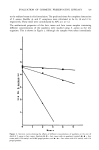
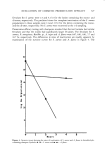
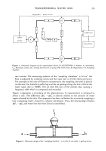
334 JOURNAL OF THE SOCIETY OF COSMETIC CHEMISTS ß diffusion properties through S.C. are modified by desorption. ethe increase of water vapor pressure gradient through the horny layers modifies the ToeWL. For some years devices have been designed which allow ToeWL to be measured under equilibrium conditions (2,3,4). We believe that the best system should have the following characteristics: 1. The measuring device should not alter the physical and chemical properties of S.C. This involves using an air flow sufficiently small to avoid any modification of the local microclimate of the skin surface (5). 2. Too large a measuring surface combines areas having different values of TEWL, resulting in the determination of an average TEWL value. With too small a surface, we may only measure a particular zone (e.g., pores) (6). Furthermore, in the case of small surfaces, an edge effect might become prevalent. 3. Measuring should be differential, i.e., should be able to record TEWL differences between two distinct zones. This is particularly necessary in case of minute variations. 4. Lastly, measurement should not take more than two or three minutes to avoid stressing the volunteer. The device we have used and describe below complies with these four requirements. EXPERIMENTAL TECHNIQUE The measuring system The principle on which the apparatus is based is the variation of dielectric permittivity (e) of water vapor air mixture, filling a resonant cavity, as a function of the amount of water vapor. e is measured in a frequency range (X band) where description and measurements of these phenomena have been made during the past few years. The permittivity variation is obtained by measurement of the resonant frequency shift of a cavity filled with the mixture under study. Our device (Figure 1) has the following characteristics: The working frequency is 8.5 GHz. The Klystron, cooled by an air blower, provides a frequency modulated wave through two parallel mounted resonant cavities. By means of a linear frequency modulation of the Klystron near the resonance frequency of the cavities, detectors D1 and D2 give the resonance curves of cavities C• and C2. The frequency modulation is 100 Hz. During one period, detection devices identify the summits of the resonance peaks. An internal clock computes the time interval between the two frequen- cies. A statistical treatment averages this time interval on 10, 100 and 1000 measure- ments. This result is digitally displayed on a counter. A numerical analog converter is used to record the signal. This signal is an ultrasensitive and accurate index of the difference in the air humidity of the two cavities. Alternatively, there is a differential system composed of a pump which blows room air, through plastic tubes and two "sampling chambers" (Figure 2), into the
Purchased for the exclusive use of nofirst nolast (unknown)
From: SCC Media Library & Resource Center (library.scconline.org)