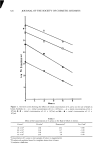
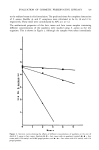
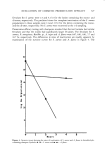
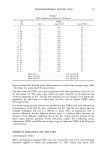
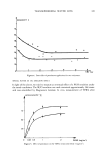
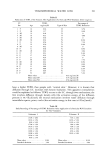
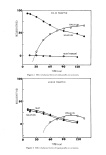
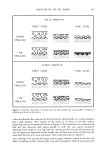
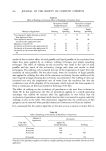
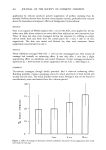
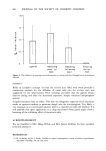
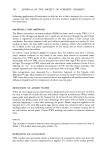
360 JOURNAL OF THE SOCIETY OF COSMETIC CHEMISTS lOO 75 50 25 24 h 7d 14d Figure 1. Degree of anhidrosis and duration after: occlusion for 24 hr ( [] ) occlusion for 3 hr ( [] ), and 15 min occlusive exposures twice daily for three days ( [] ). Table I 15-Minute Exposures with and without Iontophoresis Once Daily for Two Days Subject # Iontophoresis Patch (0.15 mA/cm 2) • Sweat Inhibition AIC!3: 5• 20• 5• 20• 25.0 37.5 0.0 25.0 12.0 25.0 0.0 12.5 0.0 50.0 0.0 12.5 --- 37.5 --- 12.5 Hean: 12.5 37.5 0.0 15.6

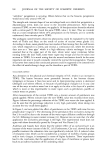
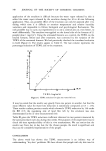
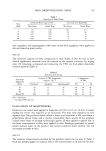
ANTIPERSPIRANT ACTION OF ALUMINUM SALTS 361 COMMENT Rubbing a 20% solution of A1C12 on the skin results in only a modest degree of anhidrosis 24 hr later. Following evaporation of water the salt crystallizes out on the surface and is no longer available. An occlusive dressing markedly enhanced the anhidrotic effect. Hydration keeps the salt in solution and promotes diffusion into the ducts. Likewise, occlusive application of soaked patches keeps the aluminum ion mobilized and provides a reservoir for the salt. Repeated open applications increase the antiperspirant effect, but only up to a maximum of about 75%. Our experience is similar to that of Tronnier & Rentschief (4): they failed to obtain complete suppression even after five daily exposures. On the other hand, occlusive exposures, either repeatedly for short terms or continuously for longer periods, will induce almost complete anhidrosis in nearly everyone. In a given person individual sweat units have different susceptibilities some become blocked much earlier than others. It is the concentration of aluminum within each duct that determines whether an obstruction will occur. The depth of the block, which affects the duration of anhidrosis, is mainly determined by both the length of the exposure and occlusivity. Short-term exposure creates a rather shallow obstruction which is comparatively short-lived. Each treatment affects only the ducts unaltered by previous exposures, that is, only the ones that are still open. Once formed, the block evidently cannot be deepened by further treatments. Procedures which expose the sweat orifices to high concentrations of solubilized aluminum for prolonged periods are invariably the most effective ones. To our great surprise, iontophoresis of various salts of aluminum for 5 min at various concentrations was a dismal failure. Five minutes is more than sufficient time to produce complete anhidrosis with anti-cholinergic drugs (5). Iontophoresis for two 15-min periods, at low current densities, on consecutive days resulted in only moderate enhancement as compared to occlusive application alone. The inhibition was far from complete though it was generally double the control values. Since iontophoresis of saline had no effect, this result is probably not due to ductal injury. A pilot study using iontophoresis of hydrochloric acid, pH 2.0, was also without effect. High current densities will damage the acrosyringium and induce an anhidrosis several days later (6). The ineffectiveness of iontophoresis is puzzling and inexplicable. STUDY 2. THE EFFECT OF SURFACTANTS ON ALUMINUM ANHIDROSIS Previous investigators felt that the antiperspirant activity of metallic salt solutions could be enhanced by surfactants, especially for the treatment of axillary hyperhidro- sis. Herrmann & Sulzberger (7) recommended aluminum chloride with the nonionic detergent Triton X-100. Hunzicker & Brun (8) and Brun (9) also thought that Triton X-100 added considerably to efficacy. In his monograph, Fiedler (10) mentioned quaternary ammonium compounds as useful additives, but no data were provided. Theoretically, surfactants might augment antiperspirants by facilitating their penetra- tion into and down the sweat ducts. Since controlled experimental studies were lacking, we investigated the effect of nonionic, anionic and cationic detergents.
Purchased for the exclusive use of nofirst nolast (unknown)
From: SCC Media Library & Resource Center (library.scconline.org)